McElfish Pearl Anna, Moore Ramey, Woodring David, Purvis Rachel S, Maskarinec Gregory G, Bing Williamina Ioanna, Hudson Jonell, Kohler Peter O, Goulden Peter A
Office of Community Health and Research, University of Arkansas for Medical Sciences Northwest, USA.
Department of Anthropology, University of Arkansas, USA.
J Fam Med Dis Prev. 2016;2(1). doi: 10.23937/2469-5793/1510026. Epub 2016 Mar 14.
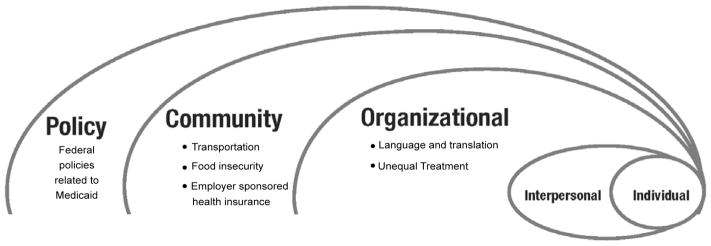
Chronic diseases disproportionately affect ethnic and racial minorities. Pacific Islanders, including the Marshallese, experience some of the highest documented rates of type 2 diabetes. Northwest Arkansas is home to the largest population of Marshallese outside of the Republic of the Marshall Islands, and many migrants are employed by the local poultry industry. This migrant population continues to increase because of climate change, limited health care and educational infrastructure in the Marshall Islands, and the ongoing health effects of US nuclear testing. The US nuclear weapons testing program had extensive social, economic, and ecological consequences for the Marshallese and many of the health disparities they face are related to the nuclear fallout. Beginning in 2013, researchers using a community-based participatory (CBPR) approach began working with the local Marshallese community to address diabetes through the development and implementation of culturally appropriate diabetes self-management education in a family setting. Preliminary research captured numerous and significant environmental barriers that constrain self-management behaviors. At the request of our CBPR stakeholders, researchers have documented the ecological barriers faced by the Marshallese living in Arkansas through a series of qualitative research projects. Using the Social Ecological Model as a framework, this research provides an analysis of Marshallese health that expands the traditional diabetes self-management perspective. Participants identified barriers at the organizational, community, and policy levels that constrain their efforts to achieve diabetes self-management. We offer practice and policy recommendations to address barriers at the community, organizational, and policy level.
慢性病对少数族裔和种族群体的影响尤为严重。包括马绍尔人在内的太平洋岛民患2型糖尿病的记录发病率在全球名列前茅。阿肯色州西北部是马绍尔群岛共和国以外马绍尔人人口最多的地区,许多移民受雇于当地的家禽业。由于气候变化、马绍尔群岛有限的医疗保健和教育基础设施,以及美国核试验持续产生的健康影响,这一移民人口持续增加。美国核武器试验计划给马绍尔人带来了广泛的社会、经济和生态后果,他们面临的许多健康差距都与核辐射有关。从2013年开始,研究人员采用基于社区参与的研究方法(CBPR),通过在家庭环境中开发和实施符合文化习惯的糖尿病自我管理教育,与当地马绍尔社区合作应对糖尿病问题。初步研究发现了许多严重制约自我管理行为的环境障碍。应我们CBPR利益相关者的要求,研究人员通过一系列定性研究项目记录了生活在阿肯色州的马绍尔人所面临的生态障碍。本研究以社会生态模型为框架,对马绍尔人的健康状况进行了分析,扩展了传统的糖尿病自我管理视角。参与者指出了组织、社区和政策层面存在的障碍,这些障碍限制了他们实现糖尿病自我管理的努力。我们针对社区、组织和政策层面的障碍提供了实践和政策建议。