Cheng Lei, Zhang Lu, Wang Ying-Ping, Canadell Josep G, Chiew Francis H S, Beringer Jason, Li Longhui, Miralles Diego G, Piao Shilong, Zhang Yongqiang
CSIRO Land and Water, Black Mountain, Canberra, ACT, 2601, Australia.
CSIRO Oceans and Atmosphere, PMB #1, Aspendale, VIC, 3195, Australia.
Nat Commun. 2017 Jul 24;8(1):110. doi: 10.1038/s41467-017-00114-5.
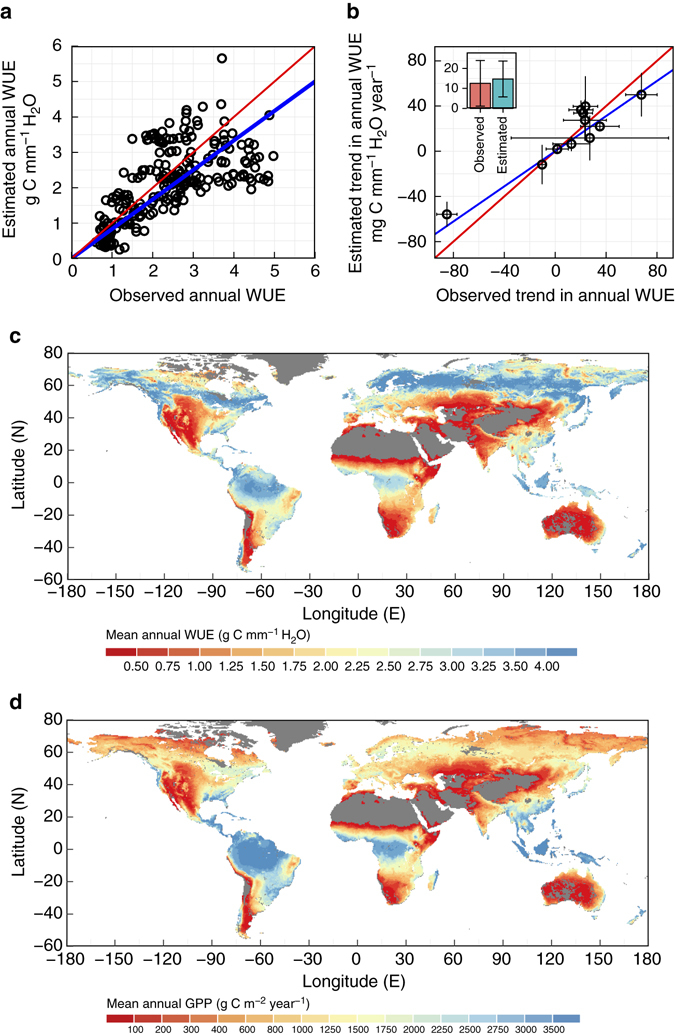
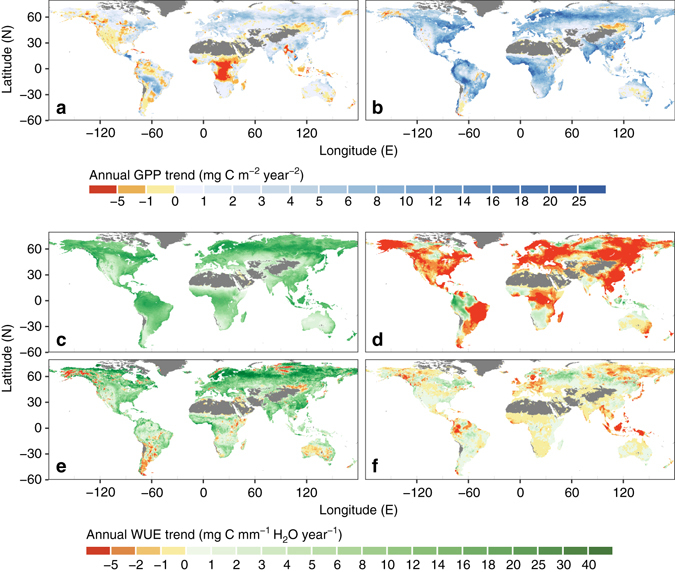
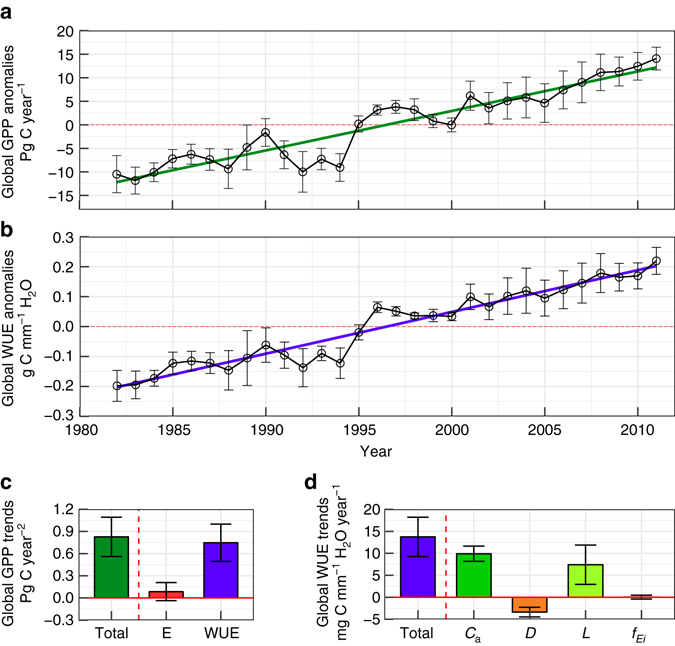
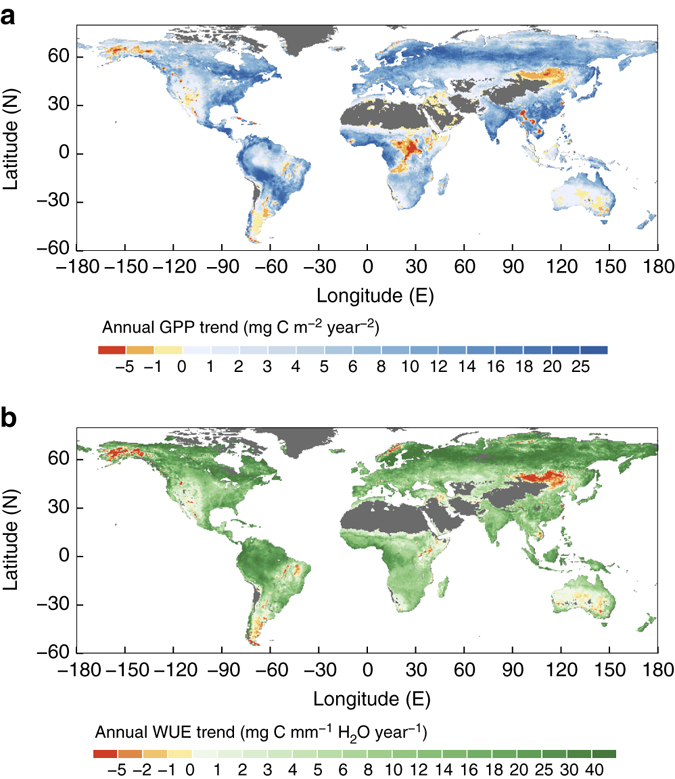
Quantifying the responses of the coupled carbon and water cycles to current global warming and rising atmospheric CO concentration is crucial for predicting and adapting to climate changes. Here we show that terrestrial carbon uptake (i.e. gross primary production) increased significantly from 1982 to 2011 using a combination of ground-based and remotely sensed land and atmospheric observations. Importantly, we find that the terrestrial carbon uptake increase is not accompanied by a proportional increase in water use (i.e. evapotranspiration) but is largely (about 90%) driven by increased carbon uptake per unit of water use, i.e. water use efficiency. The increased water use efficiency is positively related to rising CO concentration and increased canopy leaf area index, and negatively influenced by increased vapour pressure deficits. Our findings suggest that rising atmospheric CO concentration has caused a shift in terrestrial water economics of carbon uptake.The response of the coupled carbon and water cycles to anthropogenic climate change is unclear. Here, the authors show that terrestrial carbon uptake increased significantly from 1982 to 2011 and that this increase is largely driven by increased water-use efficiency, rather than an increase in water use.
量化耦合的碳循环和水循环对当前全球变暖和大气二氧化碳浓度上升的响应,对于预测和适应气候变化至关重要。在这里,我们利用地面和遥感的陆地及大气观测数据相结合的方法表明,从1982年到2011年陆地碳吸收(即总初级生产力)显著增加。重要的是,我们发现陆地碳吸收的增加并没有伴随着用水(即蒸散)的成比例增加,而是在很大程度上(约90%)由单位用水的碳吸收增加,即水分利用效率所驱动。水分利用效率的提高与二氧化碳浓度上升和冠层叶面积指数增加呈正相关,并受到水汽压差增加的负面影响。我们的研究结果表明,大气二氧化碳浓度上升导致了陆地碳吸收的水分经济发生转变。耦合的碳循环和水循环对人为气候变化的响应尚不清楚。在这里,作者表明从1982年到2011年陆地碳吸收显著增加,并且这种增加在很大程度上是由水分利用效率的提高而非用水增加所驱动。