Ponziani Francesca Romana, Zocco Maria Assunta, D'Aversa Francesca, Pompili Maurizio, Gasbarrini Antonio
Francesca Romana Ponziani, Maria Assunta Zocco, Francesca D'Aversa, Maurizio Pompili, Antonio Gasbarrini, Internal Medicine, Gastroenterology and Hepatology Division, Agostino Gemelli Hospital, 00168 Rome, Italy.
World J Gastroenterol. 2017 Jul 7;23(25):4491-4499. doi: 10.3748/wjg.v23.i25.4491.
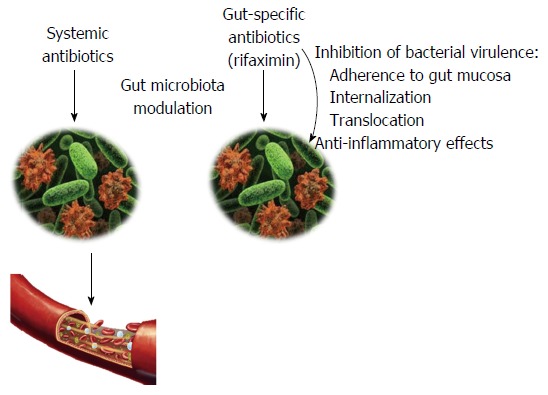
Antibiotics are usually prescribed to cure infections but they also have significant modulatory effects on the gut microbiota. Several alterations of the intestinal bacterial community have been reported during antibiotic treatment, including the reduction of beneficial bacteria as well as of microbial alpha-diversity. Although after the discontinuation of antibiotic therapies it has been observed a trend towards the restoration of the original condition, the new steady state is different from the previous one, as if antibiotics induced some kind of irreversible perturbation of the gut microbial community. The poorly absorbed antibiotic rifaximin seem to be different from the other antibiotics, because it exerts non-traditional effects additional to the bactericidal/bacteriostatic activity on the gut microbiota. Rifaximin is able to reduce bacterial virulence and translocation, has anti-inflammatory properties and has been demonstrated to positively modulate the gut microbial composition. Animal models, culture studies and metagenomic analyses have demonstrated an increase in , and abundance after rifaximin treatment, probably consequent to the induction of bacterial resistance, with no major change in the overall gut microbiota composition. Antibiotics are therefore modulators of the symbiotic relationship between the host and the gut microbiota. Specific antibiotics, such as rifaximin, can also induce eubiotic changes in the intestinal ecosystem; this additional property may represent a therapeutic advantage in specific clinical settings.
抗生素通常用于治疗感染,但它们对肠道微生物群也有显著的调节作用。在抗生素治疗期间,已报道肠道细菌群落发生了几种变化,包括有益细菌以及微生物α多样性的减少。尽管在停止抗生素治疗后,已观察到有恢复到原始状态的趋势,但新的稳定状态与之前的不同,就好像抗生素诱导了肠道微生物群落某种不可逆的扰动。吸收不良的抗生素利福昔明似乎与其他抗生素不同,因为它除了对肠道微生物群具有杀菌/抑菌活性外,还发挥非传统作用。利福昔明能够降低细菌毒力和易位,具有抗炎特性,并已被证明能积极调节肠道微生物组成。动物模型、培养研究和宏基因组分析表明,利福昔明治疗后, 、 和 的丰度增加,这可能是由于诱导了细菌耐药性,而肠道微生物群的整体组成没有重大变化。因此,抗生素是宿主与肠道微生物群共生关系的调节剂。特定的抗生素,如利福昔明,也可以在肠道生态系统中诱导有益的变化;这种额外的特性可能在特定的临床环境中代表一种治疗优势。