Lee Woojung, Noh Youran, Kang Hyeonjin, Hong Song Hee
Research Institute of Pharmaceutical Sciences, College of Pharmacy, Seoul National University, Seoul, Korea.
Patient Prefer Adherence. 2017 Jul 5;11:1119-1126. doi: 10.2147/PPA.S137263. eCollection 2017.
Understanding how patient-physician communication affects patients' medication experience would help hypertensive patients maintain their regular long-term medication therapy. This study aimed to examine whether patient-physician communication (information and interpersonal treatment) affects patients' medication experience directly or indirectly through changing medication adherence for each of the two communication domains.
A self-administered cross-sectional survey was conducted for older patients who had visited a community senior center as a member. Two communication domains were assessed using two subscales of the Primary Care Assessment Survey. Medication adherence and experience were measured using the Morisky Medication Adherence Scale and a five-point Likert scale, respectively. Mediatory effects were assessed via Baron and Kenny's procedure and a Sobel test.
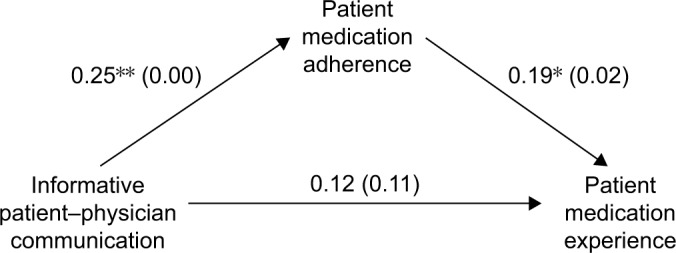
Patient-physician communication had a positive prediction on patients' medication experience (β=0.25, =0.03), and this was fully mediated by medication adherence (=3.62, <0.001). Of the two components of patient-physician communication, only informative communication showed a mediatory effect (=2.21, =0.03).
Patient-physician communication, specifically informative communication, had the potential to improve patients' medication experience via changes in medication adherence. This finding can inform health care stakeholders of the mediatory role of medication adherence in ensuring favorable medication experience for older hypertensive patients by fostering informative patient-physician communication.
了解医患沟通如何影响患者的用药体验,将有助于高血压患者维持长期规律药物治疗。本研究旨在探讨医患沟通(信息沟通和人际治疗)是否通过改变两个沟通领域中每个领域的用药依从性,直接或间接地影响患者的用药体验。
对作为社区老年中心成员就诊的老年患者进行了一项自填式横断面调查。使用初级保健评估调查的两个子量表评估两个沟通领域。用药依从性和体验分别使用Morisky用药依从性量表和五点李克特量表进行测量。通过Baron和Kenny的程序以及Sobel检验评估中介效应。
医患沟通对患者的用药体验有正向预测作用(β=0.25,=0.03),且这一作用完全由用药依从性介导(=3.62,<0.001)。在医患沟通的两个组成部分中,只有信息性沟通显示出中介效应(=2.21,=0.03)。
医患沟通,特别是信息性沟通,有可能通过改变用药依从性来改善患者的用药体验。这一发现可以让医疗保健利益相关者了解用药依从性在通过促进信息丰富的医患沟通确保老年高血压患者获得良好用药体验方面的中介作用。