Sado Junya, Kitamura Tetsuhisa, Kitamura Yuri, Sobue Tomotaka, Nishino Yoshikazu, Tanaka Hideo, Nakayama Tomio, Tsuji Ichiro, Ito Hidemi, Suzuki Takaichiro, Katanoda Kota, Tominaga Suketami
Division of Environmental Medicine and Population Sciences, Department of Social and Environmental Medicine, Graduate School of Medicine, Osaka University, Osaka, Japan.
Department of Epidemiology and Public Health, Kanazawa Medical University, Ishikawa, Japan.
Cancer Sci. 2017 Oct;108(10):2079-2087. doi: 10.1111/cas.13328. Epub 2017 Sep 26.
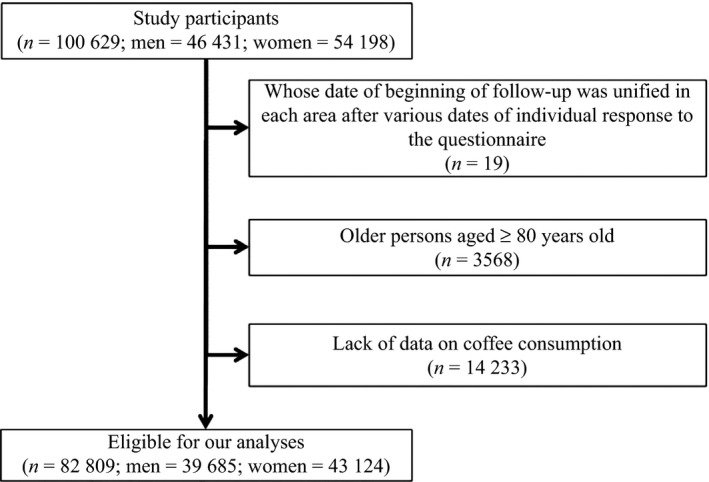
The preventive effect of coffee on cancer at different sites has been reported, but the effect on all-sites cancer incidence has not been extensively investigated. We evaluated the association between frequency of coffee consumption and risk of all-sites cancer incidence and mortality among 39 685 men and 43 124 women (age 40-79 years, at baseline), in the Three-Prefecture Cohort Study. The association between frequency of coffee consumption and risk of all-sites cancer incidence and mortality was assessed by a Cox proportional hazards regression model, adjusted for potential confounders. During 411 341 person-years among men and 472 433 person-years among women, a total of 4244 men and 2601 women developed cancer at different sites and a total of 3021 men and 1635 women died of cancer at different sites. We showed an inverse association between frequency of coffee consumption and all-sites cancer incidence in both men and women. Comparing participants who consumed coffee with those who never drank coffee, the adjusted hazard ratios (95% confidential interval) for all-sites cancer incidence was 0.74 (0.62-0.88) for coffee consumption of ≥5 cups/day in men (P for trend < 0.001) and 0.76 (0.58-1.02) in women (P for trend = 0.020). Coffee consumption frequency was inversely associated with mortality from all-sites cancer. In this population, increasing coffee consumption resulted in a decreased risk of all-sites cancer incidence and mortality.
咖啡对不同部位癌症的预防作用已有报道,但对所有部位癌症发病率的影响尚未得到广泛研究。在三县队列研究中,我们评估了39685名男性和43124名女性(基线年龄40 - 79岁)的咖啡饮用频率与所有部位癌症发病率及死亡率之间的关联。通过Cox比例风险回归模型评估咖啡饮用频率与所有部位癌症发病率及死亡率之间的关联,并对潜在混杂因素进行了调整。在男性的411341人年和女性的472433人年期间,共有4244名男性和2601名女性在不同部位患癌,并共有3021名男性和1635名女性死于不同部位的癌症。我们发现男性和女性的咖啡饮用频率与所有部位癌症发病率之间均呈负相关。将饮用咖啡的参与者与从不喝咖啡的参与者进行比较,男性每天饮用≥5杯咖啡时,所有部位癌症发病率的调整风险比(95%置信区间)为0.74(0.62 - 0.88)(趋势P<0.001),女性为0.76(0.58 - 1.02)(趋势P = 0.020)。咖啡饮用频率与所有部位癌症死亡率呈负相关。在该人群中,增加咖啡饮用可降低所有部位癌症的发病率和死亡率。