Yamasaki Tomohiro, Wakao Shohei, Kawaji Hiroshi, Koizumi Shinichiro, Sameshima Tetsuro, Dezawa Mari, Namba Hiroki
Department of Neurosurgery, Hamamatsu University School of Medicine, 1-20-1 Handayama, Higashi-ku, Hamamatsu 431-3192, Japan.
Department of Stem Cell Biology and Histology, Tohoku University Graduate School of Medicine, 1-1 Seiryocho, Aoba-ku, Sendai, 980-8574, Japan.
Mol Ther Oncolytics. 2017 Jun 15;6:45-56. doi: 10.1016/j.omto.2017.06.001. eCollection 2017 Sep 15.
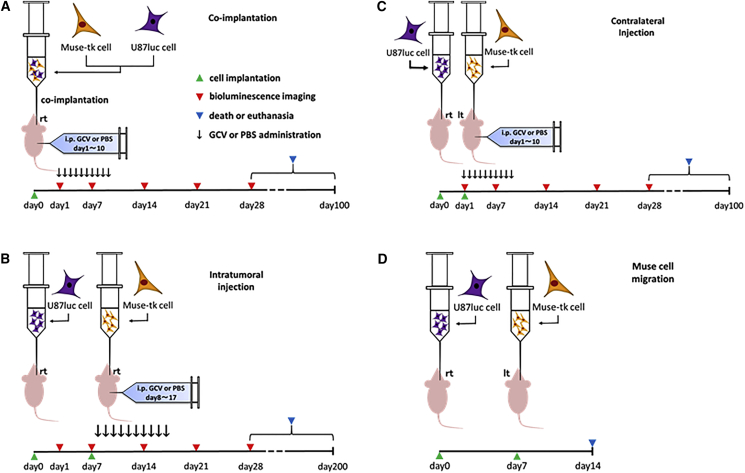
Malignant glioma, the most common malignant brain tumor in adults, is difficult to treat due to its aggressive invasive nature. Enzyme/prodrug suicide gene therapy based on the herpes simplex virus thymidine kinase (HSVtk)/ganciclovir (GCV) system is an efficient strategy for treating malignant gliomas. In the present study, we evaluated treatment with multilineage-differentiating stress-enduring (Muse) cells, which are endogenous non-tumorigenic pluripotent-like stem cells that are easily collectable from the bone marrow as SSEA-3 cells, as carriers of the HSVtk gene. Human Muse cells showed potent migratory activity toward glioma cells both in vitro and in vivo. HSVtk gene-transduced Muse cells (Muse-tk cells) at a cell number of only 1/32 that of U87 human glioma cells completely eradicated U87 gliomas in nude mouse brains, showing a robust in vivo bystander effect. Pre-existing intracranial U87 gliomas in nude mouse brains injected intratumorally with Muse-tk cells followed by intraperitoneal GCV administration were significantly reduced in size within 2 weeks, and 4 of 10 treated mice survived over 200 days. These findings suggest that intratumoral Muse-tk cell injection followed by systemic GCV administration is safe and effective and that allogeneic Muse-tk cell-medicated suicide gene therapy for malignant glioma is clinically feasible.