Zhang Hua-Gang, Chen Lu, Tang Lu, Zhang Nan, Fan Dong-Sheng
Department of Neurology, Peking University Third Hospital, Beijing 100191, China.
Chin Med J (Engl). 2017 Aug 5;130(15):1768-1772. doi: 10.4103/0366-6999.211538.
Progressive bulbar palsy (PBP) is a classic phenotype of bulbar onset amyotrophic lateral sclerosis (ALS) with more rapid progression and worse prognosis. However, as an often under-understood variant of ALS, isolated bulbar palsy (IBP) appears to progress more slowly and has a relatively benign prognosis. This study aimed to investigate the natural course and clinical features of IBP in Chinese population and to compare them with those of PBP.
The clinical data of patients with bulbar onset ALS were collected from January 2009 to December 2013. Revised ALS Functional Rating Scale (ALSFRS-R), forced vital capacity (FVC), and follow-up evaluation were performed, and the differences in basic clinical features, ALSFRS-R, FVC, and primary outcome measures between IBP and PBP were analyzed. The independent t-test, Chi-square test, Mann-Whitney U-test, and Kaplan-Meier analysis were used.
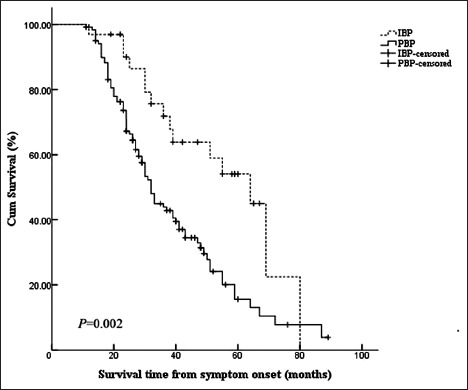
Totally 154 patients with bulbar onset ALS were categorized into two groups, 33 with IBP and 121 with PBP. In the IBP group, the male to female ratio was 0.7 to 1.0, and the mean onset age was 58.5 years. The mean duration from the onset was 16.0 months, and the mean ALSFRS-R score was 43.4 at patients' first visit to our hospital. In 14 IBP patients performing FVC examination, the mean FVC value was 90.5% and there were only two cases with abnormal FVC. In 26 IBP patients completing follow-up, 15 (58%) suffered death or tracheotomy and the mean survival time was 40.5 months. Significant differences were noted in sex ratio, onset age, ALSFRS-R score, upper motor neuron limb signs, pure lower motor neuron (LMN) bulbar signs, FVC, and survival time between IBP and PBP.
IBP was evidently different from PBP, which was characterized with the predominance of female, pure LMN bulbar signs, an older onset age, a relative preservation of respiratory function, and a better prognosis.
进行性延髓麻痹(PBP)是延髓起病的肌萎缩侧索硬化(ALS)的经典表型,进展更快,预后更差。然而,作为一种常被误解的ALS变异型,孤立性延髓麻痹(IBP)似乎进展更缓慢,预后相对较好。本研究旨在调查中国人群中IBP的自然病程和临床特征,并将其与PBP进行比较。
收集2009年1月至2013年12月延髓起病的ALS患者的临床资料。进行修订的ALS功能评定量表(ALSFRS-R)、用力肺活量(FVC)及随访评估,分析IBP和PBP在基本临床特征、ALSFRS-R、FVC及主要结局指标方面的差异。采用独立样本t检验、卡方检验、曼-惠特尼U检验及Kaplan-Meier分析。
154例延髓起病的ALS患者被分为两组,33例为IBP,121例为PBP。IBP组中,男女比例为0.7比1.0,平均起病年龄为58.5岁。从起病到就诊的平均病程为16.0个月,患者首次来我院就诊时的平均ALSFRS-R评分为43.4分。在14例进行FVC检查的IBP患者中,平均FVC值为90.5%,仅2例FVC异常。在26例完成随访的IBP患者中,15例(58%)死亡或行气管切开术,平均生存时间为40.5个月。IBP和PBP在性别比例、起病年龄、ALSFRS-R评分、上运动神经元肢体体征、单纯下运动神经元(LMN)延髓体征、FVC及生存时间方面存在显著差异。
IBP与PBP明显不同,其特点为女性占优势、单纯LMN延髓体征、起病年龄较大、呼吸功能相对保留及预后较好。