
印度旁遮普邦家禽中产超广谱β-内酰胺酶的多重耐药菌的流行情况及根据养殖方式的变化
The Prevalence of Extended-Spectrum Beta-Lactamase-Producing Multidrug-Resistant in Poultry Chickens and Variation According to Farming Practices in Punjab, India.
作者信息
Brower Charles H, Mandal Siddhartha, Hayer Shivdeep, Sran Mandeep, Zehra Asima, Patel Sunny J, Kaur Ravneet, Chatterjee Leena, Mishra Savita, Das B R, Singh Parminder, Singh Randhir, Gill J P S, Laxminarayan Ramanan
机构信息
Center for Disease Dynamics, Economics & Policy , Washington, DC, USA.
Public Health Foundation of India , New Delhi, Delhi, India.
出版信息
Environ Health Perspect. 2017 Jul 20;125(7):077015. doi: 10.1289/EHP292.
BACKGROUND
Agricultural use of antimicrobials in subtherapeutic concentrations is increasing in response to the rising demand for food animal products worldwide. In India, the use of antimicrobials in food animal production is unregulated. Research suggests that many clinically important antimicrobials are used indiscriminately. This is the largest study to date in India that surveys poultry production to test for antimicrobial resistance and the occurrence of extended-spectrum β-lactamases (ESBLs) modulated by farming and managerial practices.
OBJECTIVES
Our goal was to survey poultry production for resistance to eleven clinically relevant antimicrobials and phenotypic occurrence of ESBLs as modulated by farming and managerial practices.
METHODS
Eighteen poultry farms from Punjab were surveyed, and 1,556 isolates from 530 birds were tested for susceptibility to 11 antimicrobials using the disk diffusion method and validated using VITEK 2 (bioMérieux, Marcy-L’Étoile, France). Samples from 510 of these birds were phenotypically tested for ESBL production using the combination disk method and confirmed using VITEK 2. Generalized linear mixed models were used to infer differences in resistance profiles associated with different farming practices and facility types.
RESULTS
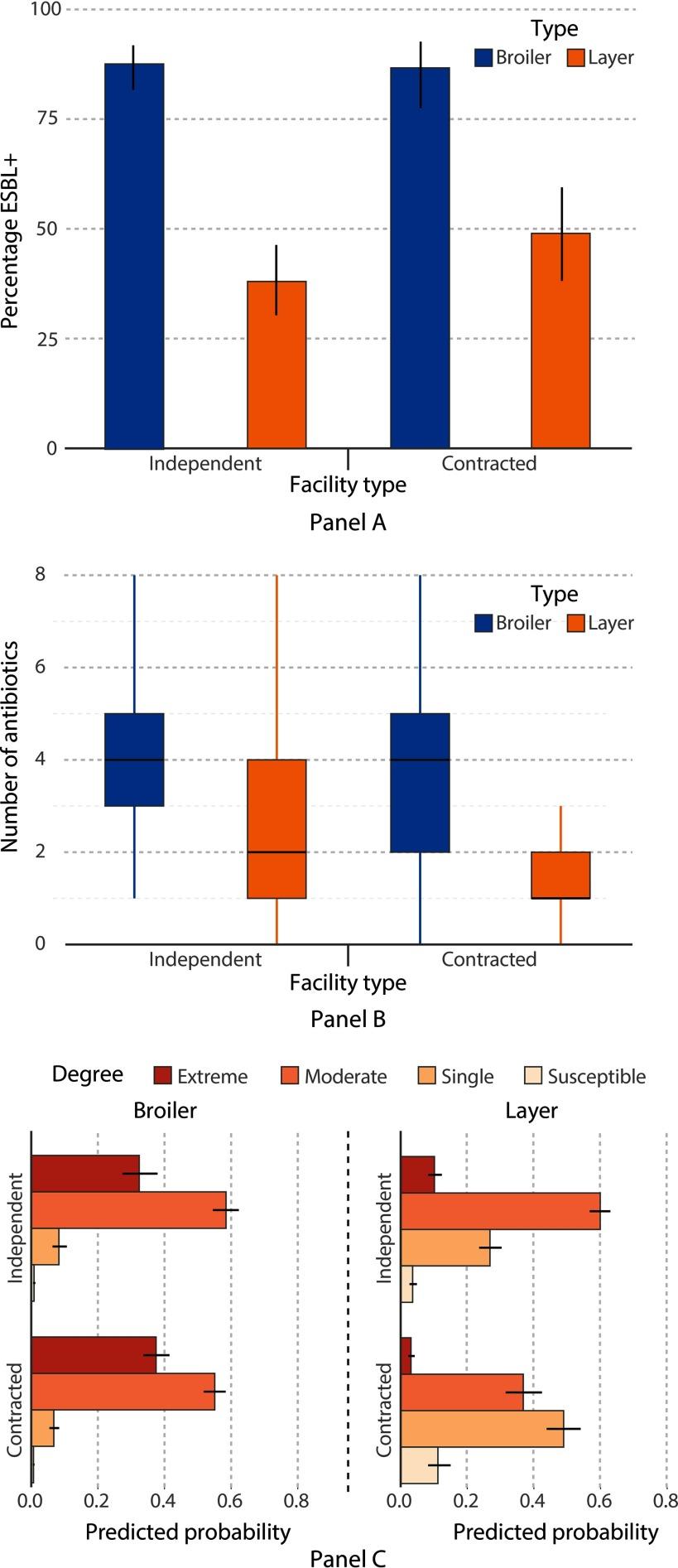
Resistance profiles were significantly different between broiler and layer farms. Broiler farms were 2.2 [ampicillin (AMP), =0.017] to 23 [nalidixic acid (NX), <0.001] times more likely to harbor resistant strains than layer farms. Adjusting for farm type (broiler vs. layer), the odds of resistance (although not statistically significant) to all antimicrobials except nitrofurantoin (NIT) were higher in independent facilities (IUs) as compared to contracted facilities (CFs). Increased prevalence of multidrug resistance (MDR; 94% compared to 60% in layers), including prevalence of ESBL-producing strains (87% compared to 42% in layers), was observed in broiler farms.
CONCLUSIONS
Our findings suggest that unregulated use of clinically relevant antimicrobials in Indian broiler and layer farms may contribute to the emergence of resistance and support the need to curb the nontherapeutic use of medically important antimicrobials in food animal production. https://doi.org/10.1289/EHP292.
背景
随着全球对食用动物产品需求的不断增加,亚治疗浓度抗菌药物在农业中的使用也日益增多。在印度,食用动物生产中抗菌药物的使用并无监管。研究表明,许多临床上重要的抗菌药物被滥用。这是印度迄今为止规模最大的一项研究,对家禽生产进行调查,以检测抗菌药物耐药性以及由养殖和管理方式所调控的超广谱β-内酰胺酶(ESBLs)的出现情况。
目的
我们的目标是调查家禽生产中对11种临床相关抗菌药物的耐药性以及由养殖和管理方式所调控的ESBLs的表型出现情况。
方法
对旁遮普邦的18家家禽养殖场进行了调查,使用纸片扩散法对来自530只家禽的1556株分离菌进行了11种抗菌药物的敏感性测试,并使用VITEK 2(法国马赛 - 埃托瓦勒生物梅里埃公司)进行验证。使用组合纸片法对其中510只家禽的样本进行ESBLs产生的表型测试,并使用VITEK 2进行确认。采用广义线性混合模型来推断与不同养殖方式和养殖设施类型相关的耐药谱差异。
结果
肉鸡养殖场和蛋鸡养殖场的耐药谱存在显著差异。肉鸡养殖场携带耐药菌株的可能性比蛋鸡养殖场高2.2倍(氨苄西林,P = 0.017)至23倍(萘啶酸,P < 0.001)。在调整养殖类型(肉鸡与蛋鸡)后,与合同制养殖场(CFs)相比,独立养殖场(IUs)对除呋喃妥因(NIT)外的所有抗菌药物的耐药几率更高(尽管无统计学意义)。在肉鸡养殖场中观察到多重耐药(MDR)的患病率增加(94%,而蛋鸡为60%),包括产ESBLs菌株的患病率(87%,而蛋鸡为42%)。
结论
我们的研究结果表明,印度肉鸡和蛋鸡养殖场中临床相关抗菌药物的无监管使用可能导致耐药性的出现,并支持有必要遏制食用动物生产中重要医用抗菌药物的非治疗性使用。https://doi.org/10.1289/EHP292


 Zotero 插件