Lee Wei-Chieh, Fang Hsiu-Yu, Chen Huang-Chung, Chen Chien-Jen, Yang Cheng-Hsu, Hang Chi-Ling, Wu Chiung-Jen, Fang Chih-Yuan
Division of Cardiology, Department of Internal Medicine, Kaohsiung Chang Gung Memorial Hospital, Chang Gung University College of Medicine, Kaohsiung, Taiwan, Republic of China.
PLoS One. 2017 Jul 27;12(7):e0180165. doi: 10.1371/journal.pone.0180165. eCollection 2017.
The effect of anemia on patients with ST-segment elevation myocardial infarction (STEMI) remains a controversial issue. The aim of this study was to explore the effect of anemia on STEMI patients.
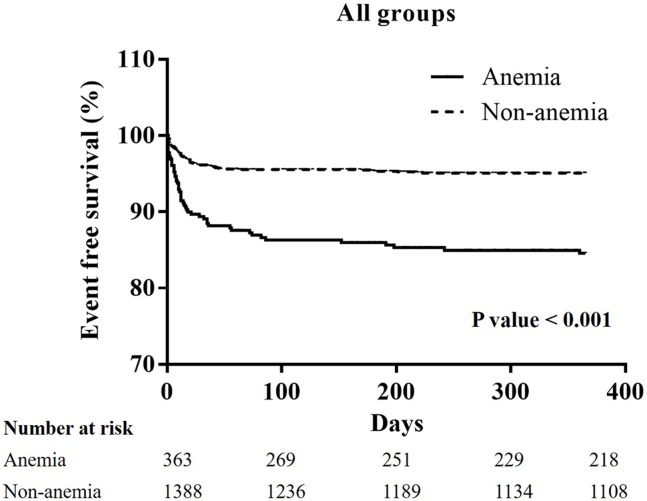
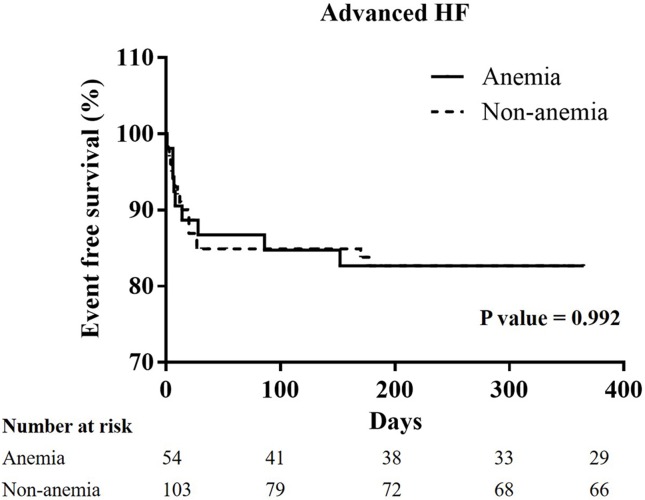
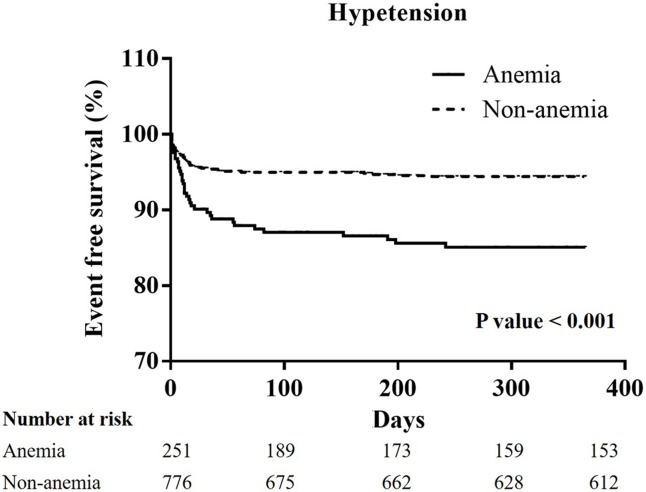
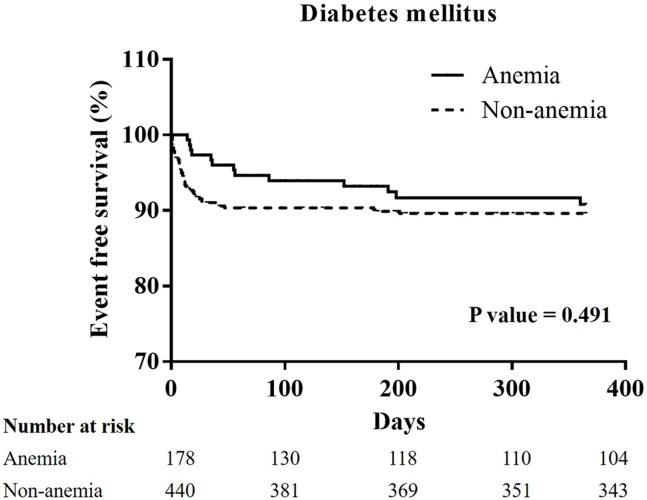
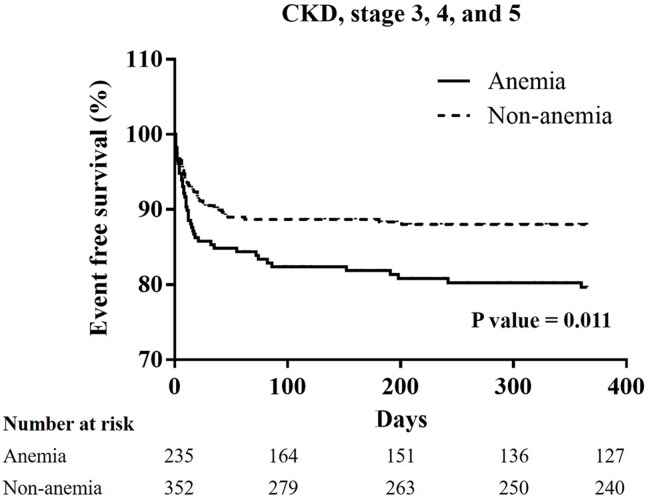
From January 2005 to December 2014, 1751 patients experienced STEMI checked serum hemoglobin initially before any administration of fluids or IV medications. 1751 patients then received primary percutaneous intervention immediately. A total of 1388 patients were enrolled in the non-anemia group because their serum hemoglobin level was more than 13 g/L in males, and 12 g/L in females. A total of 363 patients were enrolled in the anemia group because their serum hemoglobin level was less than 13 g/L in males, and 12 g/L in females. Higher incidences of major adverse cerebral cardiac events (22.9% vs. 33.8%; p<0.001) were also noted in the anemia group, and these were related to higher incidence of cardiovascular mortality (6.5% vs. 20.4%; p<0.001). A higher incidence of all-cause mortality (8.6% vs. 27.7%; p<0.001) was also noted in the anemia group. A Kaplan-Meier curve of one-year cardiovascular mortality showed significant differences between the non-anemia and anemia group in all patients (P<0.001), and the patients with hypertension (P<0.001), and chronic kidney disease (CKD) (P = 0.011).
Anemia is a marker of an increased risk in one-year cardiovascular mortality in patients with STEMI. If the patients have comorbidities such as hypertension, or CKD, the effect of anemia is very significant.
贫血对ST段抬高型心肌梗死(STEMI)患者的影响仍是一个有争议的问题。本研究旨在探讨贫血对STEMI患者的影响。
2005年1月至2014年12月,1751例经历STEMI的患者在接受任何液体或静脉药物治疗之前首先检查了血清血红蛋白。这1751例患者随后立即接受了直接经皮冠状动脉介入治疗。共有1388例患者被纳入非贫血组,因为其男性血清血红蛋白水平大于13g/L,女性大于12g/L。共有363例患者被纳入贫血组,因为其男性血清血红蛋白水平小于13g/L,女性小于12g/L。贫血组中主要不良心脑血管事件的发生率也更高(22.9%对33.8%;p<0.001),且这些事件与心血管死亡率较高有关(6.5%对20.4%;p<0.001)。贫血组全因死亡率也更高(8.6%对27.7%;p<0.001)。一年心血管死亡率的Kaplan-Meier曲线显示,在所有患者(P<0.001)、高血压患者(P<0.001)和慢性肾脏病(CKD)患者(P = 0.011)中,非贫血组和贫血组之间存在显著差异。
贫血是STEMI患者一年心血管死亡风险增加的一个标志。如果患者有高血压或CKD等合并症,贫血的影响非常显著。