VanderDrift Laura E, Vanable Peter A, Bonafide Katherine E, Brown Jennifer L, Bostwick Rebecca A, Carey Michael P
Department of Psychology, Syracuse University, Syracuse, NY, United States of America.
Department of Psychiatry and Behavioral Neuroscience, University of Cincinnati, Cincinnati, OH, United States of America.
PLoS One. 2017 Jul 27;12(7):e0181662. doi: 10.1371/journal.pone.0181662. eCollection 2017.
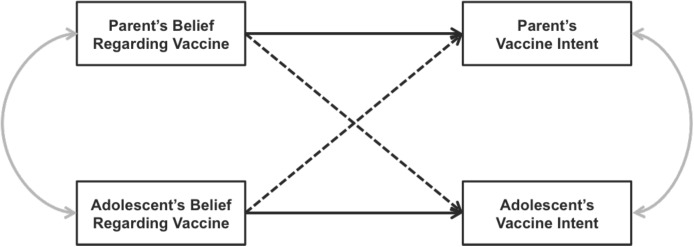
A wealth of scientific literature has been devoted to understanding what factors influence parents and their adolescent children to obtain the HPV vaccine. This literature is relatively uniform in its methodological approach of sampling individuals (i.e., either parents or adolescents) and examining the predictors of uptake for that individual. To improve understanding of HPV vaccination uptake, we sampled low-income, African American parent-child dyads with either a female (n = 93) or a male (n = 116) adolescent who had not been vaccinated. Both parents and children completed self-report measures that tapped intent to receive the vaccine and hypothesized predictors of intent (i.e., self-efficacy, beliefs about the vaccine, beliefs about HPV, knowledge of HPV). Using a dyadic analytic approach (i.e., the Actor-Partner Interdependence Model or APIM) [1], we found that parents and their adolescents have different structures of beliefs regarding HPV vaccination (i.e., they are empirically distinguishable). Consistent with prior research, the majority of predictors of an individual's own intention to vaccinate were individual-level variables; uniquely though, some predictors endorsed by one member of the dyad influenced the intentions held by the other member. Specifically, parents' reports of HPV severity and their self-efficacy were both associated with adolescents' intent to obtain the vaccine. Further, adolescents' beliefs that the vaccine will lead to greater promiscuity or be stigmatizing were associated with parents holding an increased intent to vaccinate. Use APIM improves understanding of HPV vaccination uptake and can be used to guide intervention efforts.
大量科学文献致力于探究哪些因素影响父母及其青春期子女接种人乳头瘤病毒(HPV)疫苗。这些文献在抽样个体(即父母或青少年)并研究该个体接种疫苗的预测因素的方法上相对一致。为了更好地理解HPV疫苗接种情况,我们对低收入的非裔美国家庭亲子对进行了抽样,这些家庭中的青少年(女孩93名,男孩116名)均未接种疫苗。父母和孩子都完成了自我报告测量,这些测量涉及接种疫苗的意愿以及假设的意愿预测因素(即自我效能感、对疫苗的信念、对HPV的信念、HPV知识)。使用二元分析方法(即行为者-伙伴相互依赖模型或APIM)[1],我们发现父母及其青少年对HPV疫苗接种的信念结构不同(即从经验上看是可区分的)。与先前的研究一致,个体自身接种疫苗意愿的大多数预测因素是个体层面的变量;不过独特的是,二元组中一方认可的一些预测因素会影响另一方的意愿。具体而言,父母对HPV严重性的报告及其自我效能感均与青少年接种疫苗的意愿相关。此外,青少年认为疫苗会导致更多滥交行为或带有污名化的信念与父母更高的接种意愿相关。使用APIM可以增进对HPV疫苗接种情况的理解,并可用于指导干预工作。