Böhm Anja, Wagner Robert, Machicao Fausto, Holst Jens Juul, Gallwitz Baptist, Stefan Norbert, Fritsche Andreas, Häring Hans-Ulrich, Staiger Harald
Department of Internal Medicine, Division of Endocrinology, Diabetology, Angiology, Nephrology and Clinical Chemistry, Eberhard Karls University Tübingen, Tübingen, Germany.
German Center for Diabetes Research (DZD), Tübingen, Germany.
PLoS One. 2017 Jul 27;12(7):e0181880. doi: 10.1371/journal.pone.0181880. eCollection 2017.
Dipeptidyl-peptidase 4 (DPP-4) cleaves and inactivates the insulinotropic hormones glucagon-like peptide 1 (GLP-1) and gastric inhibitory polypeptide, collectively termed incretins. DPP-4 inhibitors entered clinical practice as approved therapeutics for type-2 diabetes in 2006. However, inter-individual variance in the responsiveness to DPP-4 inhibitors was reported. Thus, we asked whether genetic variation in the DPP4 gene affects incretin levels, insulin secretion, and glucose tolerance in participants of the TÜbingen Family study for type-2 diabetes (TÜF).
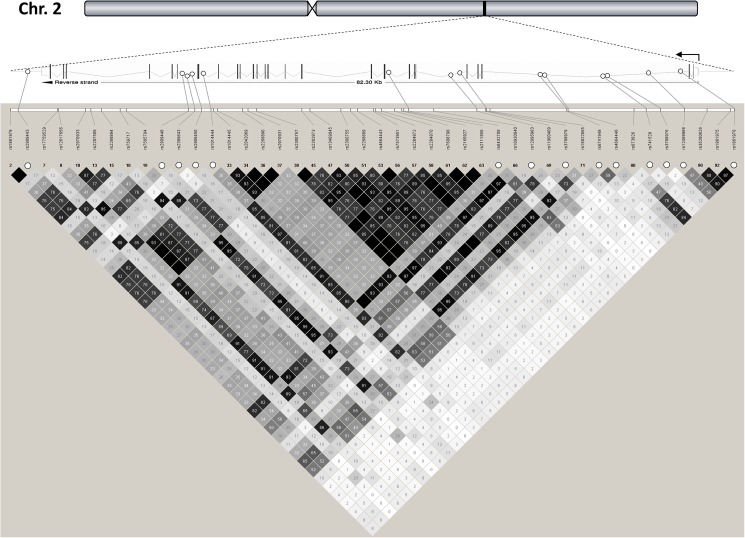
Fourteen common (minor allele frequencies ≥0.05) DPP4 tagging single nucleotide polymorphisms (SNPs) were genotyped in 1,976 non-diabetic TÜF participants characterized by oral glucose tolerance tests and bioimpedance measurements. In a subgroup of 168 subjects, plasma incretin levels were determined.
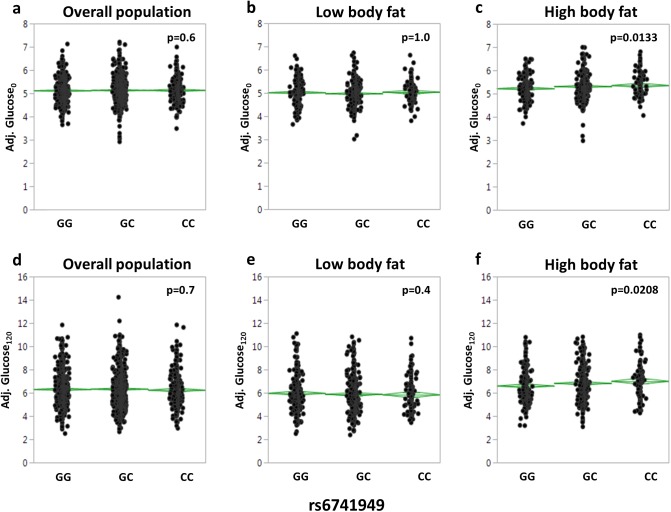
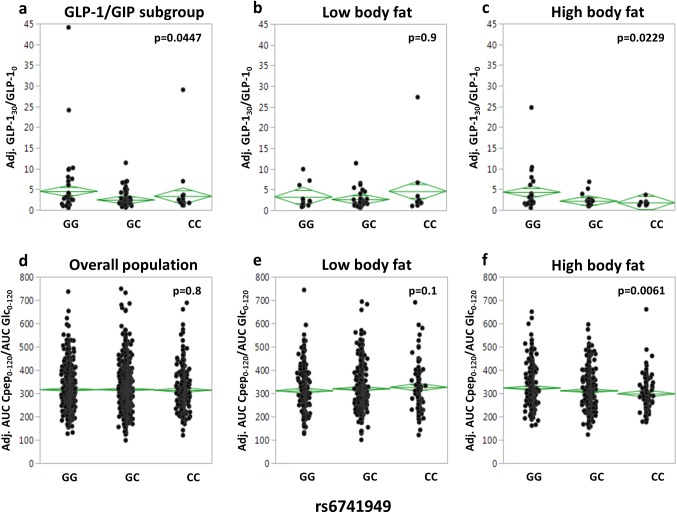
We identified a variant, i.e., SNP rs6741949, in intron 2 of the DPP4 gene that, after correction for multiple comparisons and appropriate adjustment, revealed a significant genotype-body fat interaction effect on glucose-stimulated plasma GLP-1 levels (p = 0.0021). Notably, no genotype-BMI interaction effects were detected (p = 0.8). After stratification for body fat content, the SNP negatively affected glucose-stimulated GLP-1 levels (p = 0.0229), insulin secretion (p = 0.0061), and glucose tolerance (p = 0.0208) in subjects with high body fat content only.
A common variant, i.e., SNP rs6741949, in the DPP4 gene interacts with body adiposity and negatively affects glucose-stimulated GLP-1 levels, insulin secretion, and glucose tolerance. Whether this SNP underlies the reported inter-individual variance in responsiveness to DPP-4 inhibitors, at least in subjects with high body fat content, remains to be shown.
二肽基肽酶4(DPP-4)可切割并使促胰岛素激素胰高血糖素样肽1(GLP-1)和胃抑制多肽失活,这两种激素统称为肠促胰岛素。DPP-4抑制剂于2006年作为2型糖尿病的获批治疗药物进入临床实践。然而,有报道称个体对DPP-4抑制剂的反应存在差异。因此,我们询问DPP4基因的遗传变异是否会影响图宾根2型糖尿病家族研究(TÜF)参与者的肠促胰岛素水平、胰岛素分泌和葡萄糖耐量。
对1976名非糖尿病TÜF参与者进行了14个常见(次要等位基因频率≥0.05)的DPP4标签单核苷酸多态性(SNP)基因分型,这些参与者通过口服葡萄糖耐量试验和生物电阻抗测量进行了特征描述。在168名受试者的亚组中,测定了血浆肠促胰岛素水平。
我们在DPP4基因的内含子2中鉴定出一个变异体,即SNP rs6741949,在对多重比较进行校正并进行适当调整后,该变异体显示出对葡萄糖刺激的血浆GLP-1水平有显著的基因型-体脂交互作用(p = 0.0021)。值得注意的是,未检测到基因型-体重指数交互作用(p = 0.8)。在按体脂含量分层后,该SNP仅对体脂含量高的受试者的葡萄糖刺激的GLP-1水平(p = 0.0229)、胰岛素分泌(p = 0.0061)和葡萄糖耐量(p = 0.0208)有负面影响。
DPP4基因中的一个常见变异体,即SNP rs6741949,与身体肥胖相互作用,并对葡萄糖刺激的GLP-1水平、胰岛素分泌和葡萄糖耐量产生负面影响。该SNP是否是所报道的个体对DPP-4抑制剂反应差异的基础,至少在体脂含量高的受试者中,仍有待证实。