Centro de Estudos de Doenças Crónicas (CEDOC), NOVA Medical School, Faculdade de Ciências Médicas, Universidade Nova de Lisboa, Lisbon, Portugal.
Instituto Gulbenkian de Ciência, Oeiras, Portugal.
Diabetologia. 2022 May;65(5):861-871. doi: 10.1007/s00125-021-05638-6. Epub 2022 Feb 22.
AIMS/HYPOTHESIS: Imbalances in glucose metabolism are hallmarks of clinically silent prediabetes (defined as impaired fasting glucose and/or impaired glucose tolerance) representing dysmetabolism trajectories leading to type 2 diabetes. CD26/dipeptidyl peptidase 4 (DPP4) is a clinically proven molecular target of diabetes-controlling drugs but the DPP4 gene control of dysglycaemia is not proven.
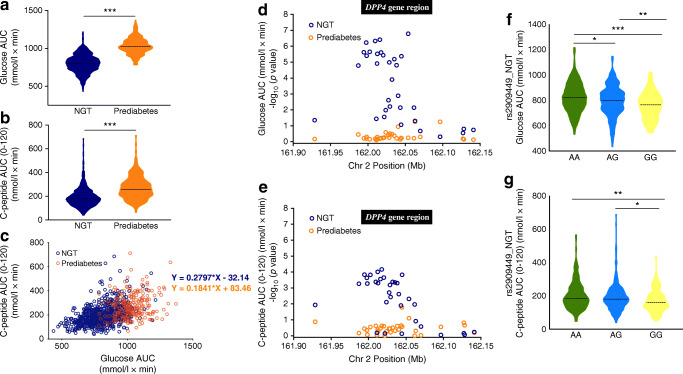
We dissected the genetic control of post-OGTT and insulin release responses by the DPP4 gene in a Portuguese population-based cohort of mainly European ancestry that comprised individuals with normoglycaemia and prediabetes, and in mouse experimental models of Dpp4 deficiency and hyperenergetic diet.
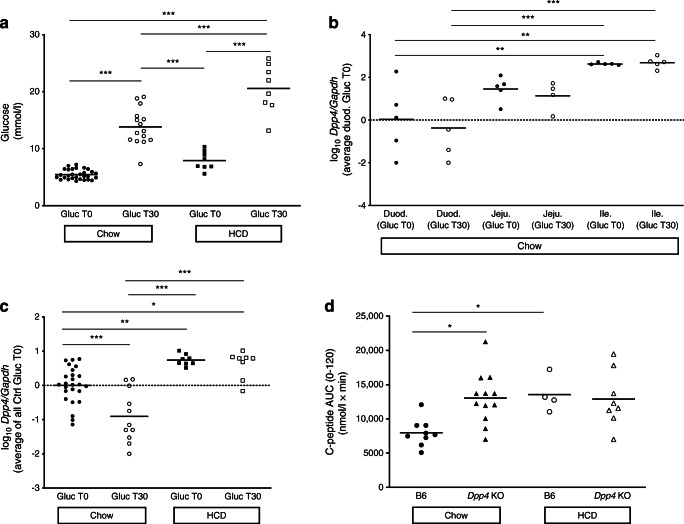
In individuals with normoglycaemia, DPP4 single-nucleotide variants governed glycaemic excursions (rs4664446, p=1.63x10) and C-peptide release responses (rs2300757, p=6.86x10) upon OGTT. Association with blood glucose levels was stronger at 30 min OGTT, but a higher association with the genetic control of insulin secretion was detected in later phases of the post-OGTT response, suggesting that the DPP4 gene directly senses glucose challenges. Accordingly, in mice fed a normal chow diet but not a high-fat diet, we found that, under OGTT, expression of Dpp4 is strongly downregulated at 30 min in the mouse liver. Strikingly, no genetic association was found in prediabetic individuals, indicating that post-OGTT control by DPP4 is abrogated in prediabetes. Furthermore, Dpp4 KO mice provided concordant evidence that Dpp4 modulates post-OGTT C-peptide release in normoglycaemic but not dysmetabolic states.
CONCLUSIONS/INTERPRETATION: These results showed the DPP4 gene as a strong determinant of post-OGTT levels via glucose-sensing mechanisms that are abrogated in prediabetes. We propose that impairments in DPP4 control of post-OGTT insulin responses are part of molecular mechanisms underlying early metabolic disturbances associated with type 2 diabetes.
目的/假设:葡萄糖代谢失衡是临床无症状性糖尿病前期(定义为空腹血糖受损和/或葡萄糖耐量受损)的特征,代表导致 2 型糖尿病的代谢异常轨迹。CD26/二肽基肽酶 4(DPP4)是一种经过临床验证的糖尿病控制药物的分子靶点,但 DPP4 基因对血糖失调的控制尚未得到证实。
我们在一个主要为欧洲血统的葡萄牙人群基础队列中,对 DPP4 基因在口服葡萄糖耐量试验(OGTT)后和胰岛素释放反应中的遗传控制进行了剖析,该队列包括血糖正常和糖尿病前期个体,以及 Dpp4 缺乏和高能量饮食的小鼠实验模型。
在血糖正常个体中,DPP4 单核苷酸变异控制 OGTT 时的血糖波动(rs4664446,p=1.63x10)和 C 肽释放反应(rs2300757,p=6.86x10)。在 30 分钟 OGTT 时与血糖水平的关联更强,但在 OGTT 后反应的后期阶段,与胰岛素分泌遗传控制的关联更高,这表明 DPP4 基因直接感知葡萄糖挑战。因此,在给予正常饮食而非高脂肪饮食的小鼠中,我们发现,在 OGTT 下,30 分钟时小鼠肝脏中 Dpp4 的表达强烈下调。引人注目的是,在糖尿病前期个体中未发现遗传关联,这表明 DPP4 在糖尿病前期时对 OGTT 的控制被阻断。此外,Dpp4 KO 小鼠提供了一致的证据,表明 Dpp4 调节血糖正常但代谢异常状态下的 OGTT 后 C 肽释放。
结论/解释:这些结果表明,DPP4 基因是通过葡萄糖感应机制强烈决定 OGTT 后水平的一个重要因素,而这种机制在糖尿病前期时被阻断。我们提出,DPP4 对 OGTT 后胰岛素反应的控制受损是 2 型糖尿病相关早期代谢紊乱的分子机制的一部分。