Unit of Cardiac Physiology, Manchester Academic Health Sciences Centre, Central Manchester Foundation Trust, 3.14 Core Technology Facility, University of Manchester, Manchester, UK.
J Physiol. 2017 Oct 1;595(19):6263-6279. doi: 10.1113/JP274053. Epub 2017 Sep 11.
Ageing is associated with an increased risk of cardiovascular disease and arrhythmias, with the most common arrhythmia being found in the atria of the heart. Little is known about how the normal atria of the heart remodel with age and thus why dysfunction might occur. We report alterations to the atrial systolic Ca transient that have implications for the function of the atrial in the elderly. We describe a novel mechanism by which increased Ca buffering can account for changes to systolic Ca in the old atria. The present study helps us to understand how the processes regulating atrial contraction are remodelled during ageing and provides a basis for future work aiming to understand why dysfunction develops.
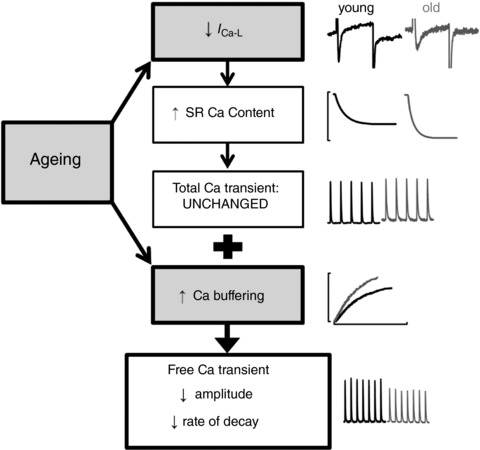
Many cardiovascular diseases, including those affecting the atria, are associated with advancing age. Arrhythmias, including those in the atria, can arise as a result of electrical remodelling or alterations in Ca homeostasis. In the atria, age-associated changes in the action potential have been documented. However, little is known about remodelling of intracellular Ca homeostasis in the healthy aged atria. Using single atrial myocytes from young and old Welsh Mountain sheep, we show the free Ca transient amplitude and rate of decay of systolic Ca decrease with age, whereas sarcoplasmic reticulum (SR) Ca content increases. An increase in intracellular Ca buffering explains both the decrease in Ca transient amplitude and decay kinetics in the absence of any change in sarcoendoplasmic reticulum calcium transport ATPase function. Ageing maintained the integrated Ca influx via I but decreased peak I . Decreased peak I was found to be responsible for the age-associated increase in SR Ca content but not the decrease in Ca transient amplitude. Instead, decreased peak I offsets increased SR load such that Ca release from the SR was maintained during ageing. The results of the present study highlight a novel mechanism by which increased Ca buffering decreases systolic Ca in old atria. Furthermore, for the first time, we have shown that SR Ca content is increased in old atrial myocytes.
随着年龄的增长,心血管疾病和心律失常的风险增加,最常见的心律失常发生在心脏的心房。对于心脏正常心房如何随年龄增长而重塑,以及为什么会出现功能障碍,人们知之甚少。我们报告了心房收缩 Ca 瞬变的改变,这对老年人心房的功能有影响。我们描述了一种新的机制,即增加 Ca 缓冲可以解释老年心房收缩 Ca 的变化。本研究有助于我们了解在衰老过程中调节心房收缩的过程是如何重塑的,并为未来旨在了解为什么会出现功能障碍的工作提供了基础。
许多心血管疾病,包括影响心房的疾病,都与年龄增长有关。心律失常,包括心房心律失常,可能是由于电重构或 Ca 稳态的改变而产生的。在心房中,已经记录了与年龄相关的动作电位变化。然而,对于健康老年心房细胞内 Ca 稳态的重塑知之甚少。使用来自年轻和老年威尔士山地绵羊的单个心房肌细胞,我们发现收缩期 Ca 的自由 Ca 瞬变幅度和衰减率随着年龄的增长而降低,而肌浆网(SR)Ca 含量增加。细胞内 Ca 缓冲的增加解释了 Ca 瞬变幅度的降低和衰减动力学的变化,而没有任何改变肌浆网内质网钙转运 ATP 酶功能。衰老维持了通过 I 的整合 Ca 内流,但降低了峰值 I。发现峰值 I 的降低是导致 SR Ca 含量随年龄增加的原因,但不是 Ca 瞬变幅度降低的原因。相反,峰值 I 的降低抵消了 SR 负荷的增加,使得 Ca 从 SR 释放在衰老过程中得以维持。本研究的结果强调了一种新的机制,即增加的 Ca 缓冲降低了老年心房的收缩期 Ca。此外,我们首次表明,老年心房肌细胞的 SR Ca 含量增加。