Knoll Lisa J, Leung Jovita T, Foulkes Lucy, Blakemore Sarah-Jayne
Institute of Cognitive Neuroscience, University College London, Alexandra House, 17 Queen Square, WC1N 3AR, London, United Kingdom.
J Adolesc. 2017 Oct;60:53-63. doi: 10.1016/j.adolescence.2017.07.002. Epub 2017 Jul 26.
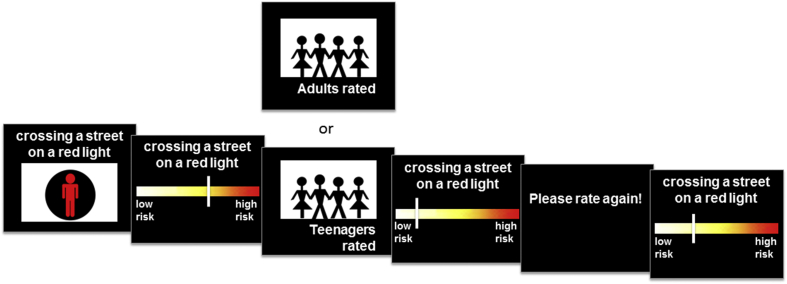
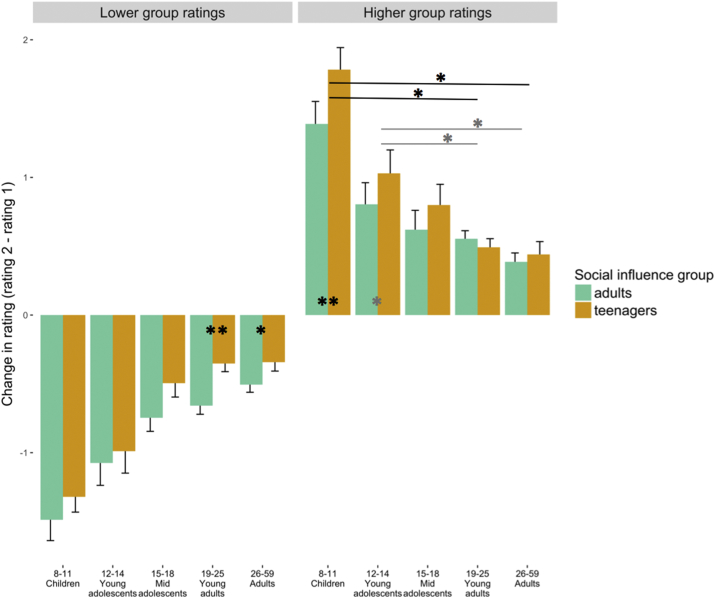
Adolescents are particularly susceptible to social influence. Here, we investigated the effect of social influence on risk perception in 590 participants aged eight to fifty-nine-years tested in the United Kingdom. Participants rated the riskiness of everyday situations, were then informed about the rating of these situations from a (fictitious) social-influence group consisting of teenagers or adults, and then re-evaluated the situation. Our first aim was to attempt to replicate our previous finding that young adolescents are influenced more by teenagers than by adults. Second, we investigated the social-influence effect when the social-influence group's rating was more, or less, risky than the participants' own risk rating. Younger participants were more strongly influenced by teenagers than by adults, but only when teenagers rated a situation as more risky than did participants. This suggests that stereotypical characteristics of the social-influence group - risk-prone teenagers - interact with social influence on risk perception.
青少年特别容易受到社会影响。在此,我们对在英国接受测试的590名年龄在8岁至59岁之间的参与者,研究了社会影响对风险认知的作用。参与者对日常情境的风险程度进行评分,随后被告知由青少年或成年人组成的(虚构的)社会影响群体对这些情境的评分,然后再次对这些情境进行评估。我们的首要目标是尝试重现我们之前的发现,即青少年比成年人更容易受到青少年的影响。其次,我们研究了当社会影响群体的评分比参与者自己的风险评分更高或更低时的社会影响效应。较年轻的参与者受青少年的影响比受成年人的影响更大,但只有当青少年对某一情境的风险评分高于参与者时才会如此。这表明社会影响群体(倾向于冒险的青少年)的刻板印象特征与社会影响在风险认知上相互作用。