Forsyth Jennifer K, Lewis David A
Department of Psychology, University of California at Los Angeles, Los Angeles, CA, USA; Department of Psychiatry and Biobehavioral Sciences, University of California at Los Angeles, Los Angeles, CA, USA.
Department of Psychiatry, University of Pittsburgh, Pittsburgh, PA, USA.
Trends Cogn Sci. 2017 Oct;21(10):760-778. doi: 10.1016/j.tics.2017.06.006. Epub 2017 Jul 25.
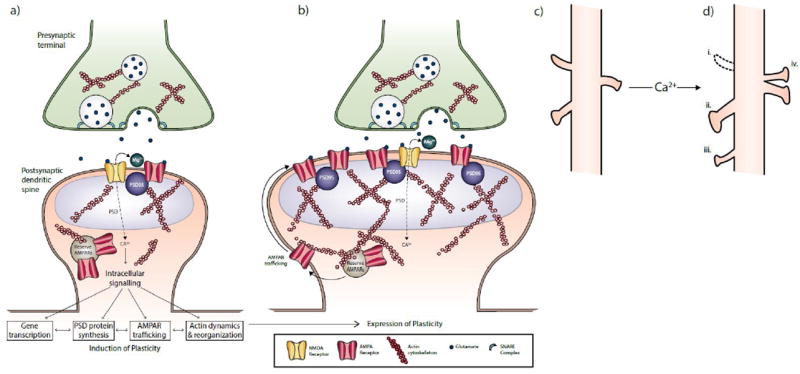
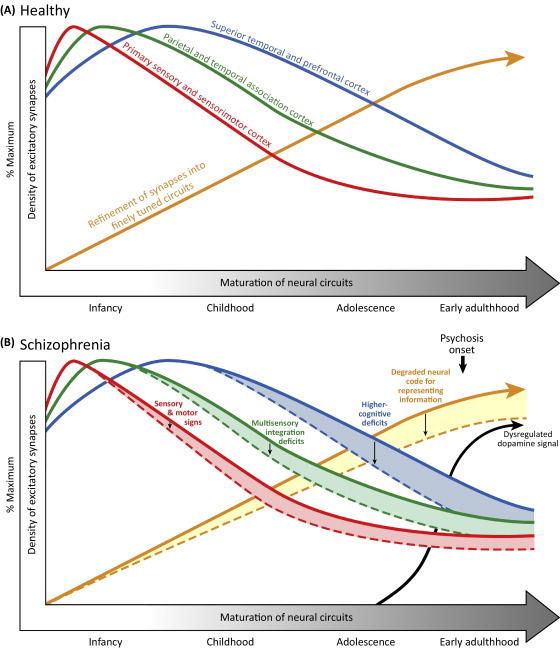
Schizophrenia is associated with alterations in sensory, motor, and cognitive functions that emerge before psychosis onset; identifying pathogenic processes that can account for this multi-faceted phenotype remains a challenge. Accumulating evidence suggests that synaptic plasticity is impaired in schizophrenia. Given the role of synaptic plasticity in learning, memory, and neural circuit maturation, impaired plasticity may underlie many features of the schizophrenia syndrome. Here, we summarize the neurobiology of synaptic plasticity, review evidence that plasticity is impaired in schizophrenia, and explore a framework in which impaired synaptic plasticity interacts with brain maturation to yield the emergence of sensory, motor, cognitive, and psychotic features at different times during development in schizophrenia. Key gaps in the literature and future directions for testing this framework are discussed.
精神分裂症与精神病发作前出现的感觉、运动和认知功能改变有关;确定能够解释这种多方面表型的致病过程仍然是一项挑战。越来越多的证据表明,精神分裂症患者的突触可塑性受损。鉴于突触可塑性在学习、记忆和神经回路成熟中的作用,可塑性受损可能是精神分裂症综合征许多特征的基础。在此,我们总结了突触可塑性的神经生物学,回顾了精神分裂症中可塑性受损的证据,并探讨了一个框架,在该框架中,受损的突触可塑性与大脑成熟相互作用,在精神分裂症患者发育的不同阶段产生感觉、运动、认知和精神病特征。文中讨论了文献中的关键空白以及测试该框架的未来方向。