Pastuszak Alexander W, Kohn Taylor P, Estis Joel, Lipshultz Larry I
Center for Reproductive Medicine, Baylor College of Medicine, Houston, TX, USA; Scott Department of Urology, Baylor College of Medicine, Houston, TX, USA.
Baylor College of Medicine, Houston, TX, USA.
J Sex Med. 2017 Sep;14(9):1095-1103. doi: 10.1016/j.jsxm.2017.06.015. Epub 2017 Jul 27.
The relation between testosterone (T) plasma concentration and cardiovascular (CV) risk is unclear, with evidence supporting increased risk in men with low and high T levels. Few studies have assessed CV risk as a function of plasma T levels using objective biomarkers.
To determine the relation between T levels and high-sensitivity CV risk biomarkers.
Ten thousand forty-one male patients were identified in the database of a commercial clinical laboratory performing biomarker testing. Patients were grouped by total T concentration and associations with the following biomarkers were determined: cardiac troponin I (cTnI), endothelin-1 (ET-1), interleukin-6 (IL-6), tumor necrosis factor-α (TNF-α), interleukin-17A, N-terminal pro-B-type natriuretic peptide (NTproBNP), high-density lipoprotein (HDL) cholesterol, high-sensitivity C-reactive protein (hs-CRP), hemoglobin A (HbA), and leptin.
Association of CV risk markers with levels of T in men.
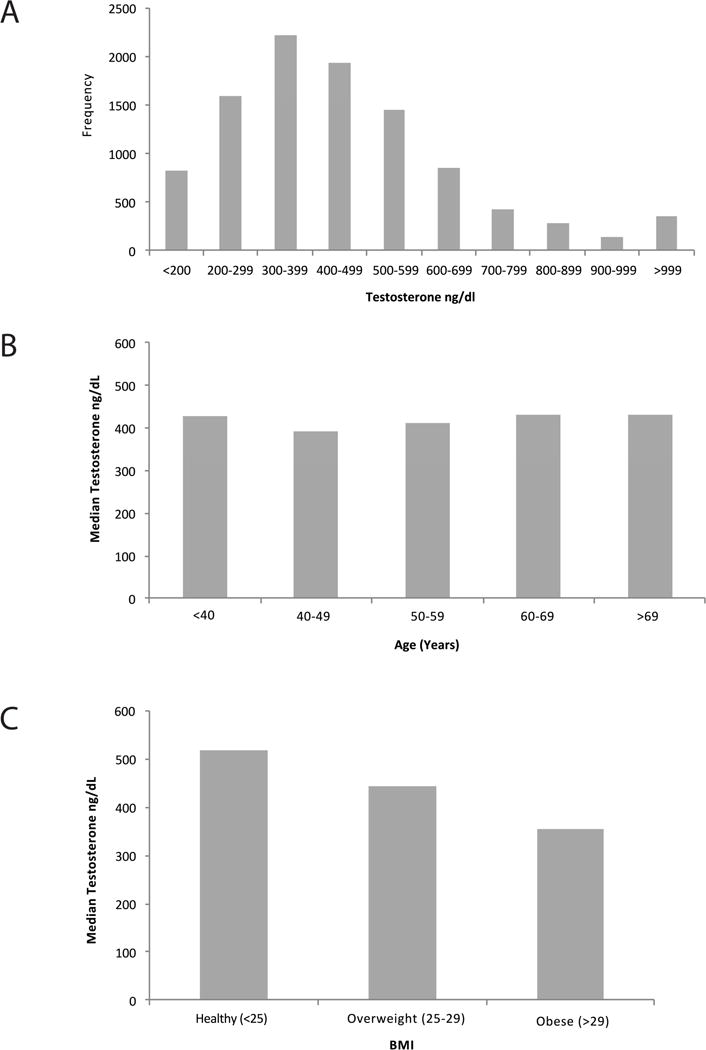
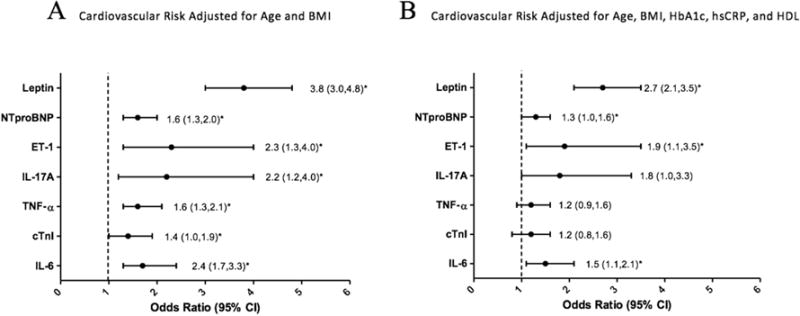
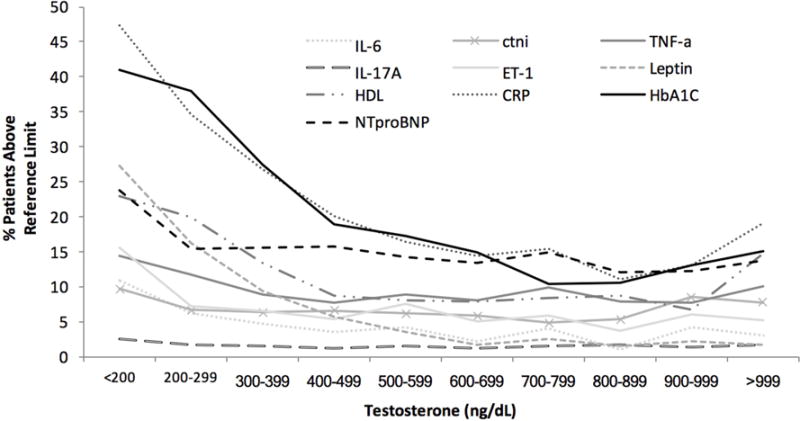
The median age of the cohort was 58 years (interquartile range = 48-68), and the median plasma T level was 420 ng/dL (interquartile range = 304-565); T levels did not vary with patient age. An inverse relation between plasma T levels and CV risk was observed for 9 of 10 CV markers: cTnI, ET-1, IL-6, TNF-α, NTproBNP, HDL cholesterol, hs-CRP, HbA, and leptin. Even after adjusting for age, body mass index, HbA, hs-CRP, and HDL cholesterol levels, the CV markers IL-6, ET-1, NTproBNP, and leptin were significantly associated with a T level lower than 250 ng/dL.
Men with low T levels could be at increased risk for increased CV disease as seen by increased CV risk markers.
This study was performed in a group of 10,041 men and is the first study to examine CV risk associated with circulating T levels using a large panel of 10 objective biomarkers. This study is limited by an absence of clinical data indicating whether men had pre-existing CV disease or other CV risk factors.
Men with low plasma T levels exhibit increases in CV risk markers, consistent with a potential increased risk of CV disease. Pastuszak AW, Kohn TP, Estis J, Lipshultz LI. Low Plasma Testosterone Is Associated With Elevated Cardiovascular Disease Biomarkers. J Sex Med 2017;14:1095-1103.
睾酮(T)血浆浓度与心血管(CV)风险之间的关系尚不清楚,有证据表明T水平低和高的男性风险增加。很少有研究使用客观生物标志物评估CV风险与血浆T水平的关系。
确定T水平与高敏CV风险生物标志物之间的关系。
在一家进行生物标志物检测的商业临床实验室的数据库中识别出10041名男性患者。根据总T浓度对患者进行分组,并确定与以下生物标志物的关联:心肌肌钙蛋白I(cTnI)、内皮素-1(ET-1)、白细胞介素-6(IL-6)、肿瘤坏死因子-α(TNF-α)、白细胞介素-17A、N末端B型利钠肽原(NTproBNP)、高密度脂蛋白(HDL)胆固醇、高敏C反应蛋白(hs-CRP)、糖化血红蛋白A(HbA)和瘦素。
CV风险标志物与男性T水平的关联。
该队列的中位年龄为58岁(四分位间距=48-68),血浆T水平的中位数为420 ng/dL(四分位间距=304-565);T水平不随患者年龄变化。在10种CV标志物中的9种观察到血浆T水平与CV风险呈负相关:cTnI、ET-1、IL-6、TNF-α、NTproBNP、HDL胆固醇、hs-CRP、HbA和瘦素。即使在调整年龄、体重指数、HbA、hs-CRP和HDL胆固醇水平后,CV标志物IL-6、ET-1、NTproBNP和瘦素与低于250 ng/dL的T水平仍显著相关。
T水平低的男性可能因CV风险标志物增加而患CV疾病的风险增加。
本研究在一组10041名男性中进行,是第一项使用10种客观生物标志物的大样本检测循环T水平与CV风险相关的研究。本研究的局限性在于缺乏临床数据表明男性是否已有CV疾病或其他CV风险因素。
血浆T水平低的男性CV风险标志物增加,这与CV疾病潜在风险增加一致。帕斯图扎克AW,科恩TP,埃斯蒂斯J,利普舒尔茨LI。低血浆睾酮与心血管疾病生物标志物升高有关。《性医学杂志》2017年;14:1095-1103。