Wang Lida, Deng Ruijie, Li Jinghong
Department of Chemistry , Beijing Key Laboratory for Microanalytical Methods and Instrumentation , Tsinghua University , Beijing 100084 , China . Email:
Chem Sci. 2015 Dec 1;6(12):6777-6782. doi: 10.1039/c5sc02784e. Epub 2015 Sep 10.
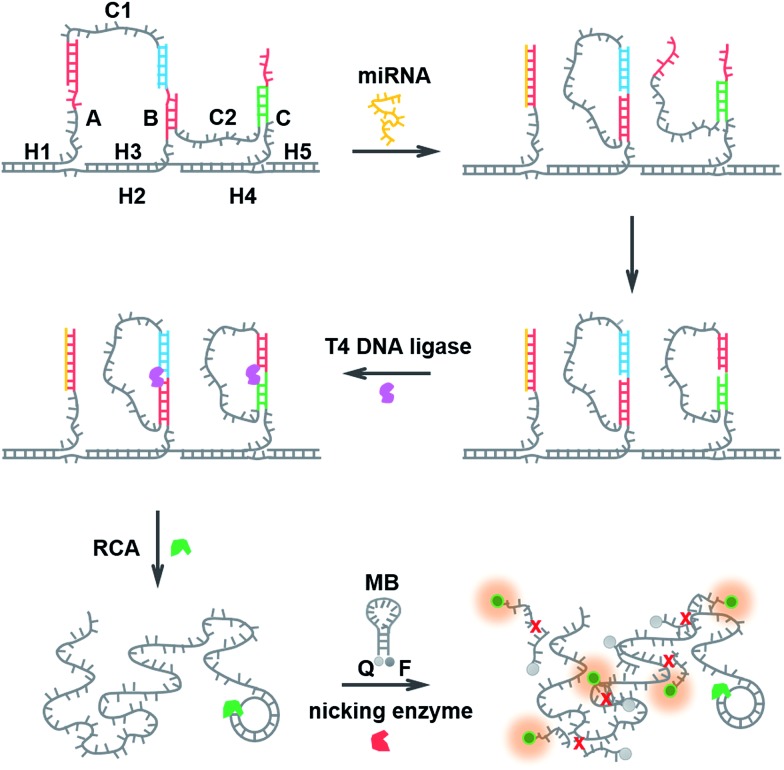
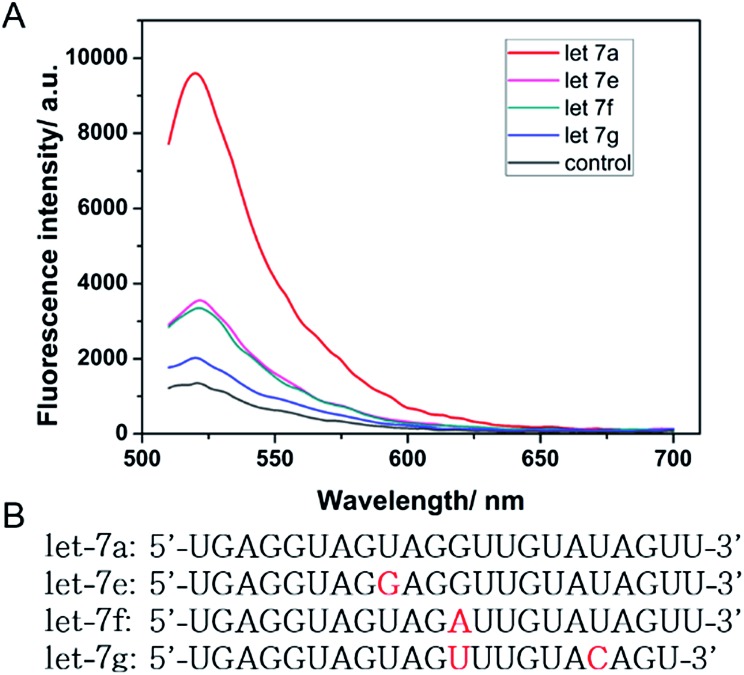
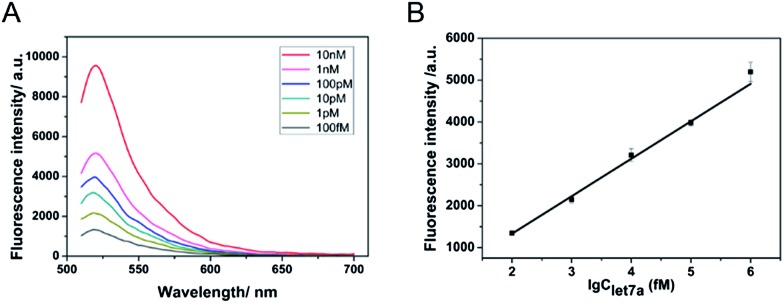
Artificial DNA motifs as architectural scaffolds have been widely used to assemble a variety of nanoscale devices. Synthetic DNA nanostructures have accomplished mechanical switching in response to external stimuli, suggesting the promise of constructing a walking device that is being used in the field of biosensors. Here, we design a novel miRNA-responsive DNA walker biosensor based on strand displacement cascades and an enzymatic recycling cleavage strategy. By using miRNA as a driving force, the DNA walkers can be activated to move along the track and generate specific signals for let-7a with a high signal-to-noise ratio. This biosensor exhibits excellent analytical performance toward the sensing of let-7a with great specificity for resolving one nucleotide variation and a detection limit of 58 fM. Such an ultraselective sensor shows that DNA nanostructures have great potential in providing platforms for applications in the fields of biosensing, clinical diagnostics and environmental sample analysis.
人工DNA基序作为结构支架已被广泛用于组装各种纳米级器件。合成DNA纳米结构已实现了响应外部刺激的机械开关,这表明构建一种正在生物传感器领域中使用的行走装置具有前景。在此,我们基于链置换级联反应和酶循环切割策略设计了一种新型的miRNA响应型DNA行走器生物传感器。通过使用miRNA作为驱动力,DNA行走器可以被激活,沿着轨道移动,并以高信噪比产生针对let-7a的特定信号。这种生物传感器在检测let-7a方面表现出优异的分析性能,具有极高的特异性,可分辨一个核苷酸的差异,检测限为58 fM。这种超选择性传感器表明,DNA纳米结构在为生物传感、临床诊断和环境样品分析等领域的应用提供平台方面具有巨大潜力。