Knabe Christine, Adel-Khattab Doaa, Kluk Esther, Struck Rainer, Stiller Michael
Department of Experimental Orofacial Medicine, Philipps University, 35039 Marburg, Germany.
Department of Oral Periodontology, School of Dentistry, Ain Shams University, Cairo 11772, Egypt.
J Funct Biomater. 2017 Jul 29;8(3):31. doi: 10.3390/jfb8030031.
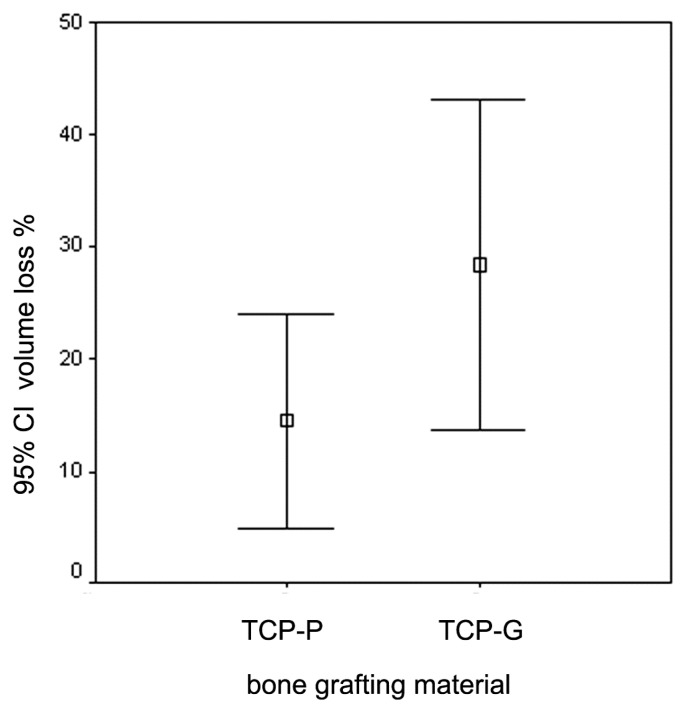
This study examines the effect of a hyaluronic acid (HyAc) containing tricalcium phosphate putty scaffold material (TCP-P) and of a particulate tricalcium phosphate (TCP-G) graft on bone formation, volume stability and osteogenic marker expression in biopsies sampled 6 months after bilateral sinus floor augmentation (SFA) in 7 patients applying a split-mouth design. 10% autogenous bone chips were added to the grafting material during surgery. The grain size of the TCP granules was 700 to 1400 µm for TCP-G and 125 to 250 µm and 500 to 700 µm (ratio 1:1) for TCP-P. Biopsies were processed for immunohistochemical analysis of resin-embedded sections. Sections were stained for collagen type I (Col I), alkaline phosphatase (ALP), osteocalcin (OC) and bone sialoprotein (BSP). Furthermore, the bone area and biomaterial area fraction were determined histomorphometrically. Cone-beam CT data recorded after SFA and 6 months later were used for calculating the graft volume at these two time points. TCP-P displayed more advantageous surgical handling properties and a significantly greater bone area fraction and smaller biomaterial area fraction. This was accompanied by significantly greater expression of Col I and BSP and in osteoblasts and osteoid and a less pronounced reduction in grafting volume with TCP-P. SFA using both types of materials resulted in formation of sufficient bone volume for facilitating stable dental implant placement with all dental implants having been in function without any complications for 6 years. Since TCP-P displayed superior surgical handling properties and greater bone formation than TCP-G, without the HyAc hydrogel matrix having any adverse effect on bone formation or graft volume stability, TCP-P can be regarded as excellent grafting material for SFA in a clinical setting. The greater bone formation observed with TCP-P may be related to the difference in grain size of the TCP granules and/or the addition of the HyAc.
本研究采用双盲设计,对7例患者双侧上颌窦底提升术(SFA)6个月后采集的活检样本进行研究,考察含透明质酸(HyAc)的磷酸三钙油灰支架材料(TCP-P)和颗粒状磷酸三钙(TCP-G)移植物对骨形成、体积稳定性和成骨标志物表达的影响。手术过程中,在移植材料中添加了10%的自体骨屑。TCP-G的TCP颗粒粒径为700至1400 µm,TCP-P的粒径为125至250 µm和500至700 µm(比例1:1)。对活检样本进行处理,用于树脂包埋切片的免疫组织化学分析。切片用I型胶原(Col I)、碱性磷酸酶(ALP)、骨钙素(OC)和骨唾液蛋白(BSP)染色。此外,通过组织形态计量学确定骨面积和生物材料面积分数。SFA后及6个月后记录的锥形束CT数据用于计算这两个时间点的移植物体积。TCP-P表现出更有利的手术操作特性,骨面积分数显著更高,生物材料面积分数更小。这伴随着Col I和BSP在成骨细胞和类骨质中的表达显著增加,且TCP-P的移植物体积减少不明显。使用这两种材料进行SFA均能形成足够的骨体积,便于稳定植入牙种植体,所有牙种植体均已正常使用6年且无任何并发症。由于TCP-P比TCP-G表现出更优越的手术操作特性和更大的骨形成,且HyAc水凝胶基质对骨形成或移植物体积稳定性没有任何不利影响,因此在临床环境中,TCP-P可被视为SFA的优良移植材料。观察到的TCP-P更大的骨形成可能与TCP颗粒的粒径差异和/或HyAc的添加有关。