Ye Yao, Vattai Aurelia, Zhang Xi, Zhu Junyan, Thaler Christian J, Mahner Sven, Jeschke Udo, von Schönfeldt Viktoria
Department of Gynaecology and Obstetrics, Ludwig-Maximilians University of Munich, Campus Großhadern: Marchioninistr. 15, 81377 Munich and Campus Innenstadt: Maistr. 11, 80337 Munich, Germany.
Int J Mol Sci. 2017 Jul 29;18(8):1651. doi: 10.3390/ijms18081651.
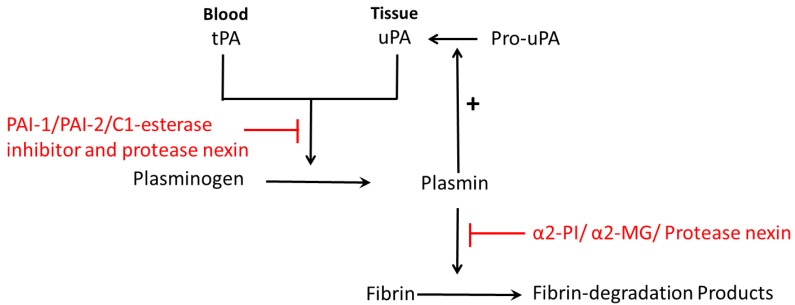
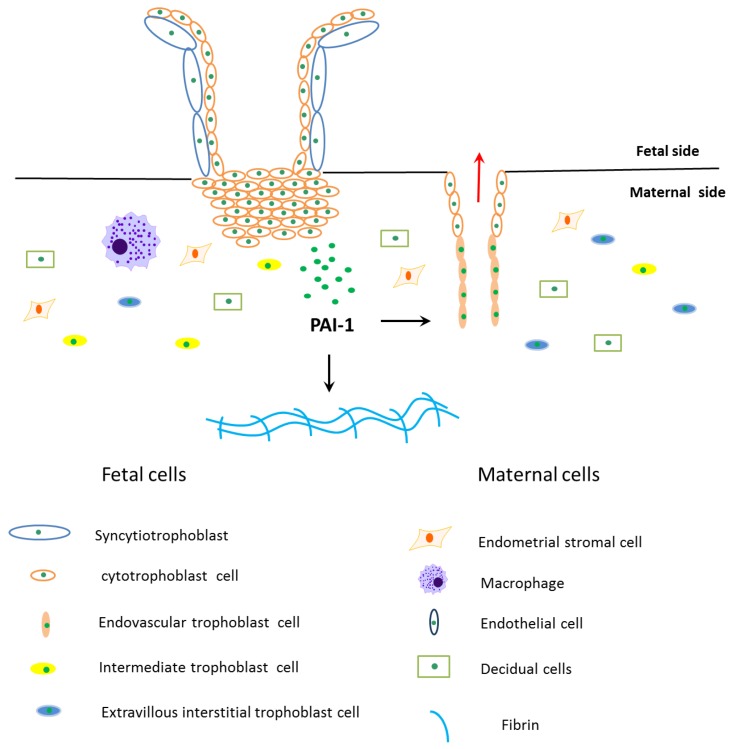
Normal pregnancy is a state of hypercoagulability with diminishing fibrinolytic activity, which is mainly caused by an increase of plasminogen activator inhibitor type 1 (PAI-1). PAI-1 is the main inhibitor of plasminogen activators, including tissue-type plasminogen activator (tPA) and urokinase-type plasminogen activator (uPA). In human placentas, PAI-1 is expressed in extravillous interstitial trophoblasts and vascular trophoblasts. During implantation and placentation, PAI-1 is responsible for inhibiting extra cellular matrix (ECM) degradation, thereby causing an inhibition of trophoblasts invasion. In the present study, we have reviewed the literature of various reproductive diseases where PAI-1 plays a role. PAI-1 levels are increased in patients with recurrent pregnancy losses (RPL), preeclampsia, intrauterine growth restriction (IUGR), gestational diabetes mellitus (GDM) in the previous pregnancy, endometriosis and polycystic ovary syndrome (PCOS). In general, an increased expression of PAI-1 in the blood is associated with an increased risk for infertility and a worse pregnancy outcome. GDM and PCOS are related to the genetic role of the 4G/5G polymorphism of . This review provides an overview of the current knowledge of the role of PAI-1 in reproductive diseases. PAI-1 represents a promising monitoring biomarker for reproductive diseases and may be a treatment target in the near future.
正常妊娠是一种具有高凝状态且纤溶活性降低的状态,这主要是由纤溶酶原激活物抑制剂1型(PAI-1)增加所致。PAI-1是纤溶酶原激活物的主要抑制剂,包括组织型纤溶酶原激活物(tPA)和尿激酶型纤溶酶原激活物(uPA)。在人胎盘中,PAI-1在绒毛外间质滋养层细胞和血管滋养层细胞中表达。在着床和胎盘形成过程中,PAI-1负责抑制细胞外基质(ECM)降解,从而抑制滋养层细胞的侵袭。在本研究中,我们回顾了PAI-1发挥作用的各种生殖疾病的文献。复发性流产(RPL)、子痫前期、胎儿生长受限(IUGR)、既往妊娠的妊娠期糖尿病(GDM)、子宫内膜异位症和多囊卵巢综合征(PCOS)患者的PAI-1水平升高。一般来说,血液中PAI-1表达增加与不孕风险增加和妊娠结局较差有关。GDM和PCOS与……的4G/5G多态性的遗传作用有关。本综述概述了目前关于PAI-1在生殖疾病中作用的知识。PAI-1是一种有前景的生殖疾病监测生物标志物,在不久的将来可能成为治疗靶点。