Thomas Lena, Balmus Caroline, Ahmadzadehfar Hojjat, Essler Markus, Strunk Holger, Bundschuh Ralph A
Klinik und Poliklinik für Nuklearmedizin, Universitätsklinikum Bonn, Bonn D-53127, Germany.
Radiologische Klinik, Universitätsklinikum Bonn, Bonn D-53012, Germany.
Pharmaceuticals (Basel). 2017 Jul 31;10(3):68. doi: 10.3390/ph10030068.
Bone scintigraphy is the standard of reference in bone metastases in prostate cancer patients. However, new radiotracers employed in prostate-specific membrane antigen (PSMA)-ligands has led to the growing importance of PET/CT as diagnostic tool. The aim of our study was to investigate the difference between bone scan and PSMA-PET/CT for the detection of bone metastases in prostate cancer.
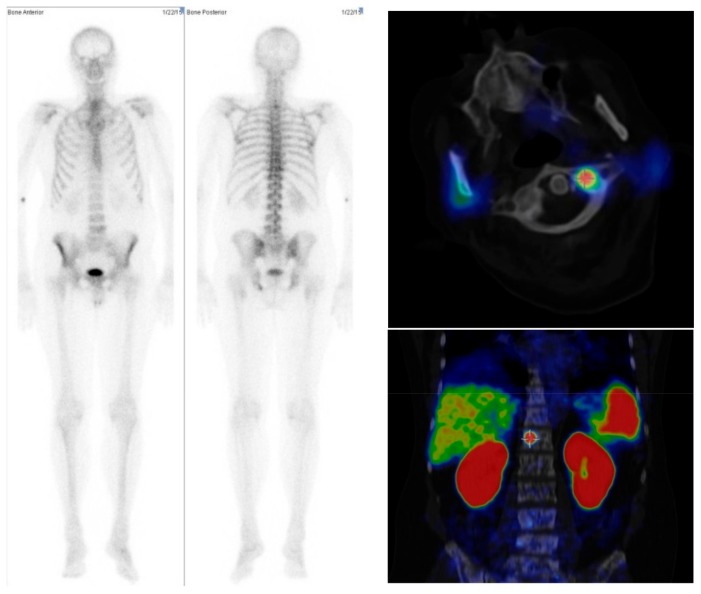
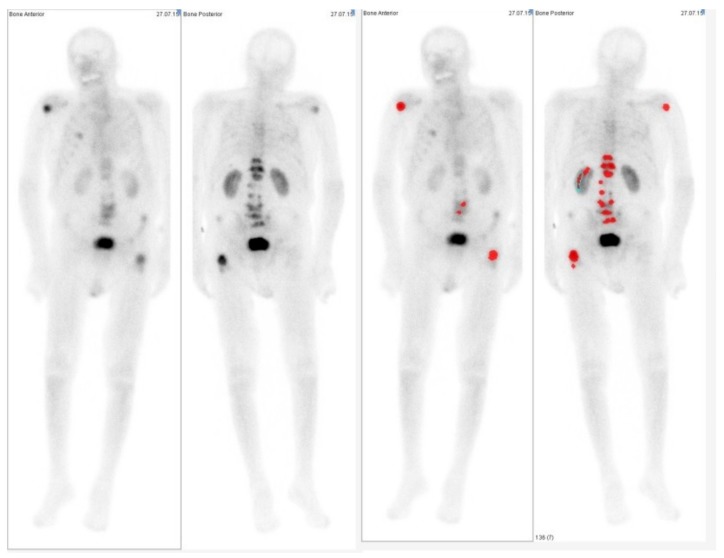
Thirty patients with bone metastases originating from prostate cancer were examined by Tc-MDP bone scan and Ga-PSMA-PET/CT within an average of 21 days. Bone scans were analyzed visually according to the number of lesions and using the software package ExiniBONE by Exini Diagnostics. PET/CT data was analyzed visually. Numbers of detected lesions were compared for the different methods for the whole patient and for different regions. In addition, results were compared to serum prostate-specific antigen (PSA), alkaline phosphatase (ALP), bone alkaline phosphatase (bALP), pro gastrin releasing peptide (pGRP) and eastern cooperative oncology group (ECOG) performance status.
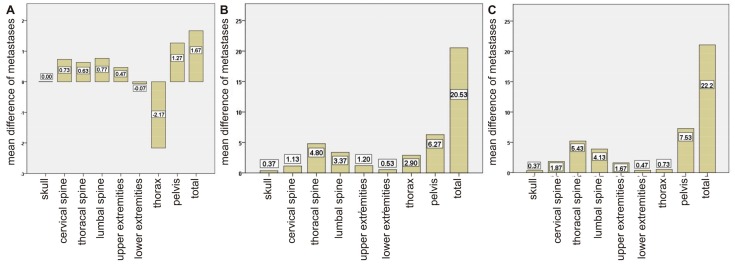
In the bone scans, visual and semiautomatic lesion detection showed similar results with an average of 19.4 and 17.8 detected bone lesion per patient. However, in PSMA-PET/CT, on average double the numbers of lesions (40.0) were detected. The largest differences were found in the thorax and pelvis, which can be explained by the advantages of tomographic imaging. Bland-Altman analysis showed greater differences in patients with large numbers of bone metastases.
No significant difference was found when using semiautomatic analysis compared to visual reading for bone scans. Fewer bone metastases were detected in bone scans than in PSMA-PET/CT. However, in none of our patients would the difference have led to clinical consequences. Therefore, it seems that for patients undergoing PSMA-PET/CT, there is no need to perform additional bone scans if the appropriate PET/CT protocols are applied.
骨闪烁扫描是前列腺癌患者骨转移的参考标准。然而,前列腺特异性膜抗原(PSMA)配体中使用的新型放射性示踪剂使得PET/CT作为诊断工具的重要性日益增加。我们研究的目的是探讨骨扫描与PSMA-PET/CT在检测前列腺癌骨转移方面的差异。
30例前列腺癌骨转移患者在平均21天内接受了Tc-MDP骨扫描和Ga-PSMA-PET/CT检查。根据病变数量对骨扫描进行视觉分析,并使用Exini Diagnostics公司的ExiniBONE软件包进行分析。对PET/CT数据进行视觉分析。比较了不同方法对全患者和不同区域检测到的病变数量。此外,将结果与血清前列腺特异性抗原(PSA)、碱性磷酸酶(ALP)、骨碱性磷酸酶(bALP)、促胃泌素释放肽(pGRP)以及东部肿瘤协作组(ECOG)的体能状态进行了比较。
在骨扫描中,视觉和半自动病变检测结果相似,每位患者平均检测到19.4个和17.8个骨病变。然而,在PSMA-PET/CT中,平均检测到的病变数量(40.0个)是其两倍。在胸部和骨盆中发现的差异最大,这可以通过断层成像的优势来解释。Bland-Altman分析显示,骨转移数量较多的患者差异更大。
与骨扫描的视觉读数相比,半自动分析未发现显著差异。骨扫描检测到的骨转移比PSMA-PET/CT少。然而,在我们的患者中,这种差异均未导致临床后果。因此,对于接受PSMA-PET/CT检查的患者,如果应用了适当的PET/CT方案,似乎无需进行额外的骨扫描。