Bayés de Luna Antoni, Martínez-Sellés Manuel, Bayés-Genís Antoni, Elosua Roberto, Baranchuk Adrian
Fundació Investigació Cardiovascular, ICCC, Hospital de Sant Pau, Barcelona, Spain.
Hospital General Universitario Gregorio Marañón. CIBERCV, Universidad Complutense, Universidad Europea, Madrid, Spain.
BMC Cardiovasc Disord. 2017 Jul 31;17(1):211. doi: 10.1186/s12872-017-0650-y.
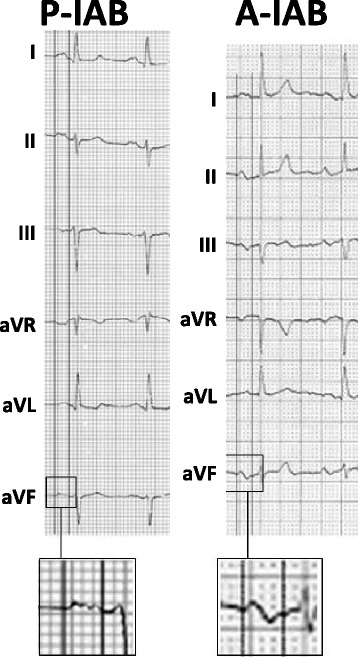
Atrial fibrillation (AF) is the most common sustained arrhythmia and is associated with stroke, cognitive impairment, and cardiovascular death. Some predisposing factors - as aging, diabetes, hypertension - induce and maintain electrophysiological and ultrastructural remodeling that usually includes fibrosis. Interatrial conduction disturbances play a crucial role in the initiation of atrial fibrosis and in its associated complications. The diagnosis of interatrial blocks (IABs) is easy to perform using the surface ECG. IAB is classified as partial when the P wave duration is ≥120 ms, and advanced if the P wave also presents a biphasic pattern in II, III and aVF. IAB is very frequent in the elderly and, particularly in the case of the advanced type, is associated with AF, AF recurrences, stroke, and dementia. The anticoagulation in elderly patients at high risk of AF without documented arrhythmias is an open issue but recent data suggest that it might have a role, particularly in elderly patients with structural heart disease, high CHADSVASc (Congestive heart failure/left ventricular dysfunction, Hypertension, Age ≥ 75 [doubled], Diabetes, Stroke [doubled] - Vascular disease, Age 65-74, and Sex category [female]), and advanced IAB. In this debate, we discuss the association of surface ECG IAB, a marker of atrial fibrosis, with AF and stroke. We also present the rationale that justifies further studies regarding anticoagulation in some of these patients.
心房颤动(AF)是最常见的持续性心律失常,与中风、认知障碍和心血管死亡相关。一些诱发因素,如衰老、糖尿病、高血压,会引发并维持电生理和超微结构重塑,通常包括纤维化。房间传导障碍在心房纤维化的发生及其相关并发症中起关键作用。使用体表心电图很容易诊断房间阻滞(IABs)。当P波时限≥120毫秒时,IAB被分类为不完全性,而如果P波在II、III和aVF导联也呈现双相形态,则为完全性。IAB在老年人中非常常见,特别是完全性IAB,与房颤、房颤复发、中风和痴呆有关。对于无记录心律失常但有房颤高风险的老年患者,抗凝治疗是一个未解决的问题,但最近的数据表明,抗凝治疗可能有作用,特别是对于有结构性心脏病、高CHADSVASc评分(充血性心力衰竭/左心室功能障碍、高血压、年龄≥75岁[加倍]、糖尿病、中风[加倍] - 血管疾病、年龄65 - 74岁和性别类别[女性])以及完全性IAB的老年患者。在本次讨论中,我们探讨作为心房纤维化标志物的体表心电图IAB与房颤和中风的关联。我们还提出了对其中一些患者进行进一步抗凝治疗研究的理论依据。