Teresa Jurado, Chamaida Plasencia-Rodríguez, Ana Martínez-Feito, Victoria Navarro-Compán, Theo Rispens, Annick Vries, Karien Bloem, Eva-María Olariaga, Cristina Diego, Alejandro Villalba, Diana Peiteado, Laura Nuño, Maria-Gema Bonilla, Alejandro Balsa, Dora Pascual-Salcedo
Immunology Unit, University Hospital La Paz, Paseo de la Castellana 261, 28046 Madrid, Spain.
Rheumatology Department and Institute for Health Research (IdiPAZ), University Hospital La Paz, Madrid, Spain.
Open Rheumatol J. 2017 Jun 29;11:75-87. doi: 10.2174/1874312901711010075. eCollection 2017.
The Infliximab, has proven effective in treating rheumatoid arthritis (RA). A good clinical response is usually associated with high serum drug levels. Development of antibodies toward Infliximab (ATI) can increase drug clearance, leading to treatment failure.
To analyze whether serum Infliximab trough levels (ITL) at the induction phase are associated with Infliximab clearance and clinical outcomes at week(W) 54 and to investigate the association with immunogenicity development.
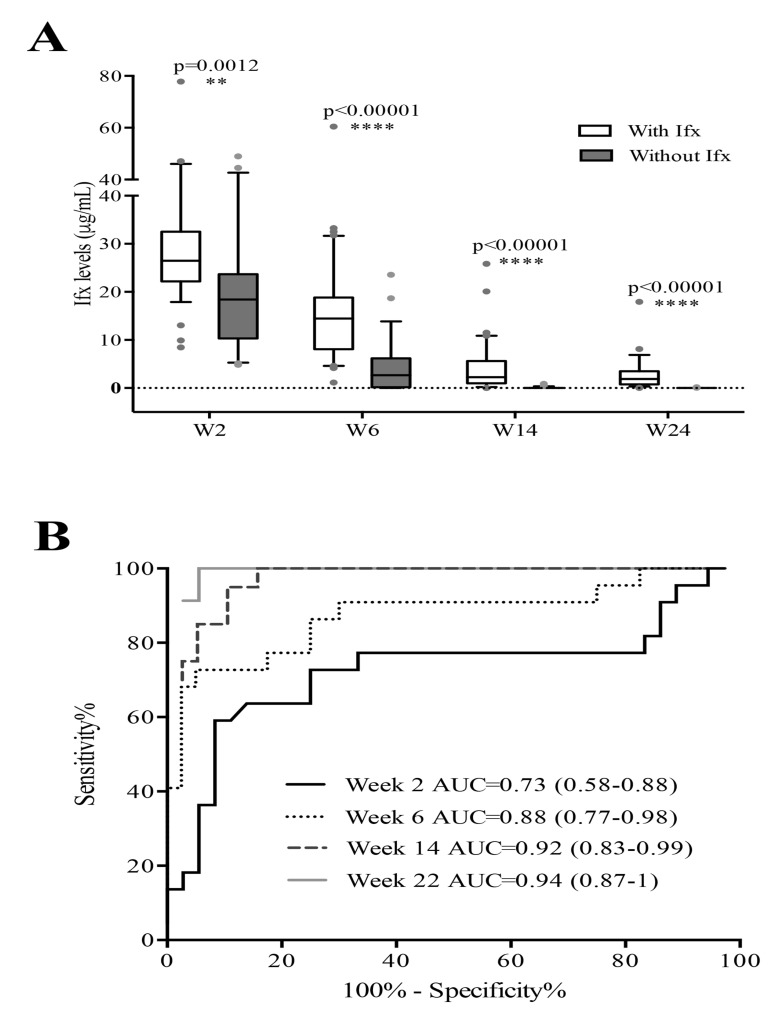
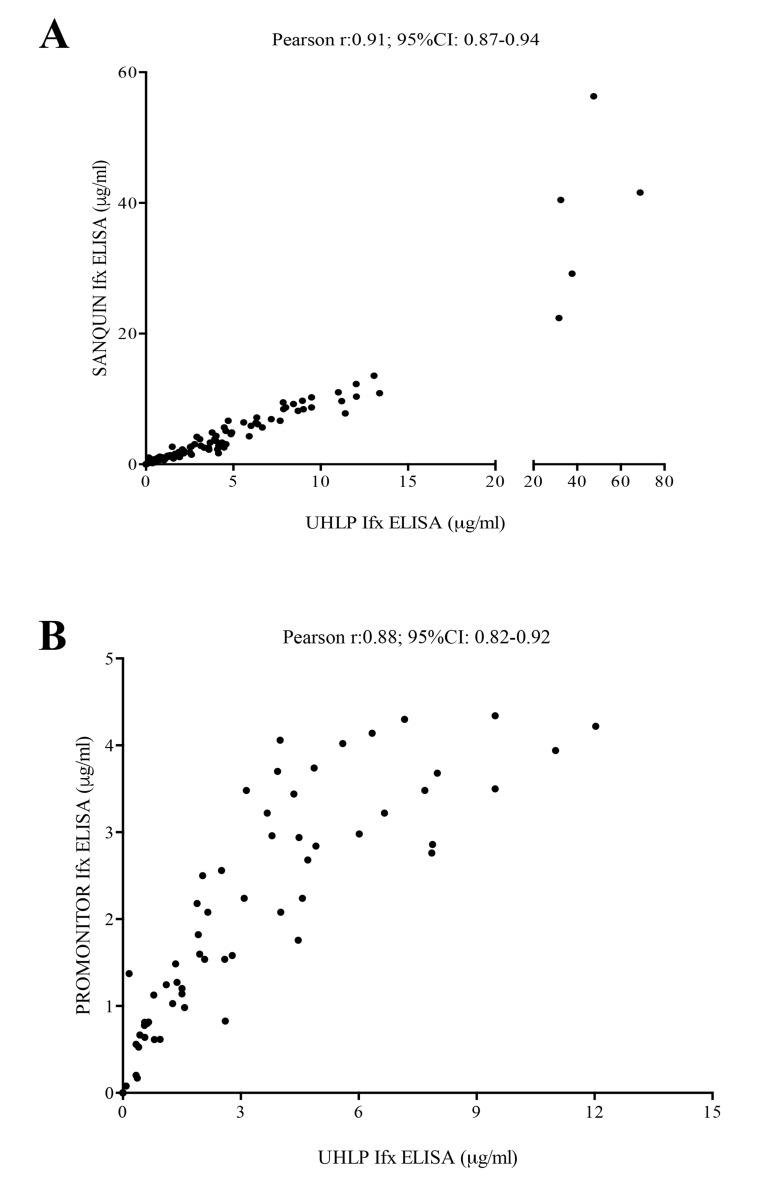
Observational retrospective study in which ITL from 66 RA patients were measured by capture ELISA at W0, W2, W6, W14 and 22. Patients were classified as ITLpos if Infliximab was detectable at W54 and ITLneg otherwise. ATI were assayed by bridging ELISA and by two drug-tolerant assays. ITL cut-off values were established by ROC curves. The association between ITL at early-stage and clearance of Infliximab at W54 was analyzed by univariable and multivariable logistic regression.
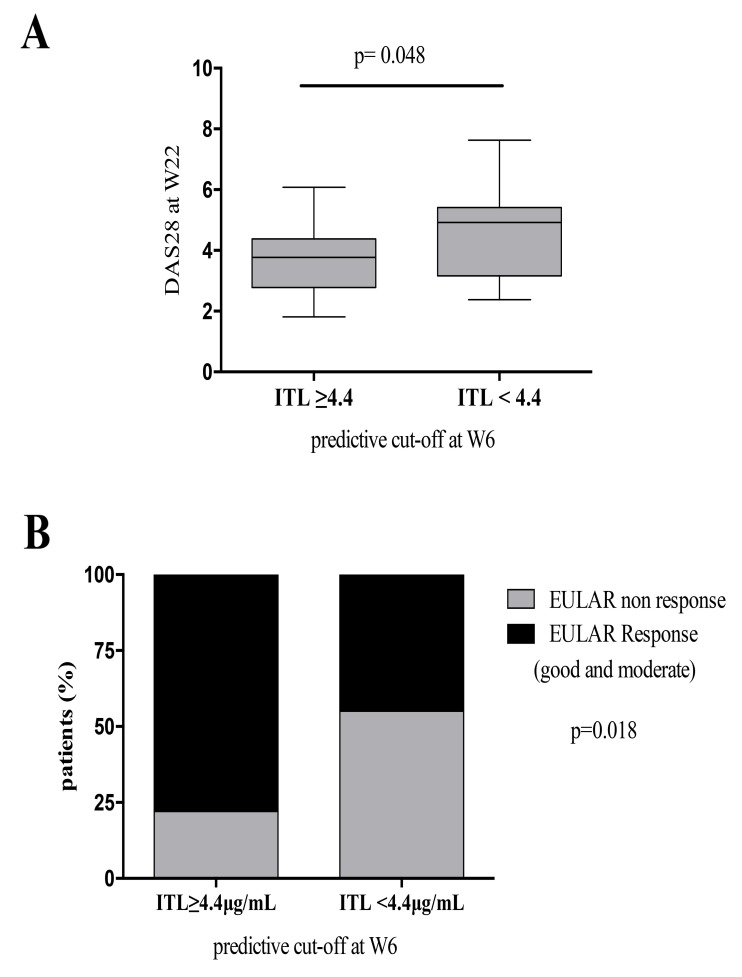
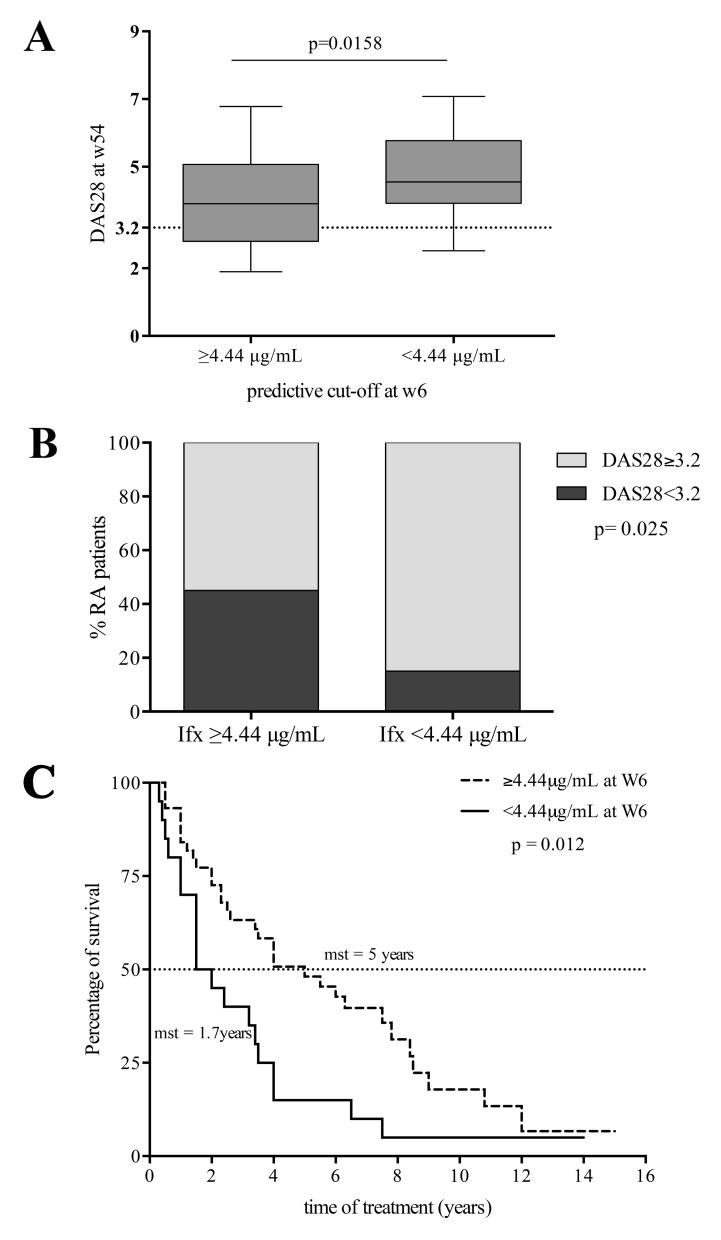
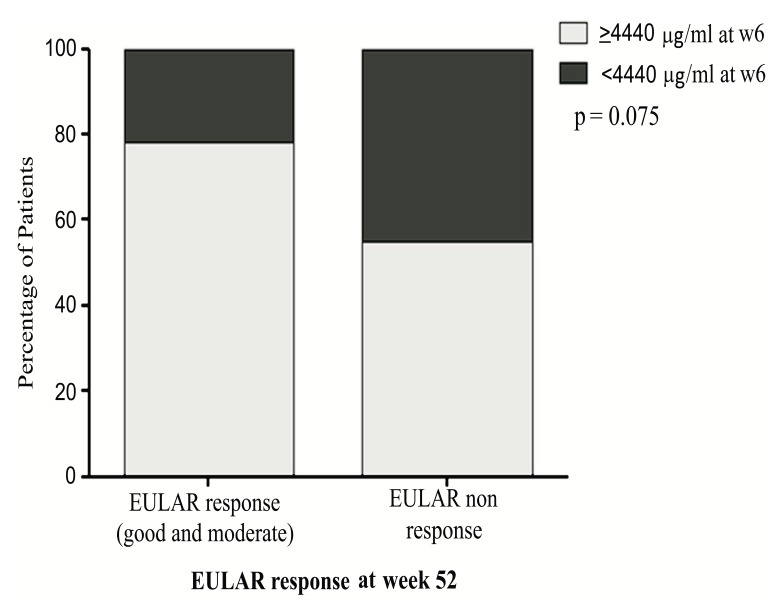
ITLneg patients (n=25) always had significantly lower Infliximab levels than ITLpos (n=41). An ITL value of 4.4 μg/mL at W6 best predicted W54 Infliximab absence. In the multivariable analysis, only ITL below the cut-off at W6 (OR: 86.6; 95%CI: 6.58-1139.99) and non-use of methotrexate (OR: 6.9; 95%CI: 1.04-45.84) remained significantly associated with W54 Infliximab absence. ATI were more frequent in patients with ITL below the cut-off at W6.
In RA, ITL at induction phase are inversely associated with Infliximab clearance and clinical outcomes at W54. ATI was the main reason for low early ITL. A predictive value of ITL at W6 was found as a useful prognostic measure of treatment efficacy.
英夫利昔单抗已被证明在治疗类风湿性关节炎(RA)方面有效。良好的临床反应通常与高血清药物水平相关。针对英夫利昔单抗(ATI)的抗体产生会增加药物清除率,导致治疗失败。
分析诱导期血清英夫利昔单抗谷浓度(ITL)是否与第54周时英夫利昔单抗清除率及临床结局相关,并研究其与免疫原性产生的关联。
进行观察性回顾性研究,通过捕获ELISA法在第0周、第2周、第6周、第14周和第22周测量66例RA患者的ITL。若在第54周可检测到英夫利昔单抗,则患者分类为ITL阳性,否则为ITL阴性。通过桥接ELISA法和两种药物耐受试验检测ATI。通过ROC曲线确定ITL临界值。采用单变量和多变量逻辑回归分析早期ITL与第54周英夫利昔单抗清除率之间的关联。
ITL阴性患者(n = 25)的英夫利昔单抗水平始终显著低于ITL阳性患者(n = 41)。第6周时ITL值为4.4μg/mL最能预测第54周英夫利昔单抗缺失。在多变量分析中,仅第6周时低于临界值的ITL(OR:86.6;95%CI:6.58 - 1139.99)和未使用甲氨蝶呤(OR:6.9;95%CI:1.04 - 45.84)仍与第54周英夫利昔单抗缺失显著相关。第6周时ITL低于临界值的患者中ATI更常见。
在RA中,诱导期ITL与第54周时英夫利昔单抗清除率及临床结局呈负相关。ATI是早期ITL较低的主要原因。发现第6周时ITL的预测价值可作为治疗疗效的有用预后指标。