Kazooba Patrick, Kasamba Ivan, Mayanja Billy Nsubuga, Lutaakome Joseph, Namakoola Ivan, Salome Tino, Kaleebu Pontiano, Munderi Paula
MRC/UVRI Uganda Research Unit on AIDS, P.O. Box 49, Entebbe, Uganda.
MRC Tropical Epidemiology Group, London School of Hygiene and Tropical Medicine, Keppel Street, London WC1E 7HT, UK.
Pan Afr Med J. 2017 May 15;27:40. doi: 10.11604/pamj.2017.27.40.9840. eCollection 2017.
We investigated the prevalence, predictors of and effect of Antiretroviral Therapy (ART) regimen on cardiometabolic risk among HIV-positive Ugandan adults at enrolment into a prospective cohort to study the Complications of Long-Term ART (CoLTART).
We collected data on cardiometabolic risk factors including dyslipidemia, hypertension, hyperglycemia, obesity and calculated the mean atherogenic index for Plasma (AIP) and 10 year Framingham risk score (FHS). Exposures were: ART regimen, duration on ART, demographic, socio-economic, behavioral, and life-style factors including smoking, physical activity and diet (including fruit and vegetables consumption).
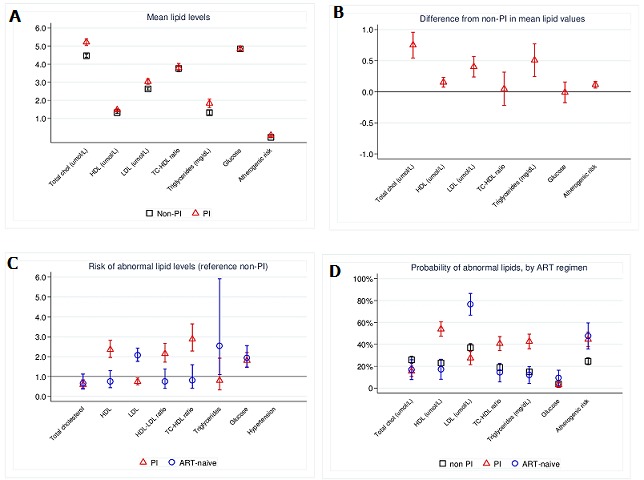
We enrolled 1024 participants, 65% female, mean age was 44.8 years (SD 8.0) and median duration on ART was 9.4 years (IQR 6.1-9.8). The prevalence of abdominal obesity was 52.6%, BMI≥25 kg/m -26.1%, hypertension-22.6%, high AIP-31.3% and FHS above 10% was 16.6%. The prevalence of low High Density Lipoprotein (HDL) was 37.5%, high Total cholesterol (Tc)-30.2%, high Low Density Lipoprotein (LDL) -23.6%, high Triglycerides (TG)-21.2%, low physical activity-46.4% and alcohol consumption-26.4%. In multivariate linear regression analyses, increasing age was associated with higher mean Tc, HDL, LDL, FHS (P<0.001) and hyperglycemia (p<0.005). In multivariate logistic regression analyses, Protease Inhibitor (PI) containing regimens were significantly associated with higher risks of abnormal: Tc, LDL, TG, AIP, abdominal obesity, hypertension, low HDL and lower risk of a FHS >10% compared to the non PI regimen.
ART increases cardiometabolic risk. Integration of routine assessment for cardiometabolic risk factors and preventive interventions into HIV care programs in resource-limited settings is recommended.
我们在一项前瞻性队列研究中,对乌干达成年HIV感染者入组时抗逆转录病毒疗法(ART)方案的流行情况、预测因素及其对心脏代谢风险的影响进行了调查,以研究长期ART的并发症(CoLTART)。
我们收集了包括血脂异常、高血压、高血糖、肥胖在内的心脏代谢危险因素的数据,并计算了血浆致动脉粥样硬化指数(AIP)和10年弗雷明汉风险评分(FHS)。暴露因素包括:ART方案、ART治疗时长、人口统计学、社会经济、行为和生活方式因素,包括吸烟、身体活动和饮食(包括水果和蔬菜摄入量)。
我们纳入了1024名参与者,其中65%为女性,平均年龄为44.8岁(标准差8.0),ART治疗的中位时长为9.4年(四分位间距6.1 - 9.8)。腹型肥胖的患病率为52.6%,BMI≥25 kg/m²为26.1%,高血压为22.6%,高AIP为31.3%,FHS高于10%为16.6%。高密度脂蛋白(HDL)水平低的患病率为37.5%,总胆固醇(Tc)高为30.2%,低密度脂蛋白(LDL)高为23.6%,甘油三酯(TG)高为21.2%,身体活动少为46.4%,饮酒为26.4%。在多变量线性回归分析中,年龄增加与平均Tc、HDL、LDL、FHS升高(P<0.001)和高血糖(P<0.005)相关。在多变量逻辑回归分析中,与不含蛋白酶抑制剂(PI)的方案相比,含PI的方案与Tc、LDL、TG、AIP异常、腹型肥胖、高血压、HDL水平低的风险显著升高以及FHS>10%的风险降低显著相关。
ART会增加心脏代谢风险。建议在资源有限的环境中将心脏代谢危险因素的常规评估和预防性干预纳入HIV护理项目。