Almario Rogelio U, Buchan Wendy M, Rocke David M, Karakas Sidika E
Division of Endocrinology, Diabetes and Metabolism, Department of Internal Medicine, The University Of California at Davis, Sacramento, California, USA.
Department of Family and Consumer Sciences, University of Sacramento, Sacramento, California, USA.
BMJ Open Diabetes Res Care. 2017 Jul 7;5(1):e000420. doi: 10.1136/bmjdrc-2017-000420. eCollection 2017.
Whey protein (WP) intake has been shown to reduce postprandial glycemia. Majority of WP research in type 2 diabetes (T2DM) involved acute challenge or weight loss studies. It is not known if WP supplementation can provide sustained glucose lowering. Our goal was to investigate the effects of WP on glycemia comprehensively by using continuous glucose monitoring (CGM) while avoiding the confounding effects of variable food intake through controlled feeding.
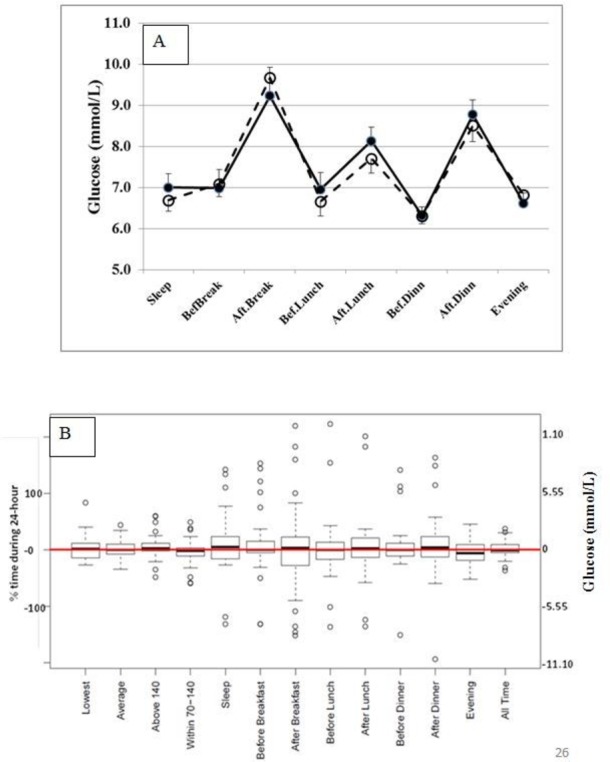
This double-blinded and placebo (PL)-controlled study included 22 patients with T2DM patients (11 male, 11 female; age 57.1±12.6 years) on diet or metformin monotherapy. First, one serving (21 g) of WP was compared with PL in parallel-armed acute challenge studies. Next, in a crossover design, each patient underwent CGM twice, over 2 consecutive weeks, 3.5 days each week. Identical diets were provided by the study during both CGM periods. During the first CGM, one serving of either WP or PL was consumed before breakfast and another before dinner. During the second CGM, participants switched to the alternate supplement. Order of the supplements was randomized.
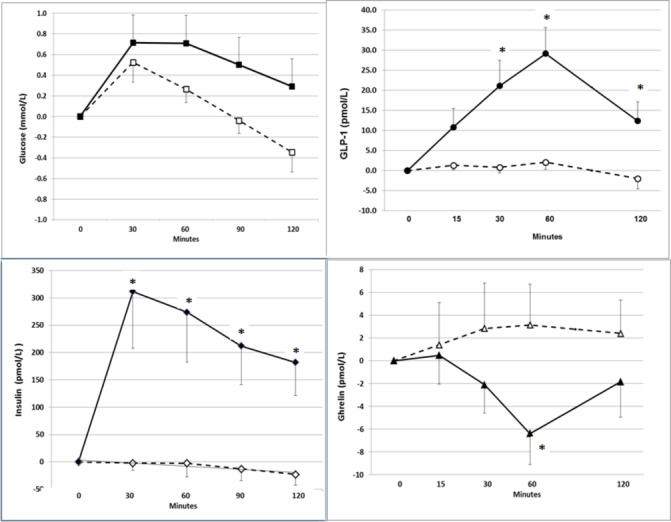
During acute challenge studies, WP stimulated insulin and glucagon-like peptide (GLP)-1 secretion; suppressed ghrelin (all p<0.05), while PL had no effect. During CGM, glucose response to WP varied depending on the baseline characteristics of the patients. When evaluated using linear regression, the most predictive baseline variables were body mass index (BMI) (p=0.0006), triglycerides (p=8.3×10) and GLP-1 (p=0.006). Lower BMI, triglyceride and GLP-1 predicted decreased glucose levels on WP. Obesity, hypertriglyceridemia and high fasting GLP-1 concentrations predicted increased glucose levels.
Effects of WP supplementation on glycemia in T2DM depend on the baseline characteristics. Lower body weight, normal triglyceride and lower GLP-1 levels predict glucose lowering. In contrast, obesity, hypertriglyceridemia and high baseline GLP-1 predict increased glucose response.
乳清蛋白(WP)摄入已被证明可降低餐后血糖。2型糖尿病(T2DM)中大多数关于WP的研究涉及急性挑战或减肥研究。目前尚不清楚补充WP是否能持续降低血糖。我们的目标是通过使用连续血糖监测(CGM)全面研究WP对血糖的影响,同时通过控制饮食避免食物摄入量变化的混杂影响。
这项双盲、安慰剂(PL)对照研究纳入了22例接受饮食或二甲双胍单药治疗的T2DM患者(11例男性,11例女性;年龄57.1±12.6岁)。首先,在平行组急性挑战研究中,将一份(21克)WP与PL进行比较。接下来,采用交叉设计,每位患者在连续2周内每周进行3.5天的CGM,共进行两次。在两个CGM期间,研究均提供相同的饮食。在第一次CGM期间,早餐前和晚餐前分别食用一份WP或PL。在第二次CGM期间,参与者改用另一种补充剂。补充剂的顺序是随机的。
在急性挑战研究中,WP刺激胰岛素和胰高血糖素样肽(GLP)-1分泌;抑制胃饥饿素(所有p<0.05),而PL无作用。在CGM期间,对WP的血糖反应因患者的基线特征而异。使用线性回归评估时,最具预测性的基线变量是体重指数(BMI)(p=0.0006)、甘油三酯(p=8.3×10)和GLP-1(p=0.006)。较低的BMI、甘油三酯和GLP-1预测WP治疗时血糖水平降低。肥胖、高甘油三酯血症和高空腹GLP-1浓度预测血糖水平升高。
补充WP对T2DM患者血糖的影响取决于基线特征。较低的体重、正常的甘油三酯和较低的GLP-1水平预示血糖降低。相反,肥胖、高甘油三酯血症和高基线GLP-1预示血糖反应增加。