
功能性消化不良患者胃微生物群的改变及其通过益生菌的恢复。
Alteration in the gastric microbiota and its restoration by probiotics in patients with functional dyspepsia.
作者信息
Igarashi Muneki, Nakae Hirohiko, Matsuoka Takashi, Takahashi Shunsuke, Hisada Takayoshi, Tomita Junko, Koga Yasuhiro
机构信息
Department of Gastroenterology, Tokai University School of Medicine, Isehara City, Japan.
Laboratory for Infectious Diseases, Tokai University School of Medicine, Isehara City, Japan.
出版信息
BMJ Open Gastroenterol. 2017 May 1;4(1):e000144. doi: 10.1136/bmjgast-2017-000144. eCollection 2017.
OBJECTIVE
The objective of this study was to comparatively analyse the gastric fluid (GF) microbiota between patients with functional dyspepsia (FD) and healthy controls (HC), and to assess the effect of probiotics on the microbiota.
DESIGN
Twenty-four Japanese patients with FD who met the Rome III definition and 21 age-matched and gender-matched HC volunteers were enrolled. The patients with FD had been treated with LG21, a probiotic strain. The GF was sampled after an overnight fast using a nasogastric tube. The bile acids concentration was determined by ELISA. The V3-V4 region of 16S rRNA gene was amplified using bacterial DNA from the GF, and then about 30 000 high-quality amplicons per sample were grouped into operational taxonomic units for analyses.
RESULTS
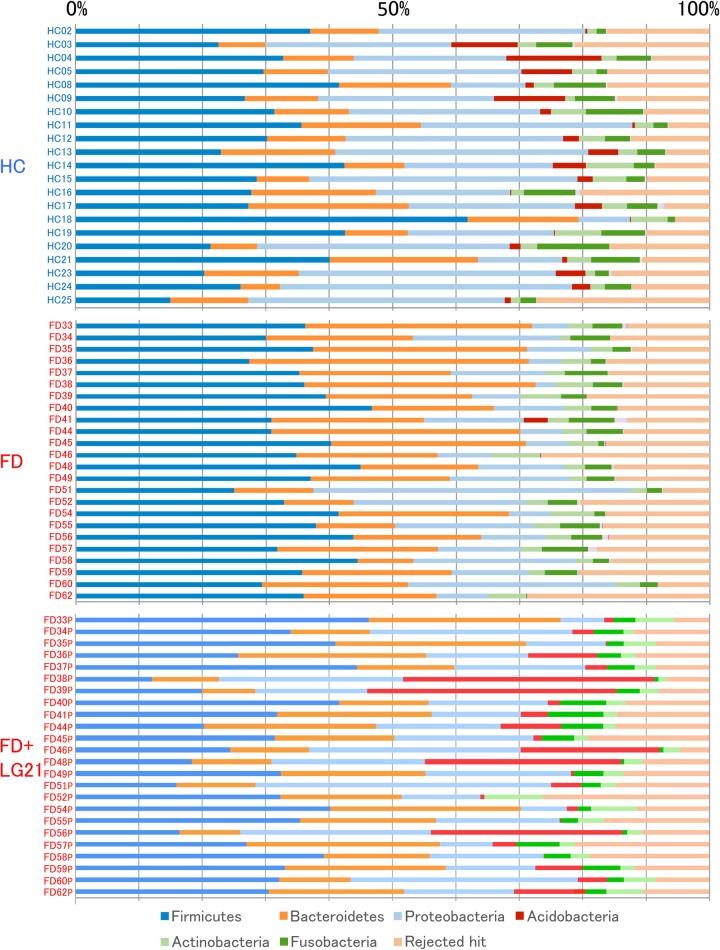
The ratio of GF samples in which the bile acids were detectable was significantly greater in the FD than in the HC groups. In the bacterial composition analysis at the phylum level, the GF microbiota had a > abundance and an absence of in the FD group, in contrast, the GF microbiota had a < abundance and the presence of in the HC group. Probiotic therapy in patients with FD shifted the composition of the GF microbiota to that observed in the HC volunteers.
CONCLUSIONS
Alteration in the GF microbiota was found in patients with FD compared with HC volunteers. Reflux of the small intestinal contents, including bile acid and intestinal bacteria, to the stomach was suggested to induce a bacterial composition change and be involved in the pathophysiology underlying FD. Probiotics appear effective in the treatment of FD through the normalisation of gastric microbiota.
TRIAL REGISTRATION NUMBER
UMINCTR 000022026; Results.
目的
本研究旨在比较分析功能性消化不良(FD)患者与健康对照者(HC)的胃液(GF)微生物群,并评估益生菌对微生物群的影响。
设计
招募了24名符合罗马III标准的日本FD患者以及21名年龄和性别匹配的HC志愿者。FD患者接受了益生菌菌株LG21的治疗。禁食过夜后,使用鼻胃管采集GF样本。通过酶联免疫吸附测定法测定胆汁酸浓度。使用来自GF的细菌DNA扩增16S rRNA基因的V3-V4区域,然后将每个样本约30000个高质量扩增子分组为操作分类单元进行分析。
结果
FD组中可检测到胆汁酸的GF样本比例显著高于HC组。在门水平的细菌组成分析中,FD组的GF微生物群具有>丰度且缺乏,相比之下,HC组的GF微生物群具有<丰度且存在。FD患者的益生菌治疗使GF微生物群的组成转变为HC志愿者中观察到的组成。
结论
与HC志愿者相比,FD患者的GF微生物群发生了改变。包括胆汁酸和肠道细菌在内的小肠内容物反流至胃被认为会导致细菌组成变化,并参与FD的病理生理学过程。益生菌似乎通过使胃微生物群正常化而有效治疗FD。
试验注册号
UMINCTR 000022026;结果。


 Zotero 插件