Rodriguez-Vida Alejo, Hutson Thomas E, Bellmunt Joaquim, Strijbos Michiel H
Medical Oncology Department, Institut Hospital del Mar d'Investigacions Mèdiques, Barcelona, Spain.
Medical Oncology Department, Charles A Sammons Cancer Center, Dallas, Texas, USA.
ESMO Open. 2017 May 9;2(2):e000185. doi: 10.1136/esmoopen-2017-000185. eCollection 2017.
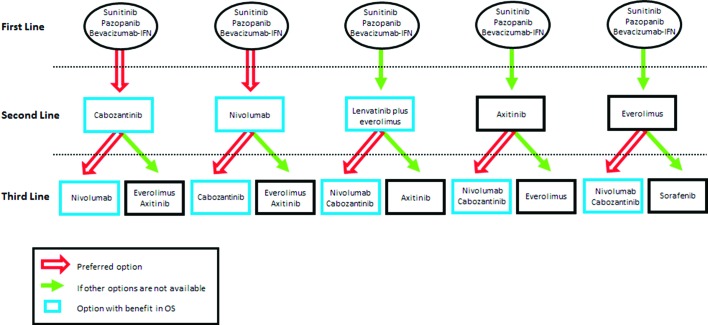
During the last decade, the treatment of advanced or metastatic renal cell carcinoma (RCC) was revolutionised with the advent of antiangiogenic drugs and tyrosine-kinase inhibitors. Several agents targeting the vascular endothelial growth factor (VEGF) pathway (sunitinib, bevacizumab, pazopanib, axitinib) or the mammalian target of rapamycin pathway (temsirolimus, everolimus) were since then progressively approved for first-line or later-line use in the treatment of patients with advanced RCC and became the new standard of care. As a result, the survival of patients with advanced RCC has significantly improved from a median overall survival of approximately 12 months in the cytokines era to more than 26 months with first-line VEGF inhibitors. During the two last years, the treatment of advanced RCC has witnessed a second revolution with the advent of immune checkpoint inhibitors, especially agents targeting the programmed cell death-1 receptor, as well as with the advent of new generation tyrosine-kinase receptor inhibitors. This article will review the new therapeutic options available for the treatment of advanced RCC, as well as the future potential molecular targets that are currently being investigated.
在过去十年中,抗血管生成药物和酪氨酸激酶抑制剂的出现彻底改变了晚期或转移性肾细胞癌(RCC)的治疗方式。从那时起,几种靶向血管内皮生长因子(VEGF)通路的药物(舒尼替尼、贝伐单抗、帕唑帕尼、阿昔替尼)或雷帕霉素哺乳动物靶点通路的药物(替西罗莫司、依维莫司)逐渐被批准用于晚期RCC患者的一线或二线治疗,并成为新的治疗标准。因此,晚期RCC患者的生存率已从细胞因子时代的中位总生存期约12个月显著提高到一线使用VEGF抑制剂时的超过26个月。在过去两年中,随着免疫检查点抑制剂的出现,尤其是靶向程序性细胞死亡-1受体的药物,以及新一代酪氨酸激酶受体抑制剂的出现,晚期RCC的治疗迎来了第二次变革。本文将综述晚期RCC治疗可用的新治疗选择,以及目前正在研究的未来潜在分子靶点。