
HIV-1感染成年患者的步态和平衡客观损伤:观察性研究的系统评价和荟萃分析
Objective impairments of gait and balance in adults living with HIV-1 infection: a systematic review and meta-analysis of observational studies.
作者信息
Berner Karina, Morris Linzette, Baumeister Jochen, Louw Quinette
机构信息
Division of Physiotherapy/Central Analytical Facilities (CAF) 3D Human Biomechanics Unit, Department of Rehabilitation & Health Sciences, Faculty of Medicine and Health Sciences, Stellenbosch University, PO Box 241, Cape Town, 8000, South Africa.
Exercise & Neuroscience Unit, Institute of Health, Nutrition and Sports Sciences, Europa-Universität Flensburg, Auf dem Campus 1, 24943, Flensburg, Germany.
出版信息
BMC Musculoskelet Disord. 2017 Aug 1;18(1):325. doi: 10.1186/s12891-017-1682-2.
BACKGROUND
Gait and balance deficits are reported in adults with HIV infection and are associated with reduced quality of life. Current research suggests an increased fall-incidence in this population, with fall rates among middle-aged adults with HIV approximating that in seronegative elderly populations. Gait and postural balance rely on a complex interaction of the motor system, sensory control, and cognitive function. However, due to disease progression and complications related to ongoing inflammation, these systems may be compromised in people with HIV. Consequently, locomotor impairments may result that can contribute to higher-than-expected fall rates. The aim of this review was to synthesize the evidence regarding objective gait and balance impairments in adults with HIV, and to emphasize those which could contribute to increased fall risk.
METHODS
This review followed the Preferred Reporting Items for Systematic Reviews and Meta-Analyses (PRISMA) guidelines. An electronic search of published observational studies was conducted in March 2016. Methodological quality was assessed using the NIH Quality Assessment Tool for Observational Cohort and Cross-Sectional Studies. Narrative synthesis of gait and balance outcomes was performed, and meta-analyses where possible.
RESULTS
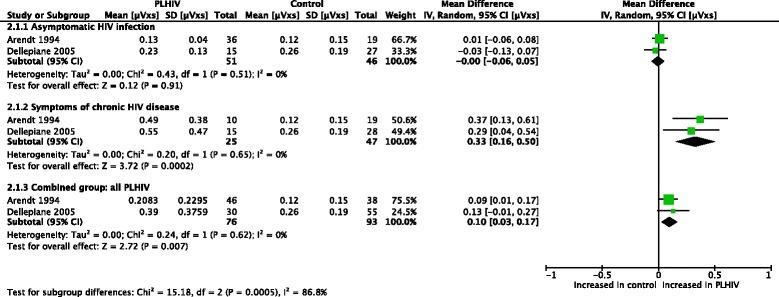
Seventeen studies were included, with fair to low methodological quality. All studies used clinical tests for gait-assessment. Gait outcomes assessed were speed, initiation-time and cadence. No studies assessed kinetics or kinematics. Balance was assessed using both instrumented and clinical tests. Outcomes were mainly related to center of pressure, postural reflex latencies, and timed clinical tests. There is some agreement that adults with HIV walk slower and have increased center of pressure excursions and -long loop postural reflex latencies, particularly under challenging conditions.
CONCLUSIONS
Gait and balance impairments exist in people with HIV, resembling fall-associated parameters in the elderly. Impairments are more pronounced during challenging conditions, might be associated with disease severity, are not influenced by antiretroviral therapy, and might not be associated with peripheral neuropathy. Results should be interpreted cautiously due to overall poor methodological quality and heterogeneity. Locomotor impairments in adults with HIV are currently insufficiently quantified. Future research involving more methodological uniformity is warranted to better understand such impairments and to inform clinical decision-making, including fall-prevention strategies, in this population.
背景
据报道,感染HIV的成年人存在步态和平衡缺陷,且与生活质量下降相关。当前研究表明,该人群跌倒发生率增加,中年HIV感染者的跌倒率接近血清学阴性老年人群。步态和姿势平衡依赖于运动系统、感觉控制和认知功能的复杂相互作用。然而,由于疾病进展以及与持续炎症相关的并发症,这些系统在HIV感染者中可能会受到损害。因此,可能会导致运动障碍,进而导致跌倒率高于预期。本综述的目的是综合关于HIV感染成年人客观步态和平衡障碍的证据,并强调那些可能导致跌倒风险增加的因素。
方法
本综述遵循系统评价和Meta分析的首选报告项目(PRISMA)指南。2016年3月对已发表的观察性研究进行了电子检索。使用美国国立卫生研究院观察性队列和横断面研究质量评估工具评估方法学质量。对步态和平衡结果进行了叙述性综合,并在可能的情况下进行了Meta分析。
结果
纳入了17项研究,方法学质量为中等偏下。所有研究均使用临床测试进行步态评估。评估的步态结果包括速度、起始时间和步频。没有研究评估动力学或运动学。使用仪器测试和临床测试评估平衡。结果主要与压力中心、姿势反射潜伏期和定时临床测试有关。人们普遍认为,HIV感染者行走速度较慢,压力中心偏移增加,长环姿势反射潜伏期延长,尤其是在具有挑战性的条件下。
结论
HIV感染者存在步态和平衡障碍,类似于老年人与跌倒相关的参数。在具有挑战性的条件下,障碍更为明显,可能与疾病严重程度有关,不受抗逆转录病毒治疗的影响,可能与周围神经病变无关。由于总体方法学质量较差和异质性,结果应谨慎解释。目前对HIV感染成年人的运动障碍量化不足。有必要开展方法学更统一的未来研究,以更好地了解此类障碍,并为该人群的临床决策(包括跌倒预防策略)提供信息。




 Zotero 插件