Nwizu Ngozi N, Marshall James R, Moysich Kirsten, Genco Robert J, Hovey Kathleen M, Mai Xiaodan, LaMonte Michael J, Freudenheim Jo L, Wactawski-Wende Jean
Department of Diagnostic and Biomedical Sciences, School of Dentistry, The University of Texas Health Science Center at Houston, Houston, Texas.
Department of Cancer Prevention and Control, Roswell Park Cancer Institute, Buffalo, New York.
Cancer Epidemiol Biomarkers Prev. 2017 Aug;26(8):1255-1265. doi: 10.1158/1055-9965.EPI-17-0212.
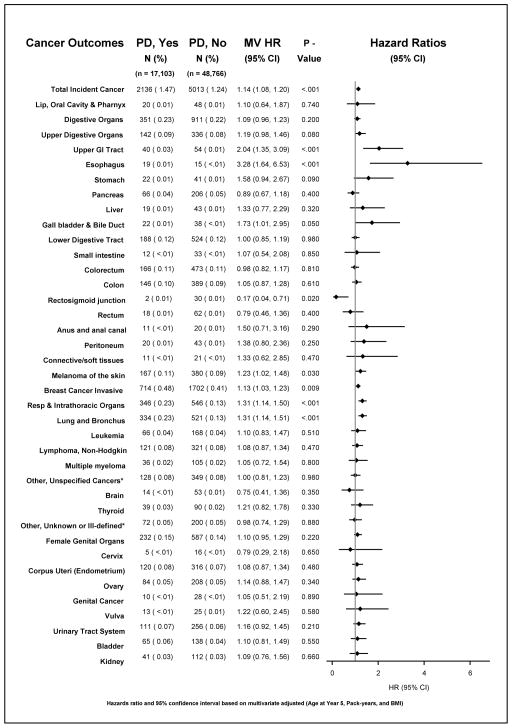
Periodontal pathogens have been isolated from precancerous and cancerous lesions and also shown to promote a procarcinogenic microenvironment. Few studies have examined periodontal disease as a risk factor for total cancer, and none have focused on older women. We examined whether periodontal disease is associated with incident cancer among postmenopausal women in the Women's Health Initiative Observational Study. Our prospective cohort study comprised 65,869 women, ages 54 to 86 years. Periodontal disease information was obtained via self-report questionnaires administered between 1999 and 2003, whereas ascertainment of cancer outcomes occurred through September 2013, with a maximum follow-up period of 15 years. Physician-adjudicated incident total cancers were the main outcomes and site-specific cancers were secondary outcomes. HRs and 95% confidence intervals (CI) were calculated using Cox proportional hazards regression. All analyses were conducted two-sided. During a mean follow-up of 8.32 years, 7,149 cancers were identified. Periodontal disease history was associated with increased total cancer risk (multivariable-adjusted HR, 1.14; 95% CI, 1.08-1.20); findings were similar in analyses limited to 34,097 never-smokers (HR, 1.12; 95% CI, 1.04-1.22). Associations were observed for breast (HR, 1.13; 95% CI, 1.03-1.23), lung (HR, 1.31; 95% CI, 1.14-1.51), esophagus (HR, 3.28; 95% CI, 1.64-6.53), gallbladder (HR, 1.73; 95% CI, 1.01-2.95), and melanoma skin (HR, 1.23; 95% CI, 1.02-1.48) cancers. Stomach cancer was borderline (HR, 1.58; 95% CI, 0.94-2.67). Periodontal disease increases risk of total cancer among older women, irrespective of smoking, and certain anatomic sites appear to be vulnerable. Our findings support the need for further understanding of the effect of periodontal disease on cancer outcomes. .
牙周病原体已从癌前病变和癌性病变中分离出来,并且还显示出可促进致癌前微环境。很少有研究将牙周病作为总体癌症的危险因素进行考察,而且没有一项研究聚焦于老年女性。在女性健康倡议观察性研究中,我们考察了牙周病是否与绝经后女性患癌风险相关。我们的前瞻性队列研究纳入了65869名年龄在54至86岁之间的女性。牙周病信息通过1999年至2003年期间发放的自我报告问卷获取,而癌症结局的确定则持续到2013年9月,最长随访期为15年。医生判定的新发总体癌症为主要结局,特定部位癌症为次要结局。使用Cox比例风险回归计算风险比(HR)和95%置信区间(CI)。所有分析均为双侧检验。在平均8.32年的随访期间,共确诊7149例癌症。牙周病病史与总体癌症风险增加相关(多变量调整后的HR为1.14;95%CI为1.08 - 1.20);在仅限于34097名从不吸烟者的分析中结果相似(HR为1.12;95%CI为1.04 - 1.22)。在乳腺癌(HR为1.13;95%CI为1.03 - 1.23)、肺癌(HR为1.31;95%CI为1.14 - 1.51)、食管癌(HR为3.28;95%CI为1.64 - 6.53)、胆囊癌(HR为1.73;95%CI为1.01 - 2.95)和皮肤黑色素瘤(HR为1.23;95%CI为1.02 - 1.48)中观察到了相关性。胃癌处于临界状态(HR为1.58;95%CI为0.94 - 2.67)。牙周病会增加老年女性患总体癌症的风险,无论其是否吸烟,并且某些解剖部位似乎易受影响。我们的研究结果支持进一步了解牙周病对癌症结局影响的必要性。