Yu Meng, Tang Suqin, Wang Chenyi, Xiang Zhendong, Yu Wei, Xu Wei, Wang Jianping, Prigerson Holly G
Beijing Key Laboratory of Applied Experimental Psychology, National Demonstration Center for Experimental Psychology Education, Faculty of Psychology, Beijing Normal UniversityBeijing, China.
Department of Social Work and Social Administration, The University of Hong KongHong Kong, China.
Front Psychol. 2017 Jul 17;8:1201. doi: 10.3389/fpsyg.2017.01201. eCollection 2017.
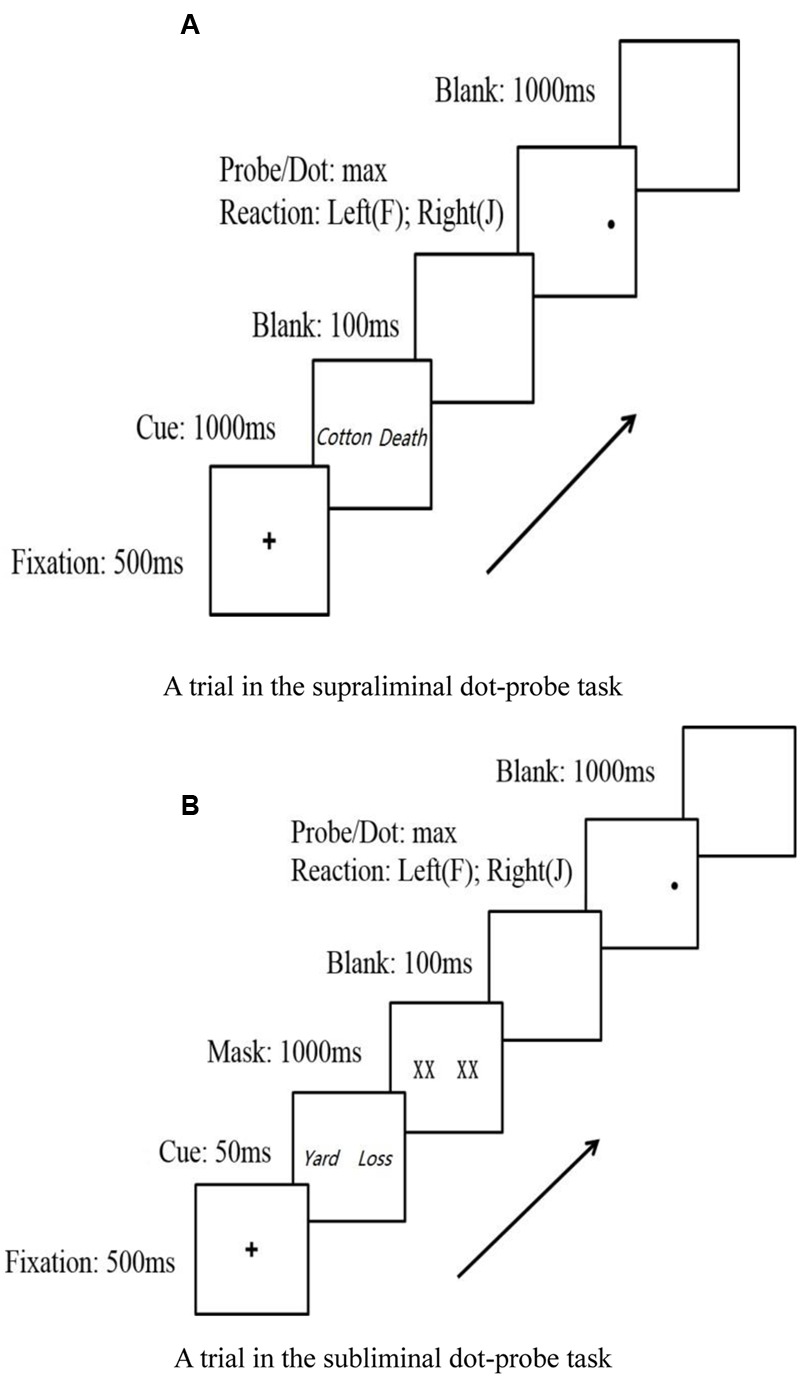
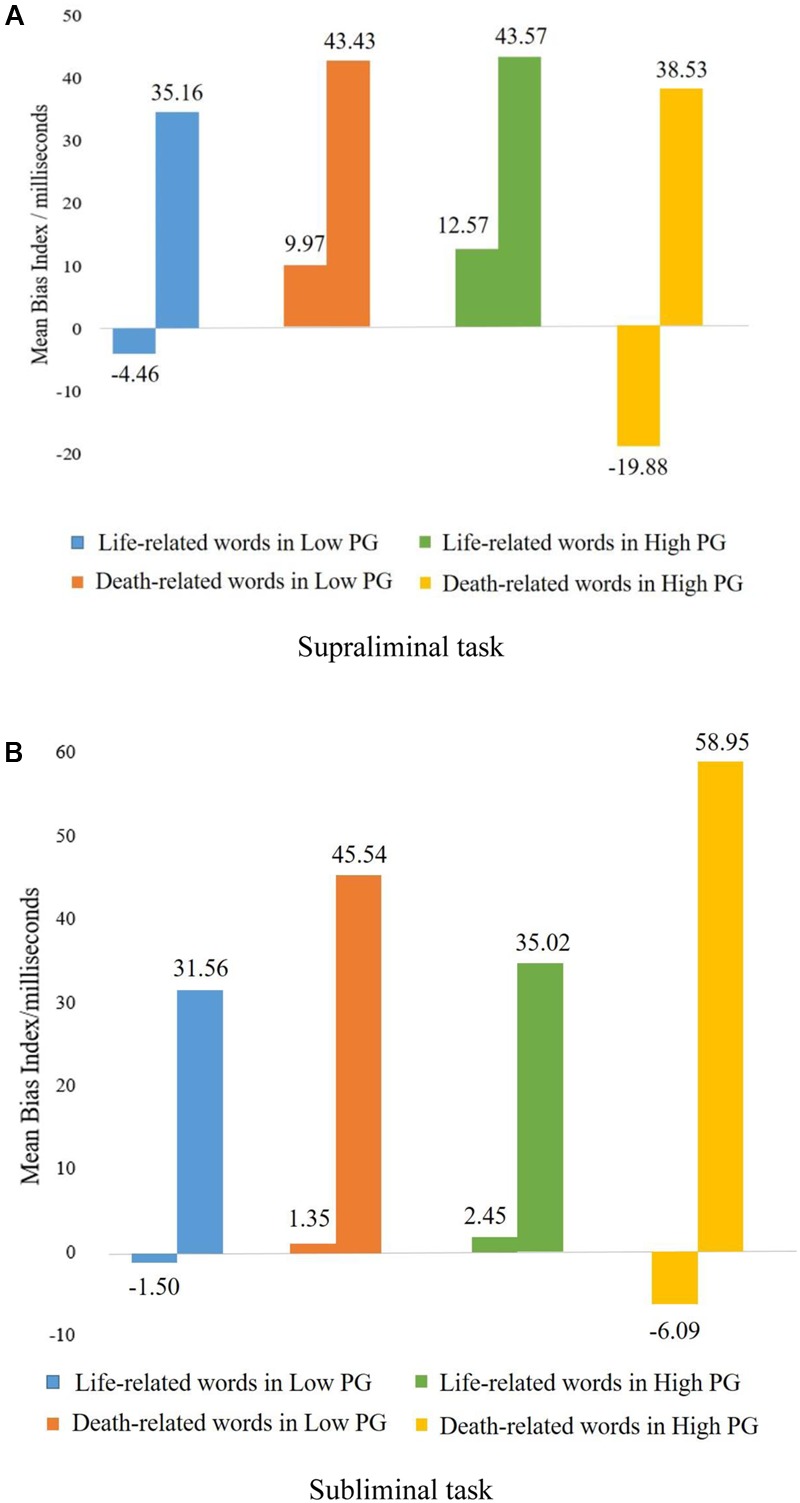
Attentional bias refers to a preference for (e.g., vigilance) or a shifting away (e.g., avoidance) of one's focus with respect to specific stimuli. Accumulating evidence suggests that an attentional bias toward death/threat-related stimuli exists in bereaved individuals experiencing prolonged grief (PG). Measuring for different processing may reflect different cognitive characteristics. Therefore, this study sought to compare information-processing biases in Chinese individuals with high versus low levels of PG symptomatology at supraliminal and subliminal levels, respectively. A 2 (grief level) × 2 (consciousness level) × 2 (word type) three-factor mixed design with supraliminal and subliminal tasks was utilized in the current study. Based on their Prolonged Grief Questionnaire-13 (PG-13) scores, 38 participants were included in the low-PG group, and 34 individuals were included in the high-PG group. All the participants completed a dot-probe task in which they were primed with death-related and life-related words paired with neutral stimuli. High-PG individuals were slower in reacting to the death-related information in both supraliminal and subliminal tasks. After controlling for other symptoms in the backward deletion regression, PG-13 scores significantly predicted the avoidance tendency to death-related words in the supraliminal task, while anxiety was the best predictor of turning one's vision away from death-related stimuli in the subliminal trials. The results suggested that high PG is associated with a tendency to avoid death-related words. Future research is needed to explore interventions that address the avoidance of death-related stimuli among individuals with elevated, or diagnosable, levels of PG.
注意偏向是指个体对特定刺激的注意力偏好(如警觉)或注意力转移(如回避)。越来越多的证据表明,在经历持续性悲伤(PG)的丧亲个体中,存在对死亡/威胁相关刺激的注意偏向。对不同加工过程的测量可能反映不同的认知特征。因此,本研究旨在分别比较PG症状水平高和低的中国个体在阈上和阈下水平的信息加工偏向。本研究采用了一个包含阈上和阈下任务的2(悲伤水平)×2(意识水平)×2(词语类型)三因素混合设计。根据他们的持续性悲伤问卷-13(PG-13)得分,38名参与者被纳入低PG组,34名个体被纳入高PG组。所有参与者都完成了一项点探测任务,在该任务中,他们被与中性刺激配对的死亡相关和生活相关词语所启动。高PG个体在阈上和阈下任务中对死亡相关信息的反应都较慢。在通过向后删除回归控制了其他症状后,PG-13得分在阈上任务中显著预测了对死亡相关词语的回避倾向,而在阈下试验中,焦虑是将视线从死亡相关刺激上移开的最佳预测因素。结果表明,高PG与回避死亡相关词语的倾向有关。未来需要开展研究,探索针对PG水平升高或可诊断的个体中对死亡相关刺激的回避行为的干预措施。