Wen Xi, Yang Sizhong, Horn Fabian, Winkel Matthias, Wagner Dirk, Liebner Susanne
Section 5.3 Geomicrobiology, GFZ German Research Centre for GeosciencesPotsdam, Germany.
College of Electrical Engineering, Northwest University for NationalitiesLanzhou, China.
Front Microbiol. 2017 Jul 18;8:1339. doi: 10.3389/fmicb.2017.01339. eCollection 2017.
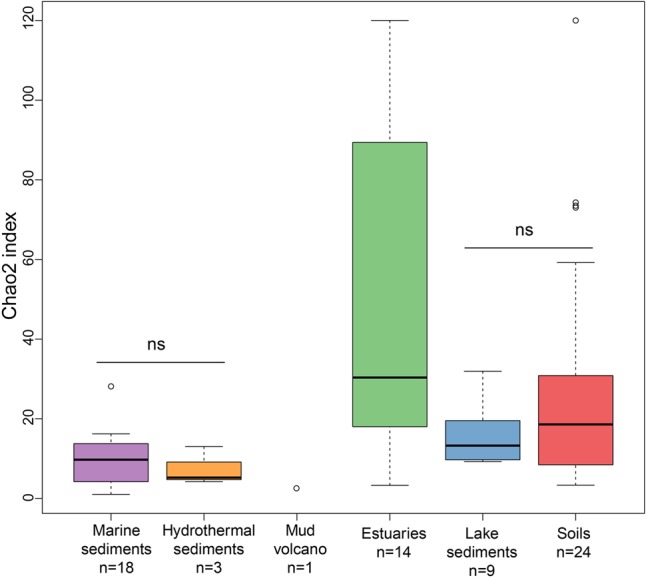
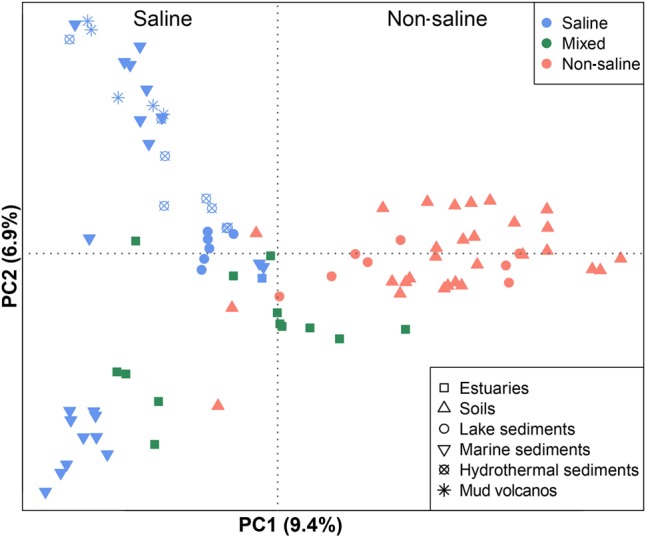
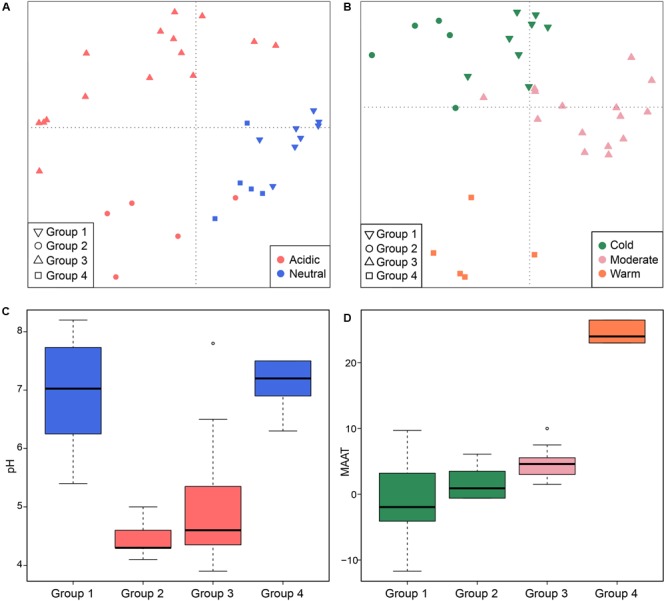
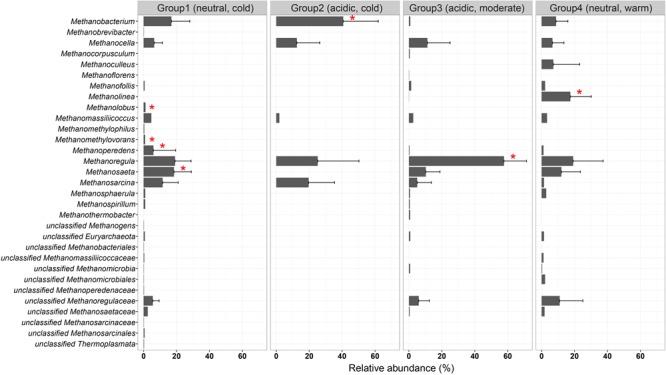
Methanogenic archaea are important for the global greenhouse gas budget since they produce methane under anoxic conditions in numerous natural environments such as oceans, estuaries, soils, and lakes. Whether and how environmental change will propagate into methanogenic assemblages of natural environments remains largely unknown owing to a poor understanding of global distribution patterns and environmental drivers of this specific group of microorganisms. In this study, we performed a meta-analysis targeting the biogeographic patterns and environmental controls of methanogenic communities using 94 public gene datasets. We show a global pattern of methanogenic archaea that is more associated with habitat filtering than with geographical dispersal. We identify salinity as the control on methanogenic community composition at global scale whereas pH and temperature are the major controls in non-saline soils and lakes. The importance of salinity for structuring methanogenic community composition is also reflected in the biogeography of methanogenic lineages and the physiological properties of methanogenic isolates. Linking methanogenic alpha-diversity with reported values of methane emission identifies estuaries as the most diverse methanogenic habitats with, however, minor contribution to the global methane budget. With salinity, temperature and pH our study identifies environmental drivers of methanogenic community composition facing drastic changes in many natural environments at the moment. However, consequences of this for the production of methane remain elusive owing to a lack of studies that combine methane production rate with community analysis.
产甲烷古菌对全球温室气体收支具有重要意义,因为它们在海洋、河口、土壤和湖泊等众多自然环境的缺氧条件下产生甲烷。由于对这一特定微生物群体的全球分布模式和环境驱动因素了解不足,环境变化是否以及如何传播到自然环境的产甲烷群落中,在很大程度上仍然未知。在本研究中,我们使用94个公开的基因数据集,针对产甲烷群落的生物地理模式和环境控制进行了一项荟萃分析。我们展示了产甲烷古菌的全球模式,该模式与栖息地筛选的关联比与地理扩散的关联更大。我们确定盐度是全球尺度上产甲烷群落组成的控制因素,而pH值和温度是非盐渍土壤和湖泊中的主要控制因素。盐度对构建产甲烷群落组成的重要性也反映在产甲烷谱系的生物地理学和产甲烷分离株的生理特性中。将产甲烷α多样性与报告的甲烷排放值联系起来,确定河口是产甲烷最多样化的栖息地,然而,其对全球甲烷收支的贡献较小。通过盐度、温度和pH值,我们的研究确定了目前许多自然环境中产甲烷群落组成面临剧烈变化的环境驱动因素。然而,由于缺乏将甲烷产生速率与群落分析相结合的研究,这对甲烷产生的影响仍然难以捉摸。