Noh Suegene, Everman Elizabeth R, Berger Christopher M, Morgan Theodore J
Department of Biology Washington University in St. Louis St. Louis MO USA.
Division of Biology Kansas State University Manhattan KS USA.
Ecol Evol. 2017 Jun 7;7(14):5248-5257. doi: 10.1002/ece3.3112. eCollection 2017 Jul.
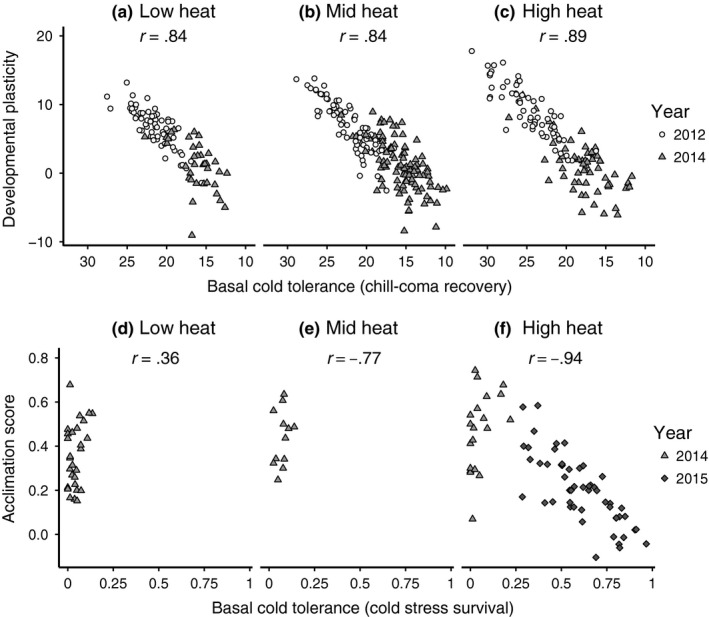
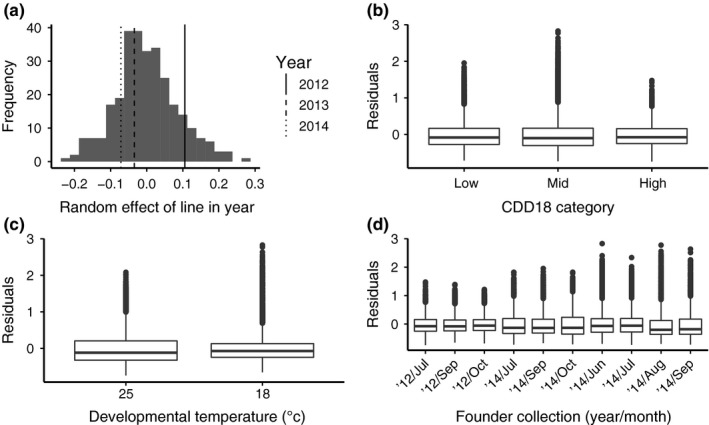
Understanding how thermal selection affects phenotypic distributions across different time scales will allow us to predict the effect of climate change on the fitness of ectotherms. We tested how seasonal temperature variation affects basal levels of cold tolerance and two types of phenotypic plasticity in . Developmental acclimation occurs as developmental stages of an organism are exposed to seasonal changes in temperature and its effect is irreversible, while reversible short-term acclimation occurs daily in response to diurnal changes in temperature. We collected wild flies from a temperate population across seasons and measured two cold tolerance metrics (chill-coma recovery and cold stress survival) and their responses to developmental and short-term acclimation. Chill-coma recovery responded to seasonal shifts in temperature, and phenotypic plasticity following both short-term and developmental acclimation improved cold tolerance. This improvement indicated that both types of plasticity are adaptive, and that plasticity can compensate for genetic variation in basal cold tolerance during warmer parts of the season when flies tend to be less cold tolerant. We also observed a significantly stronger trade-off between basal cold tolerance and short-term acclimation during warmer months. For the longer-term developmental acclimation, a trade-off persisted regardless of season. A relationship between the two types of plasticity may provide additional insight into why some measures of thermal tolerance are more sensitive to seasonal variation than others.
了解热选择如何在不同时间尺度上影响表型分布,将使我们能够预测气候变化对外温动物适应性的影响。我们测试了季节性温度变化如何影响耐寒性的基础水平以及两种表型可塑性。发育适应是指生物体的发育阶段暴露于温度的季节性变化中,其影响是不可逆的,而可逆的短期适应则每天随着温度的昼夜变化而发生。我们在不同季节从一个温带种群中收集野生果蝇,并测量了两种耐寒性指标(冷昏迷恢复和冷应激存活)以及它们对发育适应和短期适应的反应。冷昏迷恢复对温度的季节性变化有反应,短期和发育适应后的表型可塑性都提高了耐寒性。这种提高表明这两种可塑性都是适应性的,并且在果蝇耐寒性往往较低的季节较温暖的时期,可塑性可以补偿基础耐寒性的遗传变异。我们还观察到,在较温暖的月份,基础耐寒性和短期适应之间的权衡明显更强。对于长期的发育适应,无论季节如何,权衡都持续存在。两种可塑性之间的关系可能会为为什么某些耐热性指标比其他指标对季节性变化更敏感提供更多见解。