Park Jung-Hyun, Nam Woong, Kim Hyung Jun, Cha In-Ho
Department of Oral and Maxillofacial Surgery, Yonsei University College of Dentistry, Seoul, Korea.
Oral Cancer Research Institute, Yonsei University College of Dentistry, Seoul, Korea.
J Korean Assoc Oral Maxillofac Surg. 2017 Jun;43(3):166-170. doi: 10.5125/jkaoms.2017.43.3.166. Epub 2017 Jun 28.
To define the risk of occult cervical metastasis of maxillary squamous cell carcinoma (SCC) and the therapeutic value of elective neck dissection (END) in survival of clinically negative neck node (cN0) patients.
Sixty-seven patients with maxillary SCC and cN0 neck were analyzed retrospectively, including 35 patients with maxillary gingiva and 32 patients with maxillary sinus.
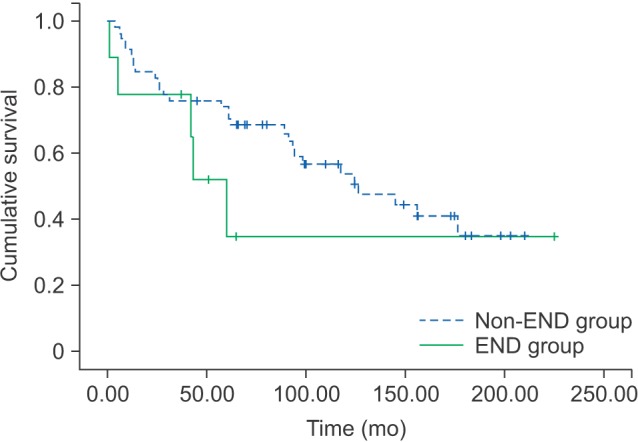
Of 67 patients, 10 patients (14.9%) had occult cervical metastasis. The incidence of occult cervical metastasis of maxillary gingival SCC was higher than that of maxillary sinus SCC (17.1% and 12.5%, respectively). The 5-year overall survival rate was 51.9% for the END group and 74.0% for the non-END group. The success rate of treatment for regional recurrence was high at 71.4%, whereas that for local or locoregional recurrence was low (33.3% and 0%, respectively).
The incidence of occult cervical metastasis of maxillary SCC was not high enough to recommend END. For survival of cN0 patients, local control of the primary tumor is more important than modality of neck management. Observation of cN0 neck is recommended when early detection of regional recurrence is possible irrespective of the site or T stage. The key enabler of early detection is patient education with periodic follow-up.
明确上颌鳞状细胞癌(SCC)隐匿性颈淋巴结转移的风险,以及选择性颈清扫术(END)对临床颈部淋巴结阴性(cN0)患者生存的治疗价值。
回顾性分析67例上颌SCC且颈部cN0的患者,其中35例为上颌牙龈癌患者,32例为上颌窦癌患者。
67例患者中,10例(14.9%)有隐匿性颈淋巴结转移。上颌牙龈SCC隐匿性颈淋巴结转移的发生率高于上颌窦SCC(分别为17.1%和12.5%)。END组的5年总生存率为51.9%,非END组为74.0%。区域复发的治疗成功率较高,为71.4%,而局部或局部区域复发的治疗成功率较低(分别为33.3%和0%)。
上颌SCC隐匿性颈淋巴结转移的发生率不足以推荐END。对于cN0患者的生存,原发肿瘤的局部控制比颈部处理方式更重要。当无论部位或T分期都有可能早期发现区域复发时,建议对cN0颈部进行观察。早期发现的关键因素是对患者进行教育并定期随访。