Lümkemann Nina, Eichberger Marlis, Stawarczyk Bogna
Department of Prosthodontics, Dental School, Ludwig-Maximilians-University Munich, Goethestrasse 70, 80336 Munich, Germany.
Materials (Basel). 2017 Jan 14;10(1):67. doi: 10.3390/ma10010067.
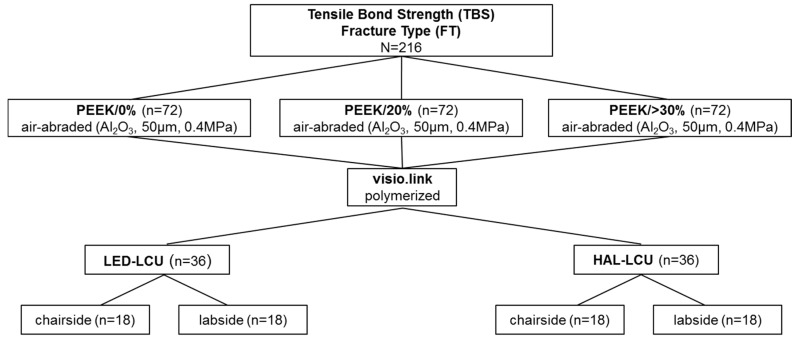
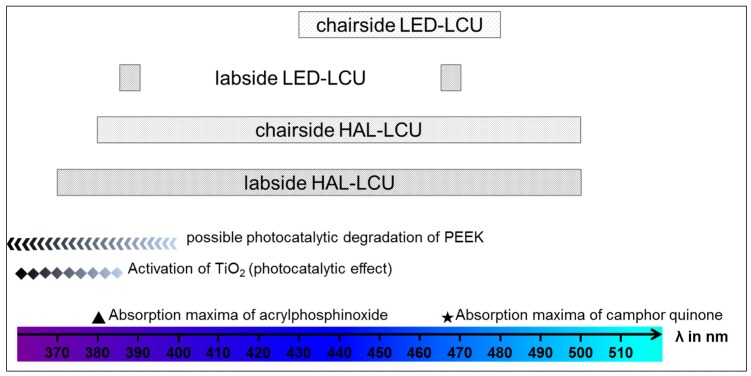
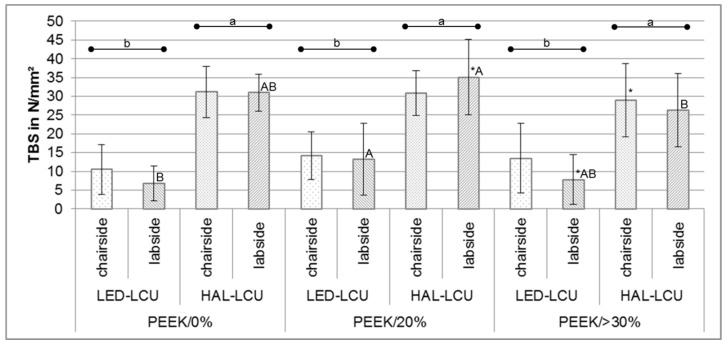
This study investigated the impact of different light curing units (LCUs) for the polymerization of adhesive system visio.link (VL) on the tensile bond strength (TBS) of different PEEK compositions. For TBS measurements, 216 PEEK specimens with varying amounts of TiO₂ (PEEK/0%, PEEK/20%, PEEK/>30%) were embedded, polished, air abraded (Al₂O₃, 50 µm, 0.4 MPa), conditioned using VL, and polymerized using either a halogen LCU (HAL-LCU) or a LED LCU (LED-LCU) for chairside or labside application, respectively. After thermocycling (5000×, 5/55 °C), TBS was measured, and fracture types were determined. Data was analyzed using a 2-way ANOVA followed by Tukey-HSD, Kruskal-Wallis H and Mann-Whitney U tests as well as a Chi²-test and a Ciba-Geigy table ( < 0.05). Globally, the light curing units, followed by PEEK composition, was shown to have the highest impact on TBS. The HAL-LCUs, compared to the LED-LCUs, resulted in a higher TBS for all PEEK compositions-without significant differences between chairside and labside units. Regarding the different PEEK compositions, PEEK/20%, compared to PEEK/0%, resulted in a higher TBS when both, HAL-LCUs or LED-LCUs were used for labside application. In comparison with PEEK/>30%, PEEK/20% resulted in a higher TBS after using HAL-LCU for labside application. No significant differences were found between PEEK/0% and PEEK/>30%. HAL-LCU with PEEK/20% for labside application showed a higher TBS than HAL-LCU with PEEK/20% for chairside application, whereas LED-LCU with PEEK/>30% for chairside application showed a higher TBS than LED-LCU with PEEK/>30% for labside application.
本研究调查了不同光固化单元(LCU)用于聚合粘结系统visio.link(VL)时,对不同聚醚醚酮(PEEK)组合物拉伸粘结强度(TBS)的影响。为了测量TBS,将216个含有不同量二氧化钛(PEEK/0%、PEEK/20%、PEEK/>30%)的PEEK试样进行包埋、抛光、空气喷砂处理(Al₂O₃,50 µm,0.4 MPa),使用VL进行预处理,并分别使用卤素LCU(HAL-LCU)或LED LCU(LED-LCU)进行椅旁或实验室应用的聚合。经过热循环(5000次,5/55°C)后,测量TBS并确定断裂类型。使用双向方差分析,随后进行Tukey-HSD检验、Kruskal-Wallis H检验和Mann-Whitney U检验以及卡方检验和Ciba-Geigy表(<0.05)对数据进行分析。总体而言,光固化单元对TBS的影响最大,其次是PEEK组合物。与LED-LCU相比,HAL-LCU使所有PEEK组合物的TBS更高,椅旁和实验室应用单元之间无显著差异。对于不同的PEEK组合物,当在实验室应用中使用HAL-LCU或LED-LCU时,与PEEK/0%相比,PEEK/20%的TBS更高。与PEEK/>30%相比,在实验室应用中使用HAL-LCU后,PEEK/20%的TBS更高。PEEK/0%和PEEK/>30%之间未发现显著差异。实验室应用中使用PEEK/20%的HAL-LCU比椅旁应用中使用PEEK/20%的HAL-LCU显示出更高的TBS,而椅旁应用中使用PEEK/>30%的LED-LCU比实验室应用中使用PEEK/>30%的LED-LCU显示出更高的TBS。