Jang Jeong Gook, Park Sol Moi, Lee Haeng Ki
Korea Institute of Geoscience and Mineral Resources, 124 Gwahak-ro, Yuseong-gu, Daejeon 34132, Korea.
Department of Civil and Environmental Engineering, Korea Advanced Institute of Science and Technology, 291 Daehak-ro, Yuseong-gu, Daejeon 34141, Korea.
Materials (Basel). 2017 Apr 23;10(4):447. doi: 10.3390/ma10040447.
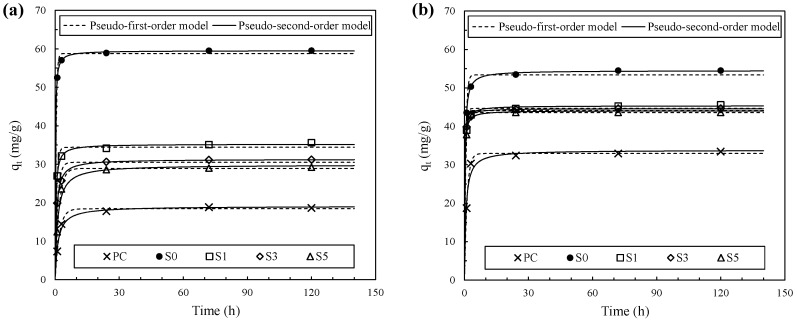
The present study investigates the retention mechanisms of cesium and strontium for alkali-activated cements. Retention mechanisms such as adsorption and precipitation were examined in light of chemical interactions. Batch adsorption experiments and multi-technical characterizations by using X-ray diffraction, zeta potential measurements, and the N₂ gas adsorption/desorption methods were conducted for this purpose. Strontium was found to crystalize in alkali-activated cements, while no cesium-bearing crystalline phases were detected. The adsorption kinetics of alkali-activated cements having relatively high adsorption capacities were compatible with pseudo-second-order kinetic model, thereby suggesting that it is governed by complex multistep adsorption. The results provide new insight, demonstrating that characteristics of aluminosilicate gel with a highly negatively charged surface and high micropore surface area facilitated more effective immobilization of cesium and strontium in comparison with calcium silicate hydrates.
本研究探讨了碱激发水泥对铯和锶的保留机制。根据化学相互作用研究了吸附和沉淀等保留机制。为此进行了批量吸附实验,并采用X射线衍射、zeta电位测量和N₂气体吸附/解吸方法进行了多技术表征。发现锶在碱激发水泥中结晶,而未检测到含铯的晶相。具有较高吸附容量的碱激发水泥的吸附动力学与准二级动力学模型相符,这表明它受复杂的多步吸附控制。研究结果提供了新的见解,表明与硅酸钙水合物相比,具有高负电荷表面和高微孔表面积的硅铝酸盐凝胶特性有助于更有效地固定铯和锶。