
在柔性纳米多孔聚碳酸酯模板中生长的BiSbTe₃纳米线的结构与热电性能
Structure and Thermoelectric Properties of BiSbTe₃ Nanowires Grown in Flexible Nanoporous Polycarbonate Templates.
作者信息
Datta Anuja, Sangle Abhijeet, Hardingham Nick, Cooper Charles, Kraan Max, Ritchie David, Narayan Vijay, Kar-Narayan Sohini
机构信息
Department of Materials Science & Metallurgy, University of Cambridge, Cambridge CB3 0FS, UK.
Cavendish Laboratory, Department of Physics, University of Cambridge, Cambridge CB3 0HE, UK.
出版信息
Materials (Basel). 2017 May 19;10(5):553. doi: 10.3390/ma10050553.
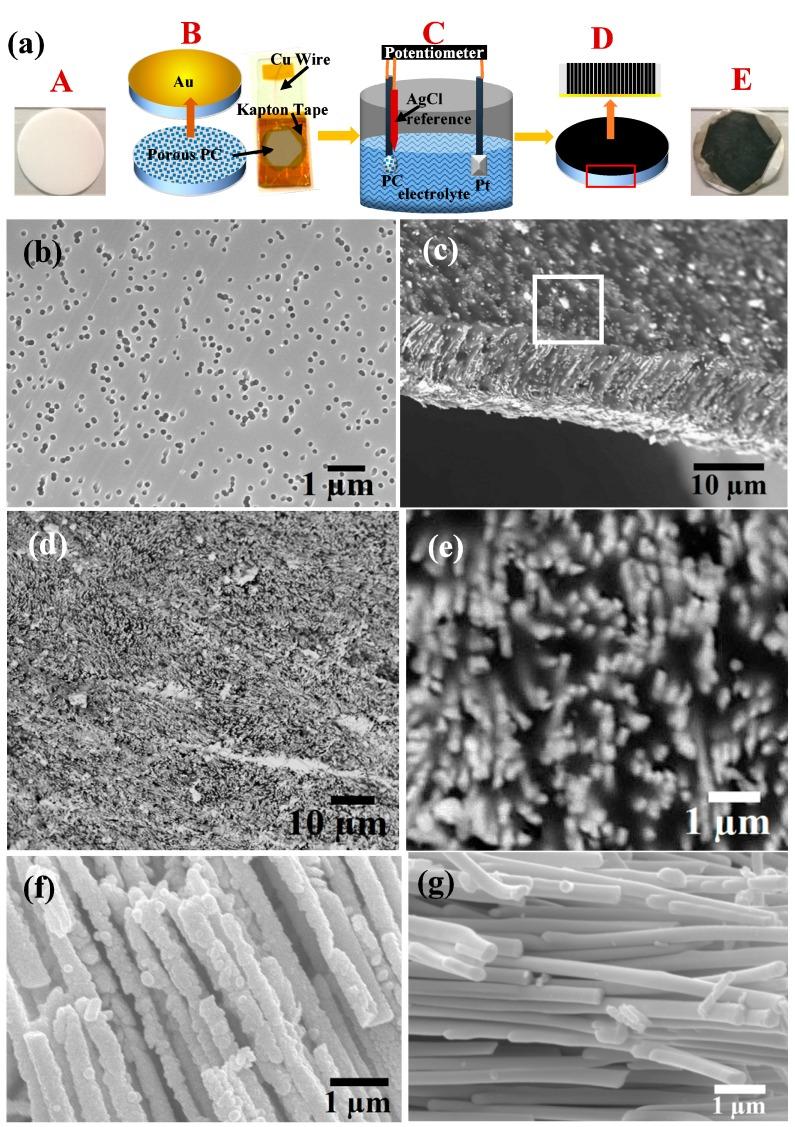
We report the room-temperature growth of vertically aligned ternary BiSbTe₃ nanowires of diameter ~200 nm and length ~12 µm, within flexible track-etched nanoporous polycarbonate (PC) templates via a one-step electrodeposition process. BiSbTe₃ nanowires with compositions spanning the entire range from pure Bi₂Te₃ ( = 0) to pure Sb₂Te₃ ( = 2) were systematically grown within the nanoporous channels of PC templates from a tartaric-nitric acid based electrolyte, at the end of which highly crystalline nanowires of uniform composition were obtained. Compositional analysis showed that the Sb concentration could be tuned by simply varying the electrolyte composition without any need for further annealing of the samples. Thermoelectric properties of the BiSbTe₃ nanowires were measured using a standardized bespoke setup while they were still embedded within the flexible PC templates.
我们报道了通过一步电沉积工艺,在柔性径迹蚀刻纳米多孔聚碳酸酯(PC)模板内室温生长出直径约200 nm、长度约12 µm的垂直排列的三元BiSbTe₃纳米线。从基于酒石酸 - 硝酸的电解质中,在PC模板的纳米多孔通道内系统地生长出了成分涵盖从纯Bi₂Te₃( = 0)到纯Sb₂Te₃( = 2)整个范围的BiSbTe₃纳米线,最终获得了成分均匀的高度结晶的纳米线。成分分析表明,通过简单改变电解质成分就可以调节Sb浓度,而无需对样品进行进一步退火。在BiSbTe₃纳米线仍嵌入柔性PC模板内时,使用标准化定制装置测量了它们的热电性能。



 Zotero 插件