Gentile Piergiorgio, McColgan-Bannon Kegan, Gianone Nicolò Ceretto, Sefat Farshid, Dalgarno Kenneth, Ferreira Ana Marina
School of Mechanical and Systems Engineering, Newcastle University, Newcastle-upon-Tyne NE1 7RU, UK.
Department of Mechanical and Aerospace Engineering, Politecnico di Torino, 10129 Turin, Italy.
Materials (Basel). 2017 Jun 23;10(7):693. doi: 10.3390/ma10070693.
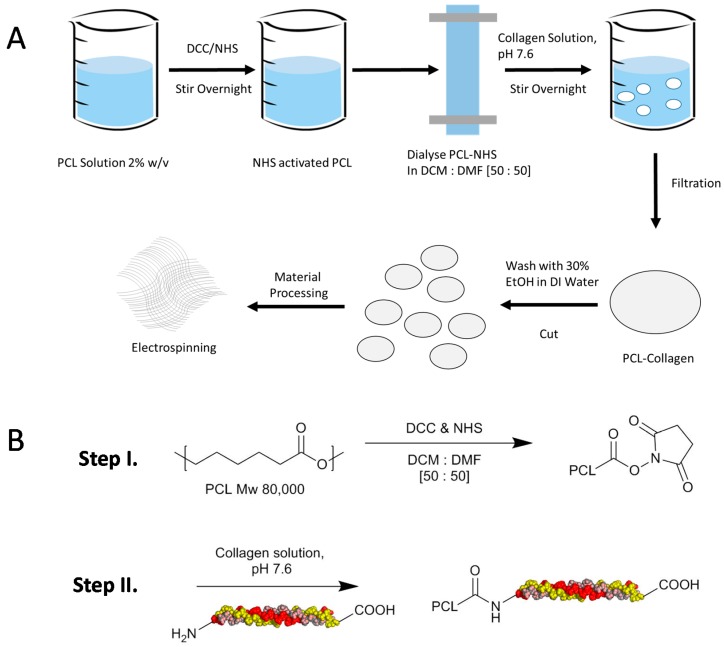
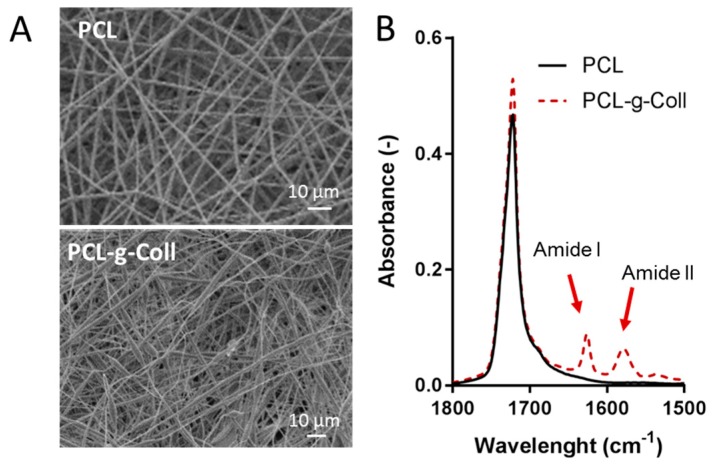
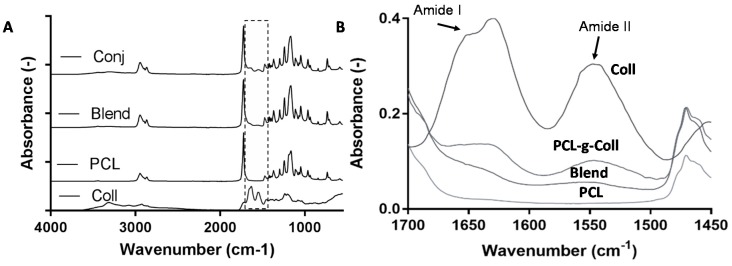
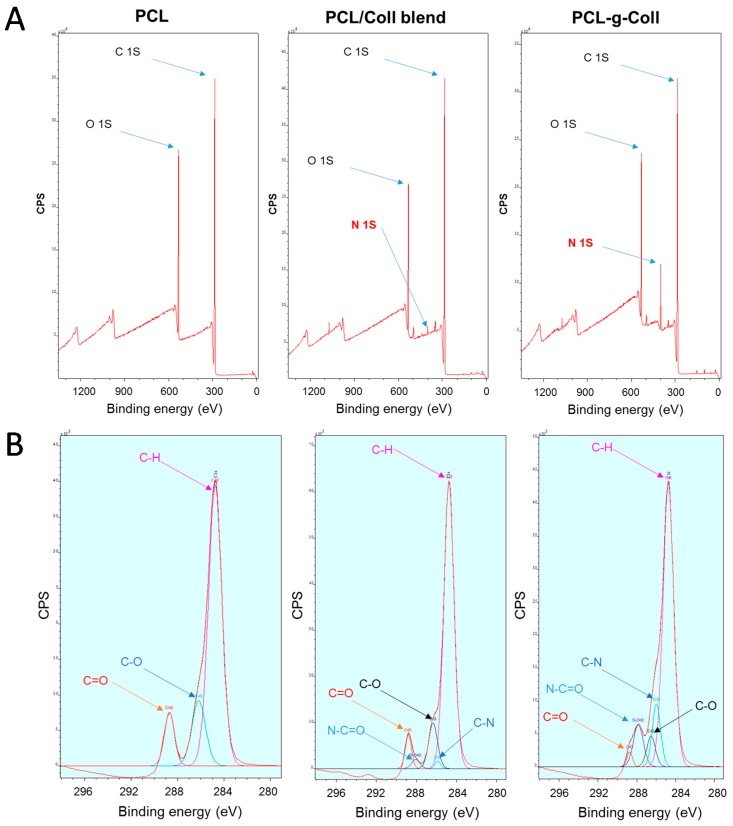
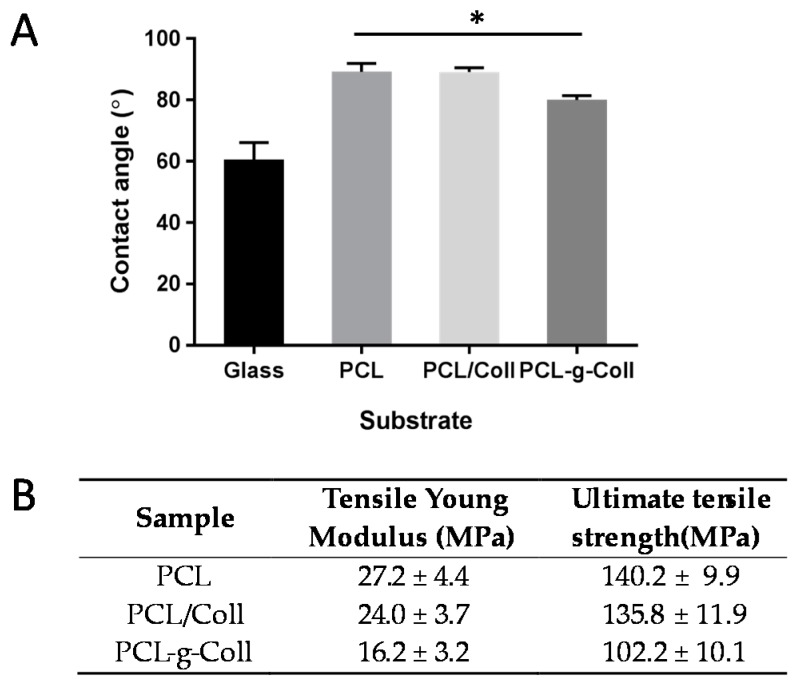
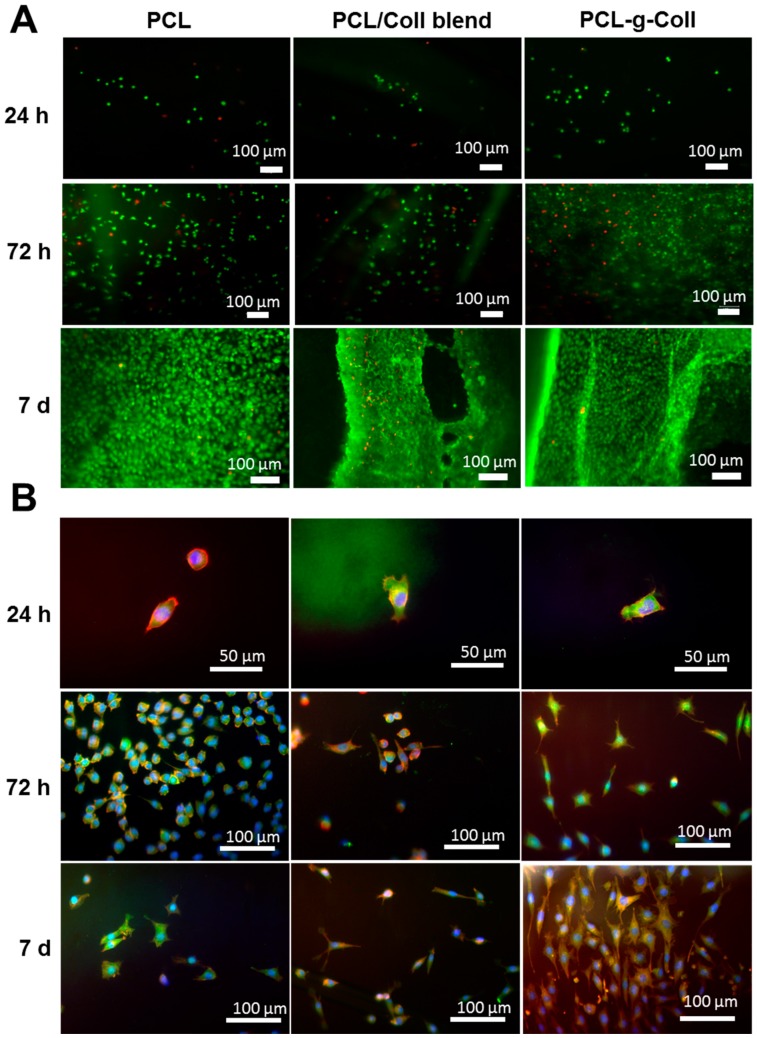
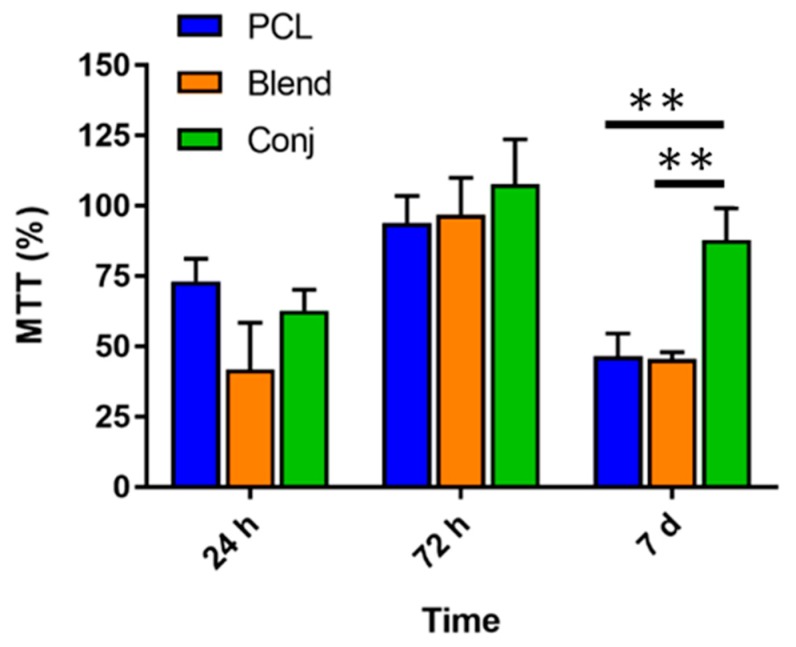
Biosynthetic materials have emerged as one of the most exciting and productive fields in polymer chemistry due to their widespread adoption and potential applications in tissue engineering (TE) research. In this work, we report the synthesis of a poly(ε-caprolactone)--collagen (PCL--Coll) copolymer. We combine its good mechanical and biodegradable PCL properties with the great biological properties of type I collagen as a functional material for TE. PCL, previously dissolved in dimethylformamide/dichloromethane mixture, and reacted with collagen using carbodiimide coupling chemistry. The synthesised material was characterised physically, chemically and biologically, using pure PCL and PCL/Coll blend samples as control. Infrared spectroscopy evidenced the presence of amide I and II peaks for the conjugated material. Similarly, XPS evidenced the presence of C-N and N-C=O bonds (8.96 ± 2.02% and 8.52 ± 0.63%; respectively) for PCL--Coll. Static contact angles showed a slight decrease in the conjugated sample. However, good biocompatibility and metabolic activity was obtained on PCL--Coll films compared to PCL and blend controls. After 3 days of culture, fibroblasts exhibited a spindle-like morphology, spreading homogeneously along the PCL--Coll film surface. We have engineered a functional biosynthetic polymer that can be processed by electrospinning.
由于生物合成材料在组织工程(TE)研究中的广泛应用和潜在应用,它们已成为聚合物化学中最令人兴奋和最具成效的领域之一。在这项工作中,我们报告了聚(ε-己内酯)-胶原蛋白(PCL-Coll)共聚物的合成。我们将其良好的机械性能和可生物降解的PCL特性与I型胶原蛋白的优异生物学特性相结合,作为TE的功能材料。PCL先前溶解在二甲基甲酰胺/二氯甲烷混合物中,并使用碳二亚胺偶联化学与胶原蛋白反应。以纯PCL和PCL/Coll共混样品作为对照,对合成材料进行了物理、化学和生物学表征。红外光谱证明了共轭材料中酰胺I和II峰的存在。同样,XPS证明了PCL-Coll中存在C-N和N-C=O键(分别为8.96±2.02%和8.52±0.63%)。静态接触角显示共轭样品略有下降。然而,与PCL和共混对照相比,PCL-Coll膜具有良好的生物相容性和代谢活性。培养3天后,成纤维细胞呈现纺锤状形态,沿PCL-Coll膜表面均匀铺展。我们设计了一种可以通过静电纺丝加工的功能性生物合成聚合物。