Korn Ronald L, Von Hoff Daniel D, Borad Mitesh J, Renschler Markus F, McGovern Desmond, Curtis Bay R, Ramanathan Ramesh K
Imaging Endpoints Core Lab, 9700 N 91st St, B-200, Scottsdale, AZ, 85258, USA.
Translational Genomics Research Institute and HonorHealth, 445 North Fifth St, Suite 600, Phoenix, AZ, 85004, USA.
Cancer Imaging. 2017 Aug 3;17(1):23. doi: 10.1186/s40644-017-0125-5.
Positron emission tomography (PET) is poised to become a useful imaging modality in staging and evaluating therapeutic responses in patients with metastatic pancreatic cancer (mPC). This analysis from a phase 1/2 study examined the utility of early PET imaging in patients with mPC treated with nab-paclitaxel plus gemcitabine.
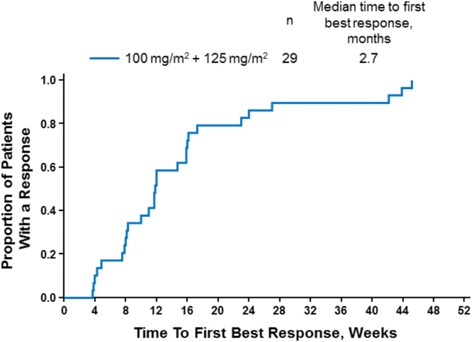
Tumors were measured by [F]2-fluoro-2-deoxyglucose PET/computed tomography (CT) in patients who received nab-paclitaxel 100 (n = 13), 125 (n = 38), or 150 (n = 1) mg/m plus gemcitabine 1000 mg/m on days 1, 8, and 15 of a 28-day cycle. Lesion metabolic activity was evaluated at baseline and 6 and 12 weeks postbaseline.
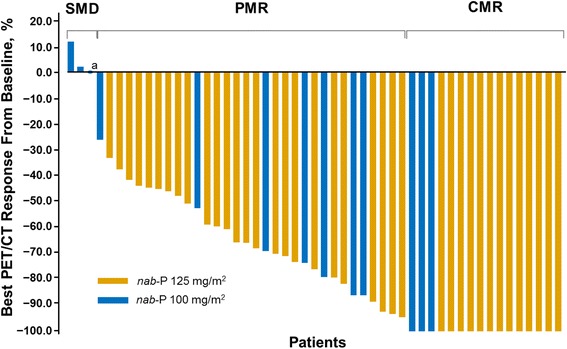
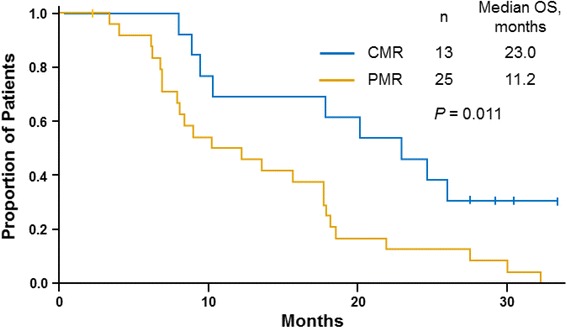
Fifty-two patients had baseline and ≥1 follow-up PET scan. The median maximum standardized uptake values per pancreatic lesion in the nab-paclitaxel 100 mg/m and 125 mg/m cohorts were 5.1 and 6.5, respectively. Among patients who had a metabolic response by PET, those who received nab-paclitaxel 125 mg/m had a 4-month survival advantage over those who received 100 mg/m. All patients in the nab-paclitaxel 125 mg/m cohort experienced an early complete metabolic response (CMR; 34%) or partial metabolic response (PMR; 66%). In the nab-paclitaxel 125 mg/m cohort, investigator-assessed objective response rates were 77% and 44% among patients with a CMR and PMR, respectively, with no correlation between PET and CT response (Spearman r = 0.22; P = 0.193). Patients in the nab-paclitaxel 125 mg/m cohort with a CMR experienced a significantly longer overall survival vs those with a PMR (median, 23.0 vs 11.2 months; P = 0.011), and a significant correlation was found between best percentage change in tumor burden by PET and survival: for each 1% decrease in PET score, the risk of death decreased by 2%.
The majority of primary pancreatic tumors and their metastases were PET avid, and PET effectively measured changes in tumor metabolic activity at 6 and 12 weeks. These results support the antitumor activity of nab-paclitaxel 125 mg/m plus gemcitabine 1000 mg/m for treating mPC and the utility of PET for measuring treatment response. Treatment response by PET analysis may be considered when evaluating investigational agents in mPC.
NCT00398086.
正电子发射断层扫描(PET)有望成为转移性胰腺癌(mPC)患者分期及评估治疗反应的一种有用的成像方式。这项来自1/2期研究的分析探讨了早期PET成像在接受纳米白蛋白结合型紫杉醇联合吉西他滨治疗的mPC患者中的应用价值。
在28天周期的第1、8和15天接受纳米白蛋白结合型紫杉醇100(n = 13)、125(n = 38)或150(n = 1)mg/m²加吉西他滨1000 mg/m²治疗的患者中,通过[¹⁸F]2-氟-2-脱氧葡萄糖PET/计算机断层扫描(CT)测量肿瘤。在基线以及基线后6周和12周评估病变的代谢活性。
52例患者有基线及≥1次随访PET扫描。纳米白蛋白结合型紫杉醇100 mg/m²和125 mg/m²队列中,每个胰腺病变的最大标准化摄取值中位数分别为5.1和6.5。在PET显示有代谢反应的患者中,接受纳米白蛋白结合型紫杉醇125 mg/m²的患者比接受100 mg/m²的患者有4个月的生存优势。纳米白蛋白结合型紫杉醇125 mg/m²队列中的所有患者均出现早期完全代谢反应(CMR;34%)或部分代谢反应(PMR;66%)。在纳米白蛋白结合型紫杉醇125 mg/m²队列中,CMR和PMR患者的研究者评估的客观缓解率分别为77%和44%,PET与CT反应之间无相关性(Spearman相关系数r = 0.22;P = 0.193)。纳米白蛋白结合型紫杉醇125 mg/m²队列中CMR患者的总生存期显著长于PMR患者(中位数分别为23.0个月和11.2个月;P = 0.011),并且发现PET显示的肿瘤负荷最佳百分比变化与生存率之间存在显著相关性:PET评分每降低1%,死亡风险降低2%。
大多数原发性胰腺肿瘤及其转移灶在PET上呈高摄取,PET能有效测量6周和12周时肿瘤代谢活性的变化。这些结果支持纳米白蛋白结合型紫杉醇125 mg/m²加吉西他滨1000 mg/m²治疗mPC的抗肿瘤活性以及PET用于测量治疗反应的效用。在评估mPC的研究药物时,可考虑通过PET分析来评估治疗反应。
NCT00398086。