Ramanathan R K, Goldstein D, Korn R L, Arena F, Moore M, Siena S, Teixeira L, Tabernero J, Van Laethem J-L, Liu H, McGovern D, Lu B, Von Hoff D D
Division of Hematology/Oncology, Mayo Clinic, Scottsdale, USA
Department of Medical Oncology, Prince of Wales Hospital, Sydney, Australia.
Ann Oncol. 2016 Apr;27(4):648-53. doi: 10.1093/annonc/mdw020. Epub 2016 Jan 22.
In the phase III MPACT trial, nab-paclitaxel plus gemcitabine (nab-P + Gem) demonstrated superior efficacy versus Gem alone for patients with metastatic pancreatic cancer. We sought to examine the feasibility of positron emission tomography (PET) and to compare metabolic response rates and associated correlations with efficacy in the MPACT trial.
Patients with previously untreated metastatic adenocarcinoma of the pancreas were randomized 1:1 to receive nab-P + Gem or Gem alone. Treatment continued until disease progression by RECIST or unacceptable toxicity.
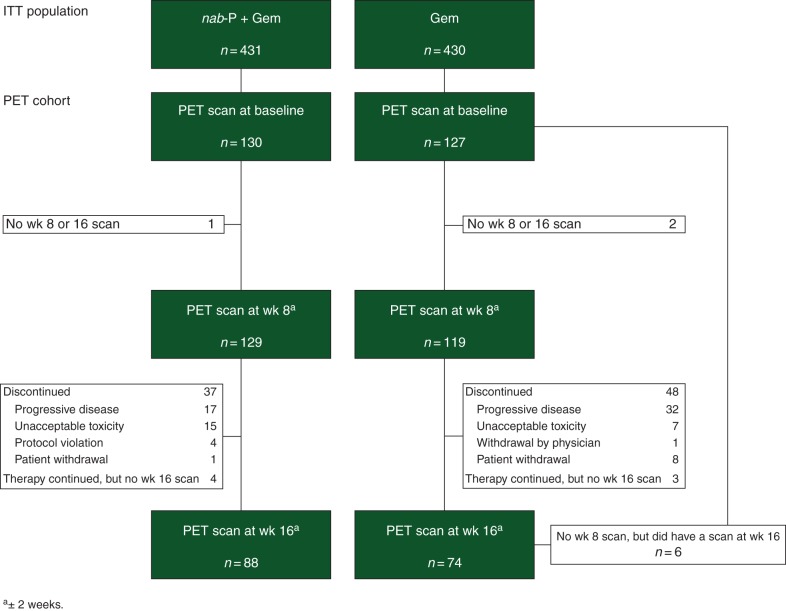
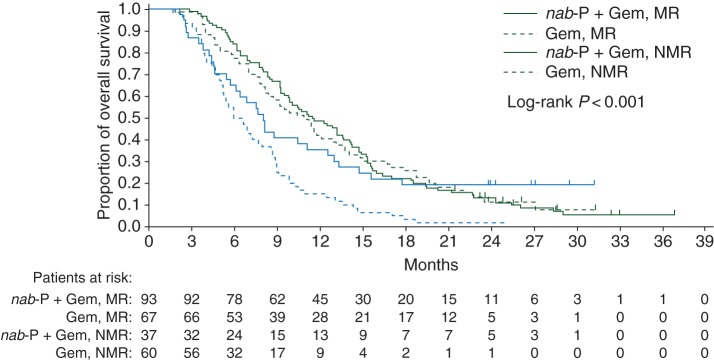
PET scans were carried out on the first 257 patients enrolled at PET-equipped centers (PET cohort). Most patients (252 of 257) had ≥2 PET-avid lesions, and median maximum standardized uptake values at baseline were 4.6 and 4.5 in the nab-P + Gem and Gem-alone arms, respectively. In a pooled treatment arm analysis, a metabolic response by PET (best response at any time during study) was associated with longer overall survival (OS) (median 11.3 versus 6.9 months; HR, 0.56; P < 0.001). Efficacy results within each treatment arm appeared better for patients with a metabolic response. The metabolic response rate (best response and week 8 response) was higher for nab-P + Gem (best response: 72% versus 53%, P = 0.002; week 8: 67% versus 51%; P = 0.014). Efficacy in the PET cohort was greater for nab-P + Gem versus Gem alone, including for OS (median 10.5 versus 8.4 months; hazard ratio [HR], 0.71; P = 0.009) and ORR by RECIST (31% versus 11%; P < 0.001).
Pancreatic lesions were PET avid at baseline, and the rate of metabolic response was significantly higher for nab-P + Gem versus Gem alone at week 8 and for best response during study. Having a metabolic response was associated with longer survival, and more patients experienced a metabolic response than a RECIST-defined response.
NCT00844649.
在III期MPACT试验中,与单用吉西他滨相比,白蛋白结合型紫杉醇联合吉西他滨(nab-P+Gem)对转移性胰腺癌患者显示出更高的疗效。我们试图研究正电子发射断层扫描(PET)的可行性,并比较MPACT试验中的代谢反应率及其与疗效的相关性。
将先前未接受过治疗的胰腺转移性腺癌患者按1:1随机分组,分别接受nab-P+Gem或单用吉西他滨治疗。治疗持续至根据RECIST标准判定疾病进展或出现不可接受的毒性反应。
对在配备PET设备的中心入组的前257例患者进行了PET扫描(PET队列)。大多数患者(257例中的252例)有≥2个PET高摄取病灶,nab-P+Gem组和单用吉西他滨组基线时最大标准化摄取值的中位数分别为4.6和4.5。在合并治疗组分析中,PET代谢反应(研究期间任何时间的最佳反应)与更长的总生存期(OS)相关(中位数分别为11.3个月和6.9个月;风险比[HR],0.56;P<0.001)。每个治疗组内,有代谢反应的患者疗效似乎更好。nab-P+Gem组的代谢反应率(最佳反应和第8周反应)更高(最佳反应:72%对53%,P=0.002;第8周:67%对51%;P=0.014)。在PET队列中,nab-P+Gem组的疗效优于单用吉西他滨组,包括OS(中位数分别为10.5个月和8.4个月;风险比[HR],0.71;P=0.009)和根据RECIST标准判定的客观缓解率(ORR)(31%对11%;P<0.001)。
胰腺病灶在基线时呈PET高摄取,nab-P+Gem组在第8周时的代谢反应率以及研究期间的最佳反应率均显著高于单用吉西他滨组。有代谢反应与更长的生存期相关,且经历代谢反应的患者比根据RECIST标准判定有反应的患者更多。
NCT00844649。