Department of Internal Medicine and Therapeutics, Unit of Pediatrics and Adolescentology, University of Pavia, Fondazione IRCCS Policlinico San Matteo, Piazzale C. Golgi 19, 27100, Pavia, Italy.
University of Pavia, Fondazione IRCCS Policlinico San Matteo, Pavia, Italy.
Ital J Pediatr. 2017 Aug 3;43(1):66. doi: 10.1186/s13052-017-0385-5.
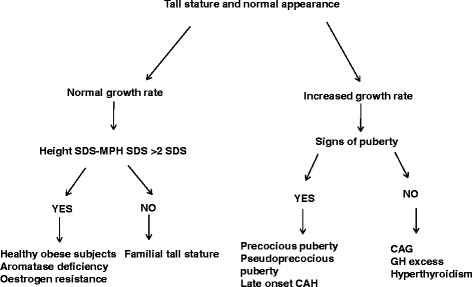
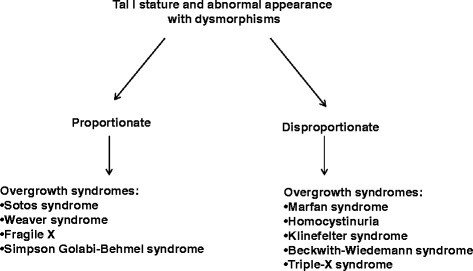
Referral for an assessment of tall stature is less common than for short stature. Tall stature is defined as a height more than two standard deviations above the mean for age. The majority of subjects with tall stature show a familial tall stature or a constitutional advance of growth (CAG), which is a diagnosis of exclusion. After a careful physical evaluation, tall subjects may be divided into two groups: tall subjects with normal appearance and tall subjects with abnormal appearance. In the case of normal appearance, the paediatric endocrinologist will have to evaluate the growth rate. If it is normal for age and sex, the subject may be classified as having familial tall stature, CAG or obese subject, while if the growth rate is increased it is essential to evaluate pubertal status and thyroid status. Tall subjects with abnormal appearance and dysmorphisms can be classified into those with proportionate and disproportionate syndromes.A careful physical examination and an evaluation of growth pattern are required before starting further investigations. Physicians should always search for a pathological cause of tall stature, although the majority of children are healthy and they generally do not need treatment to cease growth progression.The most accepted and effective treatment for an excessive height prediction is inducing puberty early and leading to a complete fusion of the epiphyses and achievement of final height, using testosterone in males and oestrogens in females. Alternatively, the most common surgical procedure for reducing growth is bilateral percutaneous epiphysiodesis of the distal femur and proximal tibia and fibula.This review aims to provide up-to-date information and suggestions about the diagnosis and management of children with tall stature.
转诊评估身材高大的情况比评估身材矮小的情况少见。身材高大定义为身高高于年龄平均值两个标准差以上。大多数身材高大的患者表现为家族性身材高大或生长提前(CAG),这是一种排除性诊断。经过仔细的身体评估,高个子患者可分为两组:外观正常的高个子患者和外观异常的高个子患者。在外观正常的情况下,儿科内分泌学家将不得不评估生长速度。如果其与年龄和性别相匹配,则可将患者归类为家族性身材高大、CAG 或肥胖患者,而如果生长速度增加,则必须评估青春期状态和甲状腺状态。外观异常和畸形的高个子患者可分为比例和不成比例的综合征。在开始进一步调查之前,需要进行仔细的体格检查和生长模式评估。尽管大多数儿童身体健康,通常不需要治疗来停止生长进展,但医生应始终寻找身材高大的病理性原因。对于过度身高预测,最被接受和有效的治疗方法是通过在男性中使用睾酮和在女性中使用雌激素来提前诱导青春期,从而导致骨骺完全融合并达到最终身高。或者,减少生长的最常见手术是双侧经皮股骨远端和胫骨近端及腓骨骺板融合术。本文旨在提供关于儿童身材高大的诊断和管理的最新信息和建议。