Ratnayaka Kanishka, Moore John W, Rios Rodrigo, Lederman Robert J, Hegde Sanjeet R, El-Said Howaida G
Division of Cardiology, Rady Children's Hospital, Department of Pediatrics, University of California San Diego, San Diego, California; Cardiovascular and Pulmonary Branch, Division of Intramural Research, National Heart, Lung, and Blood Institute, Bethesda, Maryland.
Division of Cardiology, Rady Children's Hospital, Department of Pediatrics, University of California San Diego, San Diego, California.
J Am Coll Cardiol. 2017 Aug 8;70(6):745-752. doi: 10.1016/j.jacc.2017.06.020.
In the care of patients with congenital heart disease, percutaneous interventional treatments have supplanted many surgical approaches for simple lesions, such as atrial septal defect. By contrast, complex congenital heart defects continue to require open-heart surgery. In single-ventricle patients, a staged approach is employed, which requires multiple open-heart surgeries and significant attendant morbidity and mortality. A nonsurgical transcatheter alternative would be attractive.
The authors sought to show the feasibility of catheter-only, closed-chest, large-vessel anastomosis (superior vena cava and pulmonary artery [PA] or bidirectional Glenn operation equivalent) in a patient.
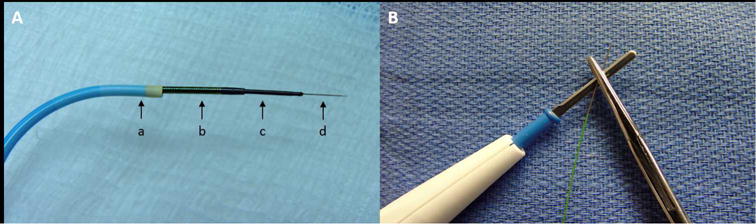
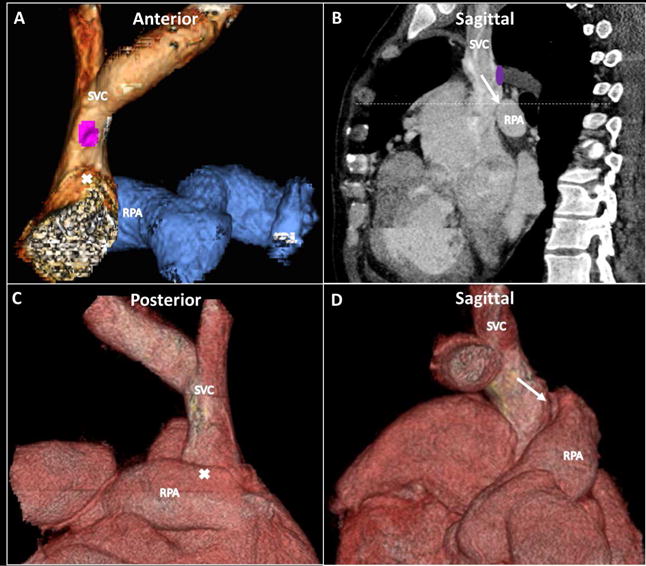
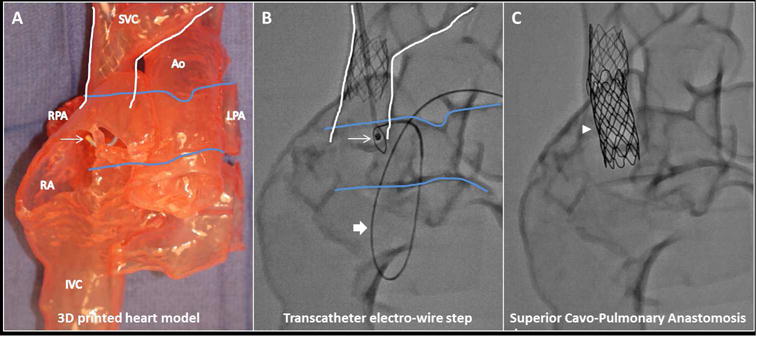
In preclinical testing over a decade, the authors developed the techniques and technology needed for nonsurgical crossing from a donor (superior vena cava) to a recipient (PA) vessel and endovascular stent-based anastomosis of those blood vessels. The authors undertook this transcatheter approach for an adult with untreated congenital heart disease with severe cyanosis and significant surgical risk. They rehearsed the procedure step by step using contrast-enhanced cardiac computed tomography and a patient-specific 3-dimensional printed heart model.
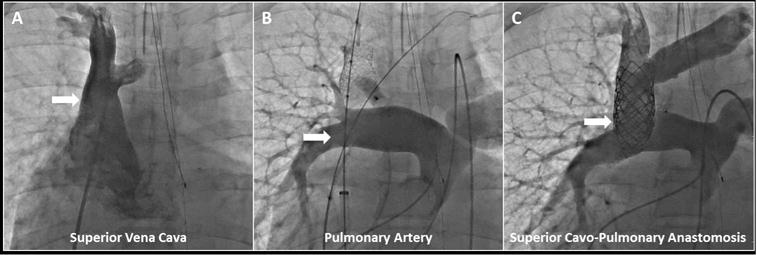
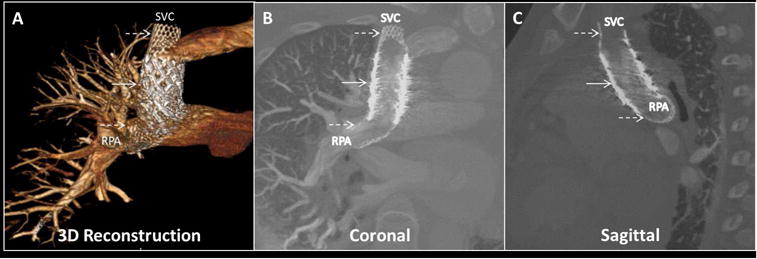
The authors describe a first-in-human, fully percutaneous superior cavopulmonary anastomosis (bidirectional Glenn operation equivalent). The patient, a 35-year-old woman, was homebound due to dyspnea and worsening cyanosis. She was diagnosed with functional single ventricle and very limited pulmonary blood flow. The heart team believed surgical palliation conferred high operative risk due to the patient's complete condition. With the percutaneous procedure, the patient recovered uneventfully and remained improved clinically after 6 months.
This procedure may provide a viable alternative to one of the foundational open-heart surgeries currently performed to treat single-ventricle congenital heart disease.
在先天性心脏病患者的治疗中,经皮介入治疗已取代了许多针对简单病变(如房间隔缺损)的外科手术方法。相比之下,复杂的先天性心脏缺陷仍需要进行心脏直视手术。对于单心室患者,采用分期治疗方法,这需要多次心脏直视手术,且伴随较高的发病率和死亡率。一种非手术的经导管替代方法将很有吸引力。
作者试图证明在一名患者中仅通过导管进行闭胸大血管吻合术(上腔静脉与肺动脉[PA]吻合或相当于双向格林手术)的可行性。
在过去十年的临床前测试中,作者开发了从供体(上腔静脉)到受体(肺动脉)血管进行非手术交叉以及基于血管内支架的血管吻合所需的技术和工艺。作者对一名患有未经治疗的先天性心脏病、严重紫绀且手术风险高的成年人采用了这种经导管方法。他们使用对比增强心脏计算机断层扫描和患者特异性三维打印心脏模型逐步演练了该手术。
作者描述了首例人体完全经皮上腔肺吻合术(相当于双向格林手术)。该患者为一名35岁女性,因呼吸困难和紫绀加重而行动不便。她被诊断为功能性单心室,肺血流量非常有限。心脏治疗团队认为,鉴于患者的整体状况,手术姑息治疗具有较高的手术风险。通过经皮手术,患者恢复顺利,6个月后临床状况持续改善。
该手术可能为目前用于治疗单心室先天性心脏病的一种基础心脏直视手术提供一种可行的替代方法。