Flynn Kevin J, Kenny Philip, Mitra Aditee
Swansea University, Swansea, SA2 8PP UK.
J Appl Phycol. 2017;29(4):1829-1840. doi: 10.1007/s10811-017-1112-8. Epub 2017 Mar 10.
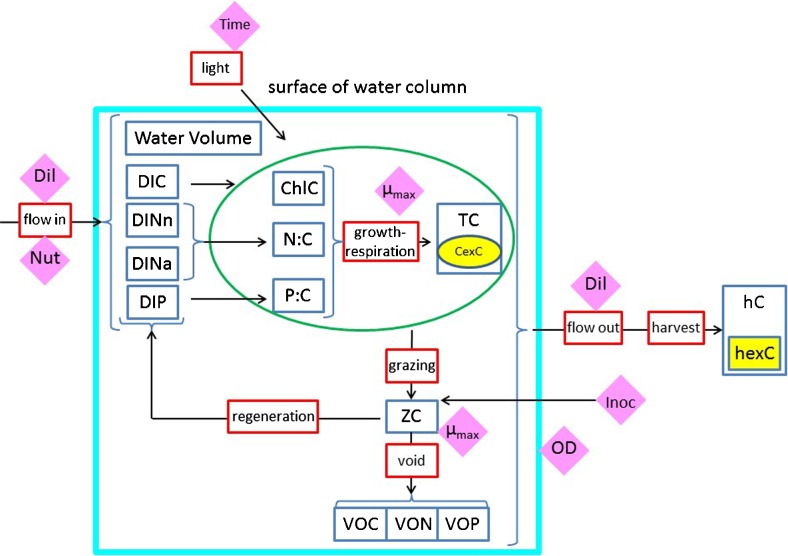
We explore approaches to minimise impacts of zooplanktonic pests upon commercial microalgal crops using system dynamics models to describe algal growth controlled by light and nutrient availability and zooplankton growth controlled by crop abundance and nutritional quality. Losses of microalgal crops are minimised when their growth is fastest and, in contrast, also when growing slowly under conditions of nutrient exhaustion. In many culture systems, however, dwindling light availability due to self-shading in dense suspensions favours slow growth under nutrient sufficiency. Such a situation improves microalgal quality as prey, enhancing zooplankton growth, and leads to rapid crop collapse. Timing of pest entry is important; crop losses are least likely in established, nutrient-exhausted microalgal communities grown for high C-content (e.g. for biofuels). A potentially useful approach is to promote a low level of P-stress that does not adversely affect microalgal growth but which produces a crop that is suboptimal for zooplankton growth.
我们利用系统动力学模型探索将浮游动物害虫对商业微藻作物的影响降至最低的方法,该模型用于描述受光照和养分可用性控制的藻类生长以及受作物丰度和营养质量控制的浮游动物生长。当微藻作物生长最快时,其损失最小;相反,在养分耗尽的条件下生长缓慢时,损失也最小。然而,在许多养殖系统中,由于密集悬浮液中的自遮荫导致光照可用性下降,有利于在养分充足的情况下缓慢生长。这种情况会提高微藻作为猎物的质量,促进浮游动物生长,并导致作物迅速崩溃。害虫进入的时间很重要;在为高碳含量(例如用于生物燃料)而种植的已建立的、养分耗尽的微藻群落中,作物损失的可能性最小。一种潜在有用的方法是促进低水平的磷胁迫,这种胁迫不会对微藻生长产生不利影响,但会产生对浮游动物生长而言并非最优的作物。