Baek Kiook, Chung Insung
Division of Occupational and Environmental Medicine, Keimyung University Dongsan Medical Center, Daegu, Korea.
Division of Occupational and Environmental Medicine, Department of Preventive Medicine, Keimyung University School of Medicine, Daegu, Korea.
J Korean Med Sci. 2017 Sep;32(9):1415-1422. doi: 10.3346/jkms.2017.32.9.1415.
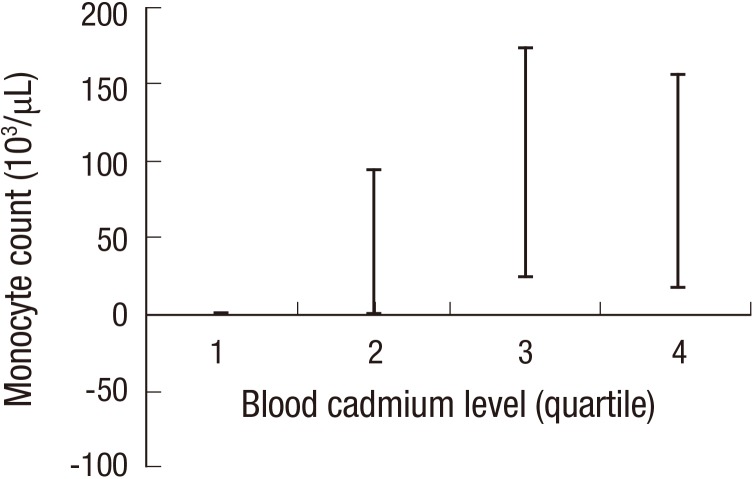
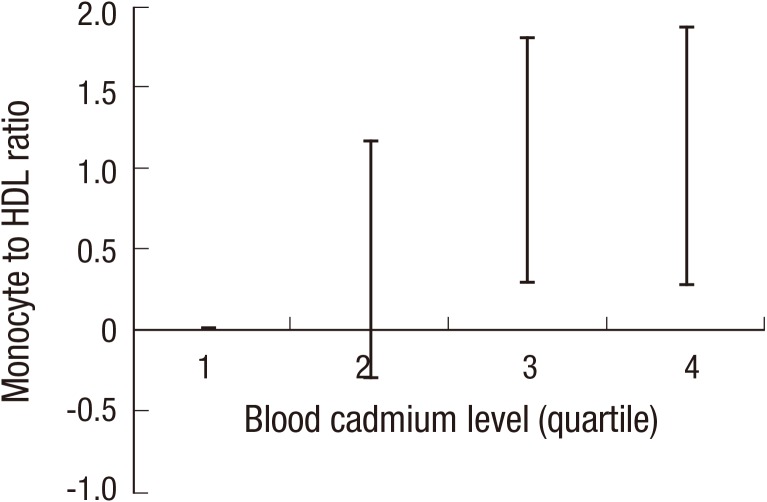
Cadmium is a heavy metal that humans can be exposed to the in environment and occupation, and its relationship with cardiovascular diseases has been reported. in various reports. Epidemiological studies have also been associated with various inflammatory markers of cardiovascular diseases. In this study, we examined the relationship between monocyte count and monocyte to high density lipoprotein (HDL) ratio (MHR) and blood cadmium, which are one of the inflammatory markers of cardiovascular diseases. Data from a total of 733 male fire officers who received a health checkup at a hospital for one year in 2016 were analyzed. Populations were classified into 4 groups according to the quartile of blood cadmium and general characteristics were described. The relationship between monocyte count, MHR and cadmium in blood was statistically analyzed by linear regression analysis. In the univariate analysis and multivariate analysis, monocyte count was significantly higher in the second, third and fourth quartile groups than in the first quartile of cadmium, and the linear trend was significant. In univariate and multivariate analysis, MHR was significantly higher in the third and fourth quartile groups than in the first quartile group, and the linear trend was also significant. This study showed the significant relationship between blood cadmium and monocyte count and MHR among male fire officers. This was also statistically significant in the model adjusted for possible confounders and other cardiovascular risk factors and showed a linear trend.
镉是一种人类可在环境和职业中接触到的重金属,其与心血管疾病的关系已有诸多报道。流行病学研究也将其与心血管疾病的各种炎症标志物联系起来。在本研究中,我们检测了单核细胞计数、单核细胞与高密度脂蛋白(HDL)比值(MHR)这两种心血管疾病炎症标志物与血镉之间的关系。分析了2016年在一家医院进行了为期一年健康检查的733名男性消防员的数据。根据血镉四分位数将人群分为4组,并描述了一般特征。通过线性回归分析对单核细胞计数、MHR与血镉之间的关系进行了统计学分析。在单因素分析和多因素分析中,镉的第二、第三和第四四分位数组的单核细胞计数显著高于第一四分位数组,且线性趋势显著。在单因素和多因素分析中,第三和第四四分位数组的MHR显著高于第一四分位数组,线性趋势也显著。本研究表明男性消防员血镉与单核细胞计数及MHR之间存在显著关系。在针对可能的混杂因素和其他心血管危险因素进行调整的模型中,这一关系也具有统计学意义,并呈现出线性趋势。