Lee Joon Kee, Yun Ki Wook, Choi Eun Hwa, Kim Sun Jung, Lee Seong Yeon, Lee Hoan Jong
Department of Pediatrics, Seoul National University College of Medicine, Seoul, Korea.
Department of Pediatrics, Seoul National University Children's Hospital, Seoul, Korea.
J Korean Med Sci. 2017 Sep;32(9):1431-1439. doi: 10.3346/jkms.2017.32.9.1431.
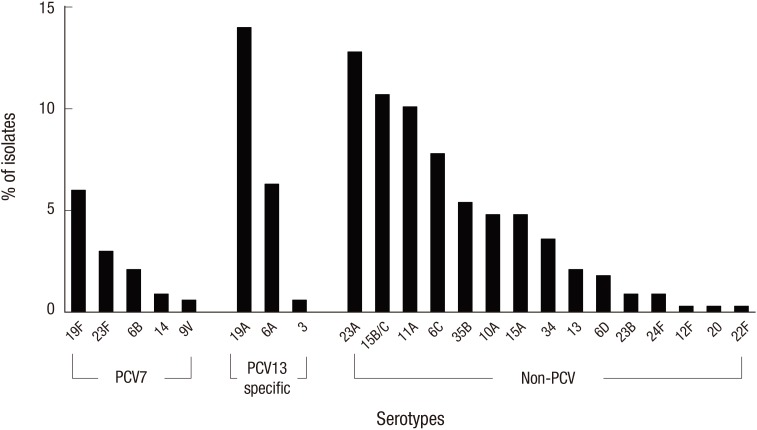
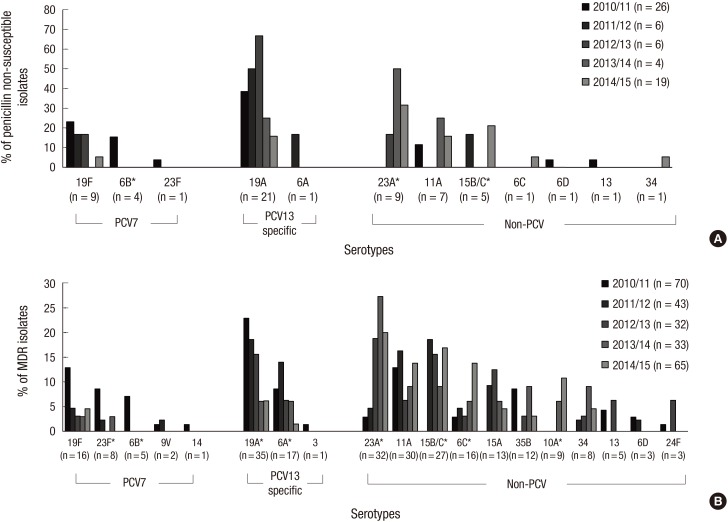
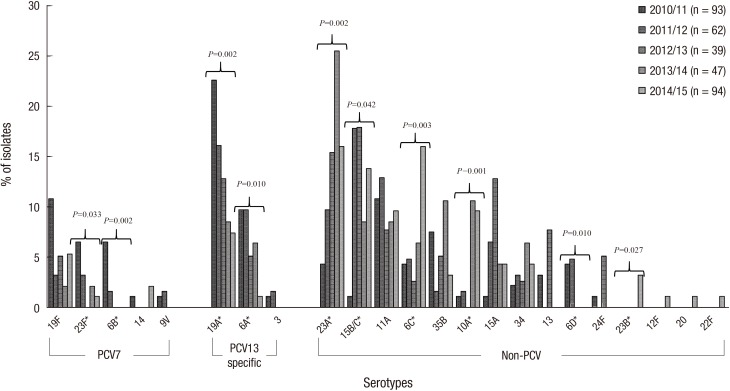
This study investigated the serotype distribution and antimicrobial resistance of 3,820 nasopharyngeal Streptococcus pneumoniae isolates from infants and children who presented with respiratory symptoms at Seoul National University Children's Hospital from July 2010 to June 2015 after the introduction of the extended-valency pneumococcal conjugate vaccines (PCVs). Serotypes and antimicrobial susceptibility were determined using the Quellung reaction and E-test, respectively. S. pneumoniae was isolated from 397 (10.4%) specimens. The most common serotypes were 19A (14.0%), 23A (12.8%), 15B/C (10.7%), 11A (10.1%), 6C (7.8%), and 6A (6.3%) among the typeable pneumococci (n = 335). The PCV serotype proportions significantly decreased (59.1% in 2010/11 to 17.0% in 2014/15, P < 0.001), whereas the non-PCV serotype proportions significantly increased (40.9% in 2010/11 to 83.0% in 2014/15, P < 0.001). The non-susceptibility rates for penicillin (oral), penicillin (parenteral, non-meningitis), cefotaxime, and erythromycin were 97.8%, 22.8%, 27.7%, and 95.5%, respectively. The proportions of PCV serotypes responsible for non-susceptibility to penicillin (parenteral, non-meningitis) and multidrug resistance significantly decreased (80.8% to 21.1%, P < 0.001 and 64.3% to 12.3%, P < 0.001, respectively), whereas the non-PCV serotype proportions significantly increased (19.2% to 78.9%, P < 0.001 and 35.7% to 87.7%, P < 0.001, respectively). Serotypes 23A and 15B/C demonstrated significant proportional increase among the antibiotics resistant strains. Thus, the PCV serotype proportions decreased and the non-PCV serotype proportions increased among nasopharyngeal carriage pneumococci after the introduction of extended-valency PCVs in Korea. Antimicrobial non-susceptibility rates for penicillin and erythromycin remain high despite the decrease in the proportion of PCV serotypes responsible for antimicrobial resistance over time.
本研究调查了2010年7月至2015年6月在首尔国立大学儿童医院出现呼吸道症状的婴幼儿中3820株鼻咽部肺炎链球菌分离株的血清型分布及抗菌药物耐药性,此期间已引入了多价肺炎球菌结合疫苗(PCV)。分别采用荚膜肿胀反应和E试验确定血清型及抗菌药物敏感性。从397份(10.4%)标本中分离出肺炎链球菌。在可分型的肺炎球菌(n = 335)中,最常见的血清型为19A(14.0%)、23A(12.8%)、15B/C(10.7%)、11A(10.1%)、6C(7.8%)和6A(6.3%)。PCV血清型比例显著下降(2010/11年度为59.1%,2014/15年度为17.0%,P < 0.001),而非PCV血清型比例显著上升(2010/11年度为40.9%,2014/15年度为83.0%,P < 0.001)。青霉素(口服)、青霉素(胃肠外,非脑膜炎)、头孢噻肟和红霉素的不敏感率分别为97.8%、22.8%、27.7%和95.5%。对青霉素(胃肠外,非脑膜炎)不敏感及多重耐药的PCV血清型比例显著下降(分别从80.8%降至21.1%,P < 0.001;从64.3%降至12.3%,P < 0.001),而非PCV血清型比例显著上升(分别从19.2%升至78.9%,P < 0.001;从35.7%升至87.7%,P < 0.001)。血清型23A和15B/C在耐药菌株中的比例显著增加。因此,在韩国引入多价PCV后,鼻咽部携带的肺炎球菌中PCV血清型比例下降,非PCV血清型比例上升。尽管随着时间推移,导致抗菌药物耐药的PCV血清型比例有所下降,但青霉素和红霉素的抗菌药物不敏感率仍然很高。