Research Group for Host-Microbe Interaction, Department of Medical Biology, Faculty of Health Sciences, UiT - The Arctic University of Norway, Tromsø, Norway.
Department of Virus and Microbiological Special Diagnostics, Division of Infectious Disease Preparedness, Statens Serum Institut, Artillerivej 5, DK-2300, Copenhagen S, Denmark.
BMC Infect Dis. 2020 Apr 15;20(1):279. doi: 10.1186/s12879-020-04998-5.
The 13-valent Pneumococcal Conjugate Vaccine (PCV-13) was introduced in the National Immunization Programme (NIP) schedule in Russia in March 2014. Previously, the 7-valent Pneumococcal Conjugate Vaccine (PCV-7) was marketed in Russia in 2009 but has never been offered for mass vaccination. A carriage study was performed among children in Arkhangelsk in 2006. The objective was to determine the prevalence of carriage, serotype distribution, antimicrobial susceptibility and the molecular structure of Streptococcus pneumoniae strains before marketing and introduction of PCV-13.
A cross-sectional study was conducted on a cluster-randomized sample of children and a self-administrated questionnaire for parents/guardians. Nasopharyngeal samples were collected from 438 children younger than 7 years attending nurseries and kindergartens in the Arkhangelsk region, Russia. Detailed demographic data, as well as information about the child's health, traveling, exposure to antimicrobials within the last 3 months and anthropometric measurements were collected for all study subjects. Variables extracted from the questionnaire were analysed using statistic regression models to estimate the risk of carriage. All pneumococcal isolates were examined with susceptibility testing, serotyping and multilocus sequence typing.
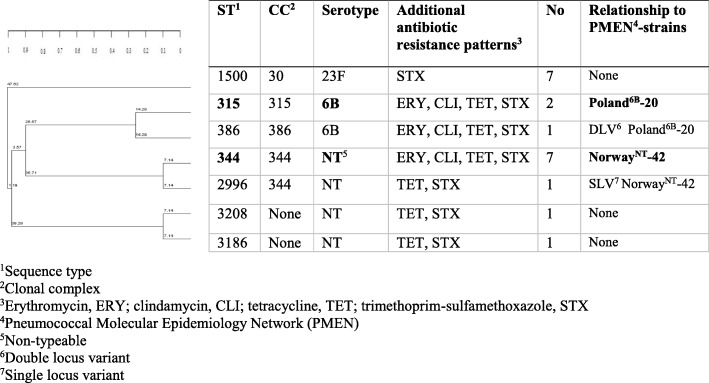
The overall prevalence of asymptomatic carriage was high and peaking at 36 months with a rate of 57%. PCV-13 covered 67.3% of the detected strains. High rates of non-susceptibility to penicillin, macrolides and multidrug resistance were associated with specific vaccine serotypes, pandemic clones, and local sequence types. Nine percent of isolates represented three globally disseminated disease-associated pandemic clones; penicillin- and macrolide-resistant clones Norway-42 and Poland-20, as well as penicillin- and macrolide-susceptible clone Netherlands-31. A high level of antimicrobial consumption was noted by the study. According to the parent's reports, 89.5% of the children used at least one antimicrobial regime since birth. None of the hypothesised predictors of S. pneumoniae carriage were statistically significant in univariable and multivariable logistic models.
The study identified a high coverage of the PCV-13-vaccine, but serotype replacement and expansion of globally disseminated disease-associated clones with non-vaccine serotypes may be expected. Further surveillance of antimicrobial resistance and serotype distribution is therefore required.
2014 年 3 月,13 价肺炎球菌结合疫苗(PCV-13)在俄罗斯国家免疫规划(NIP)计划中推出。此前,2009 年俄罗斯市场上销售 7 价肺炎球菌结合疫苗(PCV-7),但从未用于大规模疫苗接种。2006 年在阿尔汉格尔斯克进行了一项带菌者研究。目的是在 PCV-13 上市和引入之前,确定携带率、血清型分布、抗菌药物敏感性以及肺炎链球菌株的分子结构。
采用横断面研究,对俄罗斯阿尔汉格尔斯克地区的儿童进行了随机分组抽样,并对家长/监护人进行了自填式问卷调查。从 438 名年龄小于 7 岁的托儿所和幼儿园儿童中采集鼻咽样本。对所有研究对象收集详细的人口统计学数据,以及儿童健康、旅行、最近 3 个月接触抗菌药物的信息和人体测量学数据。从问卷中提取的变量使用统计回归模型进行分析,以估计携带的风险。所有肺炎链球菌分离株均进行药敏试验、血清分型和多位点序列分型。
无症状携带率总体较高,在 36 个月时达到峰值,为 57%。PCV-13 覆盖了 67.3%的检测菌株。青霉素、大环内酯类和多药耐药率高与特定疫苗血清型、大流行克隆和本地序列类型有关。9%的分离株代表了三种全球传播的疾病相关大流行克隆;青霉素和大环内酯类耐药克隆挪威-42 和波兰-20,以及青霉素和大环内酯类敏感克隆荷兰-31。研究中发现了高水平的抗菌药物消耗。根据家长的报告,自出生以来,89.5%的儿童至少使用过一种抗菌药物方案。在单变量和多变量逻辑模型中,没有一个假设的肺炎链球菌携带预测因素具有统计学意义。
研究发现 PCV-13 疫苗覆盖率很高,但预计会出现疫苗血清型替代和具有非疫苗血清型的全球传播疾病相关克隆的扩展。因此,需要进一步监测抗菌药物耐药性和血清型分布。