Department of Pediatrics, Seoul National University Hospital, Seoul, Korea.
Department of Pediatrics, Seoul National University Bundang Hospital, Seongnam, Korea.
J Korean Med Sci. 2023 Apr 24;38(16):e127. doi: 10.3346/jkms.2023.38.e127.
The coronavirus disease-2019 (COVID-19) pandemic has contributed to the change in the epidemiology of many infectious diseases. This study aimed to establish the pre-pandemic epidemiology of pediatric invasive bacterial infection (IBI).
A retrospective multicenter-based surveillance for pediatric IBIs has been maintained from 1996 to 2020 in Korea. IBIs caused by eight bacteria (, , , , , , , and species) in immunocompetent children > 3 months of age were collected at 29 centers. The annual trend in the proportion of IBIs by each pathogen was analyzed.
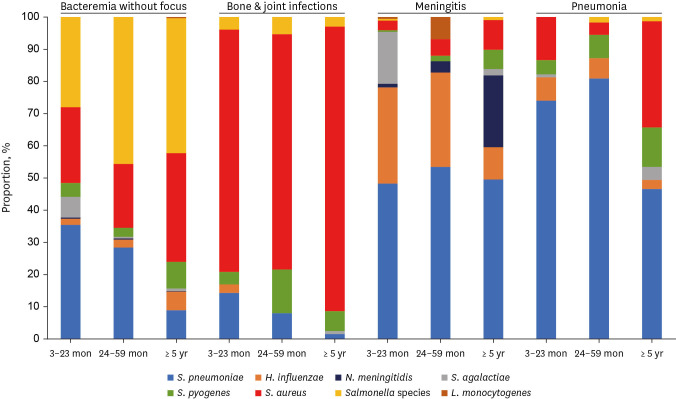
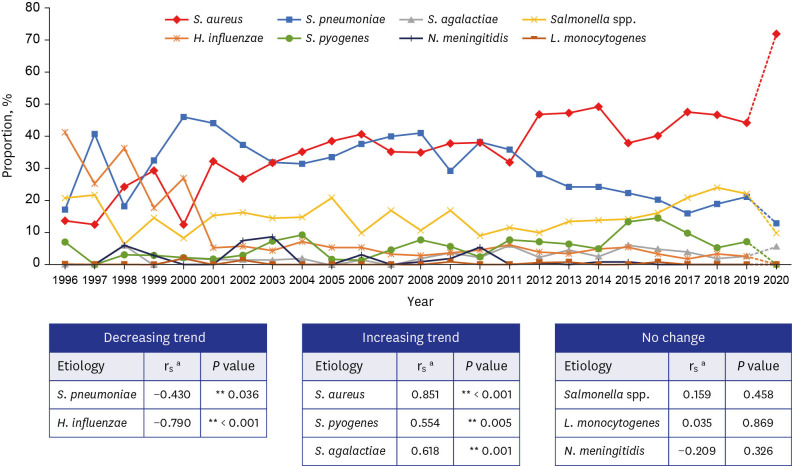
A total of 2,195 episodes were identified during the 25-year period between 1996 and 2020. (42.4%), (22.1%), and species (21.0%) were common in children 3 to 59 months of age. In children ≥ 5 years of age, (58.1%), followed by species (14.8%) and (12.2%) were common. Excluding the year 2020, there was a trend toward a decrease in the relative proportions of (r = -0.430, = 0.036), (r = -0.922, < 0.001), while trend toward an increase in the relative proportion of (r = 0.850, < 0.001), (r = 0.615, = 0.001), and (r = 0.554, = 0.005).
In the proportion of IBIs over a 24-year period between 1996 and 2019, we observed a decreasing trend for and and an increasing trend for , , and in children > 3 months of age. These findings can be used as the baseline data to navigate the trend in the epidemiology of pediatric IBI in the post COVID-19 era.
2019 年冠状病毒病(COVID-19)大流行导致许多传染病的流行病学发生变化。本研究旨在建立儿童侵袭性细菌感染(IBI)的流行前流行病学。
自 1996 年至 2020 年,韩国一直在进行一项基于回顾性多中心的儿童 IBI 监测。共收集了 29 个中心 3 个月以上免疫功能正常儿童由 8 种细菌(、、、、、、和 种)引起的 IBI。分析了每种病原体引起的 IBI 比例的年度趋势。
在 1996 年至 2020 年的 25 年期间,共确定了 2195 例。3 至 59 个月龄儿童中常见的病原体为(42.4%)、(22.1%)和 种(21.0%)。≥5 岁儿童中常见的病原体为(58.1%),其次为 种(14.8%)和 (12.2%)。排除 2020 年,的相对比例呈下降趋势(r = -0.430,= 0.036),(r = -0.922,<0.001),而 种的相对比例呈上升趋势(r = 0.850,<0.001),(r = 0.615,= 0.001)和 (r = 0.554,= 0.005)。
在 1996 年至 2019 年的 24 年期间,我们观察到 3 个月以上儿童的 IBI 中 、和 的比例呈下降趋势,、、和 的比例呈上升趋势。这些发现可以作为 COVID-19 后儿童 IBI 流行病学趋势的基线数据。