He Dianning, Zamora Marta, Oto Aytekin, Karczmar Gregory S, Fan Xiaobing
Sino-Dutch Biomedical and Information Engineering School, Northeastern University, Shenyang, People's Republic of China. Department of Radiology, The University of Chicago, Chicago, IL 60637, United States of America.
Phys Med Biol. 2017 Sep 5;62(18):N445-N459. doi: 10.1088/1361-6560/aa84d6.
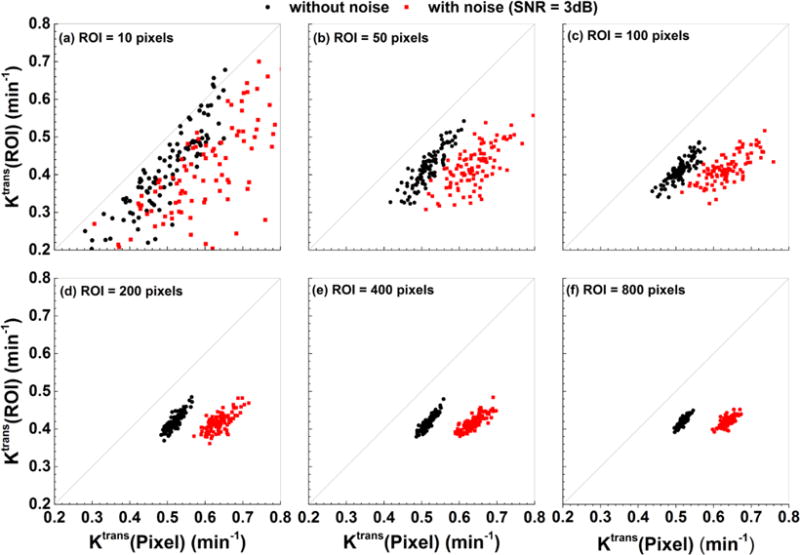
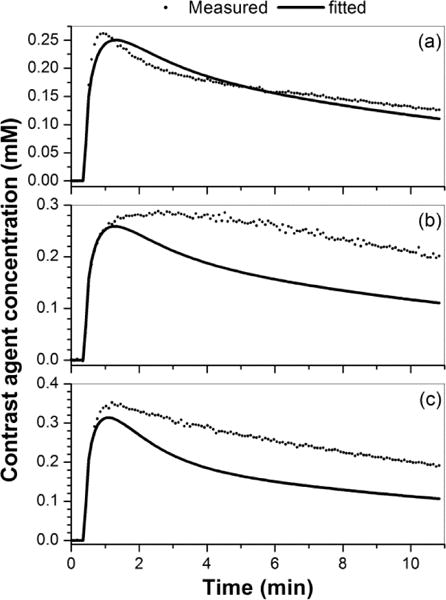
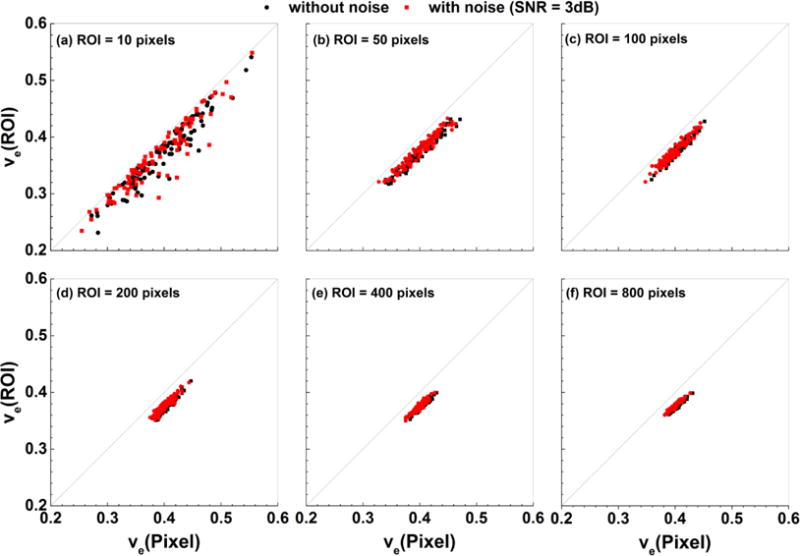
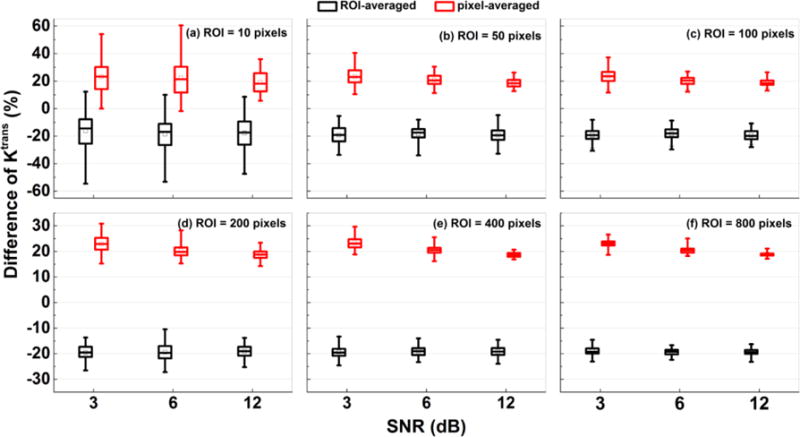
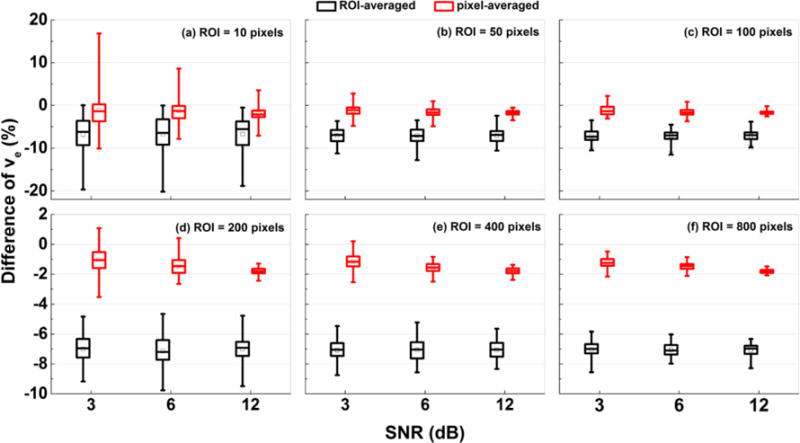
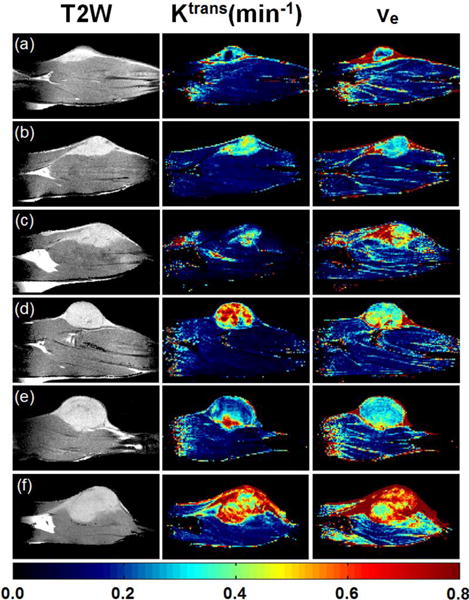
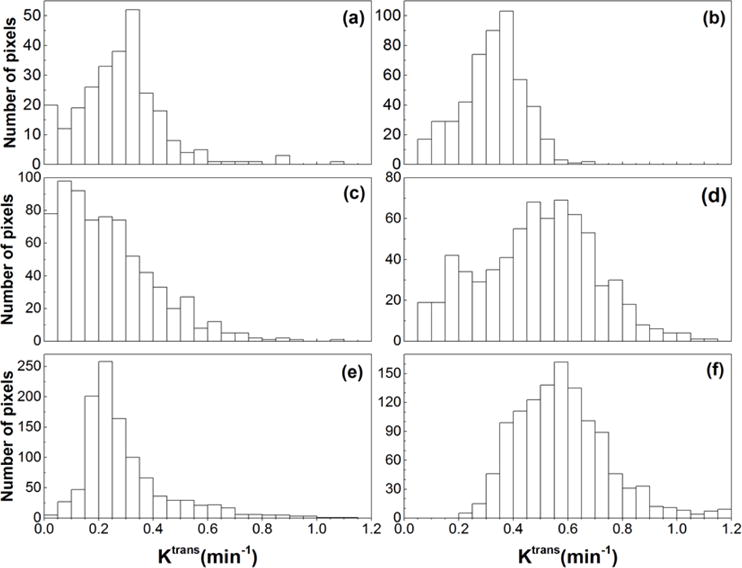
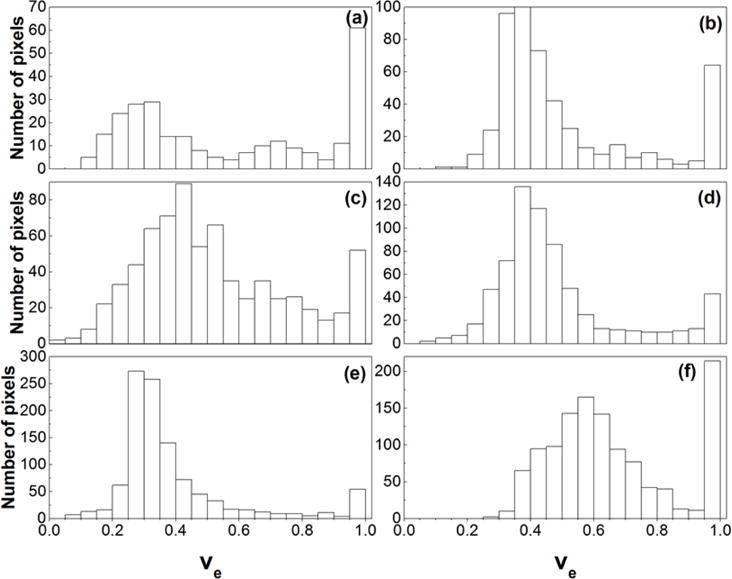
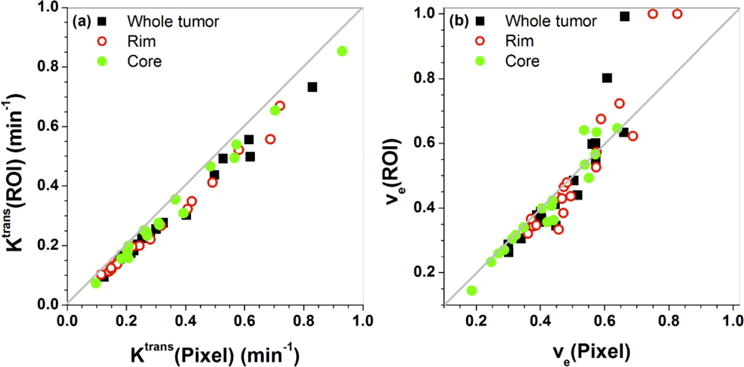
Differences between region-of-interest (ROI) and pixel-by-pixel analysis of dynamic contrast enhanced (DCE) MRI data were investigated in this study with computer simulations and pre-clinical experiments. ROIs were simulated with 10, 50, 100, 200, 400, and 800 different pixels. For each pixel, a contrast agent concentration as a function of time, C(t), was calculated using the Tofts DCE-MRI model with randomly generated physiological parameters (K and v ) and the Parker population arterial input function. The average C(t) for each ROI was calculated and then K and v for the ROI was extracted. The simulations were run 100 times for each ROI with new K and v generated. In addition, white Gaussian noise was added to C(t) with 3, 6, and 12 dB signal-to-noise ratios to each C(t). For pre-clinical experiments, Copenhagen rats (n = 6) with implanted prostate tumors in the hind limb were used in this study. The DCE-MRI data were acquired with a temporal resolution of ~5 s in a 4.7 T animal scanner, before, during, and after a bolus injection (<5 s) of Gd-DTPA for a total imaging duration of ~10 min. K and v were calculated in two ways: (i) by fitting C(t) for each pixel, and then averaging the pixel values over the entire ROI, and (ii) by averaging C(t) over the entire ROI, and then fitting averaged C(t) to extract K and v . The simulation results showed that in heterogeneous ROIs, the pixel-by-pixel averaged K was ~25% to ~50% larger (p < 0.01) than the ROI-averaged K . At higher noise levels, the pixel-averaged K was greater than the 'true' K , but the ROI-averaged K was lower than the 'true' K . The ROI-averaged K was closer to the true K than pixel-averaged K for high noise levels. In pre-clinical experiments, the pixel-by-pixel averaged K was ~15% larger than the ROI-averaged K . Overall, with the Tofts model, the extracted physiological parameters from the pixel-by-pixel averages were larger than the ROI averages. These differences were dependent on the heterogeneity of the ROI.
本研究通过计算机模拟和临床前实验,对动态对比增强(DCE)MRI数据的感兴趣区域(ROI)分析和逐像素分析之间的差异进行了研究。使用10、50、100、200、400和800个不同像素模拟ROI。对于每个像素,使用具有随机生成的生理参数(K和v)的Tofts DCE-MRI模型以及Parker群体动脉输入函数,计算作为时间函数的造影剂浓度C(t)。计算每个ROI的平均C(t),然后提取该ROI的K和v。对于每个ROI,使用新生成的K和v运行模拟100次。此外,以3、6和12分贝的信噪比向每个C(t)添加白色高斯噪声。对于临床前实验,本研究使用了后肢植入前列腺肿瘤的哥本哈根大鼠(n = 6)。在4.7 T动物扫描仪中,在静脉注射钆喷酸葡胺(<5 s)之前、期间和之后,以约5 s的时间分辨率采集DCE-MRI数据,总成像持续时间约为10分钟。K和v通过两种方式计算:(i)对每个像素的C(t)进行拟合,然后在整个ROI上对像素值求平均值;(ii)在整个ROI上对C(t)求平均值,然后对平均后的C(t)进行拟合以提取K和v。模拟结果表明,在异质ROI中,逐像素平均的K比ROI平均的K大25%至50%(p < 0.01)。在较高噪声水平下,像素平均的K大于“真实”K,但ROI平均的K低于“真实”K。对于高噪声水平,ROI平均的K比像素平均的K更接近真实K。在临床前实验中,逐像素平均的K比ROI平均的K大~15%。总体而言,使用Tofts模型,从逐像素平均值中提取的生理参数大于ROI平均值。这些差异取决于ROI的异质性。