Mekonnen Sefinew Alemu, Koop Gerrit, Lam Theo J G M, Hogeveen Henk
Department of Farm Animal Health, Faculty of Veterinary Medicine, Utrecht University, Utrecht, The Netherlands.
Faculty of Veterinary Medicine, University of Gondar, Gondar, Ethiopia.
PLoS One. 2017 Aug 7;12(8):e0182727. doi: 10.1371/journal.pone.0182727. eCollection 2017.
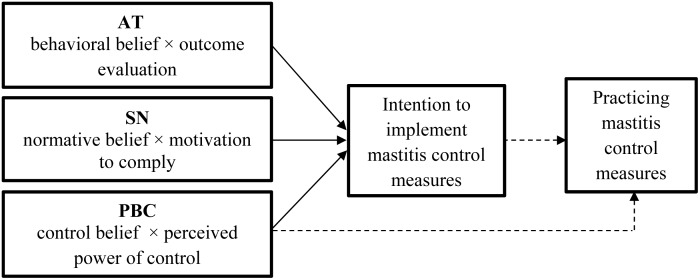
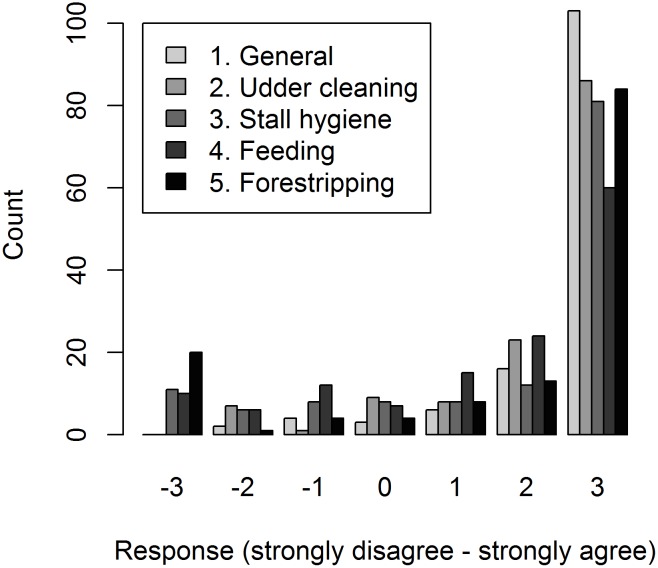
Understanding the intentions of dairy farmers towards mastitis control is important to design effective udder health control programs. We used the Theory of Planned Behavior (TPB) to explore the intentions of North-Western Ethiopian dairy farmers towards implementing non-specified mastitis control measures (nsMCMs) and towards implementing 4 specific MCMs. Face to face interviews were held with 134 dairy farmers to study associations between their intentions and any of three factors (attitude, subjective norm and perceived behavioral control) that, according to the TPB, determine intentions. The majority of the farmers (93%) had a positive intention to implement nsMCMs, whereas a smaller majority of farmers had the intention to implement the specific MCMs to improve udder cleaning (87%), to improve stall hygiene (78%), to improve feeding of cows (76%), and to perform foremilk stripping (74%). Farmers had a more positive attitude, but lower subjective norm and lower perceived behavioural control towards implementing nsMCMs compared with implementing most specific MCMs, although the subjective norms for stall hygiene and perceived behavioural control for improving feeding of cows were also low. Attitude was positively associated with intentions to implement nsMCMs, to improve cleaning of the udders, to improve stall hygiene and to implement foremilk stripping. Both the intention to improve udder cleaning and to implement foremilk stripping, were positively associated to subjective norms towards these MCMs. Our data can help tailor intervention programs aiming to increase the intention of Ethiopian dairy farmers to implement MCMs and thus to improve udder health in this country. We show that such programs should primarily focus on changing attitude and secondarily on improving the farmers' subjective norms.
了解奶农对乳腺炎防控的意图对于设计有效的乳房健康控制计划至关重要。我们运用计划行为理论(TPB)来探究埃塞俄比亚西北部奶农实施非特定乳腺炎控制措施(nsMCMs)以及实施4种特定乳腺炎控制措施(MCMs)的意图。我们与134名奶农进行了面对面访谈,以研究他们的意图与根据TPB理论确定意图的三个因素(态度、主观规范和感知行为控制)之间的关联。大多数奶农(93%)有实施nsMCMs的积极意图,而有较少比例的多数奶农打算实施特定的MCMs来改善乳房清洁(87%)、改善畜栏卫生(78%)、改善奶牛饲养(76%)以及进行挤前奶(74%)。与实施大多数特定MCMs相比,奶农对实施nsMCMs有更积极的态度,但主观规范较低,感知行为控制也较低,尽管畜栏卫生的主观规范和改善奶牛饲养的感知行为控制也较低。态度与实施nsMCMs、改善乳房清洁、改善畜栏卫生以及实施挤前奶的意图呈正相关。改善乳房清洁的意图和实施挤前奶的意图均与对这些MCMs的主观规范呈正相关。我们的数据有助于制定干预计划,旨在提高埃塞俄比亚奶农实施MCMs的意图,从而改善该国的乳房健康。我们表明,此类计划应主要侧重于改变态度,其次是改善农民的主观规范。