Geloso Maria Concetta, Corvino Valentina, Marchese Elisa, Serrano Alessia, Michetti Fabrizio, D'Ambrosi Nadia
Institute of Anatomy and Cell Biology, Università Cattolica del Sacro CuoreRome, Italy.
IRCCS San Raffaele Scientific Institute, Università Vita-Salute San RaffaeleMilan, Italy.
Front Aging Neurosci. 2017 Jul 25;9:242. doi: 10.3389/fnagi.2017.00242. eCollection 2017.
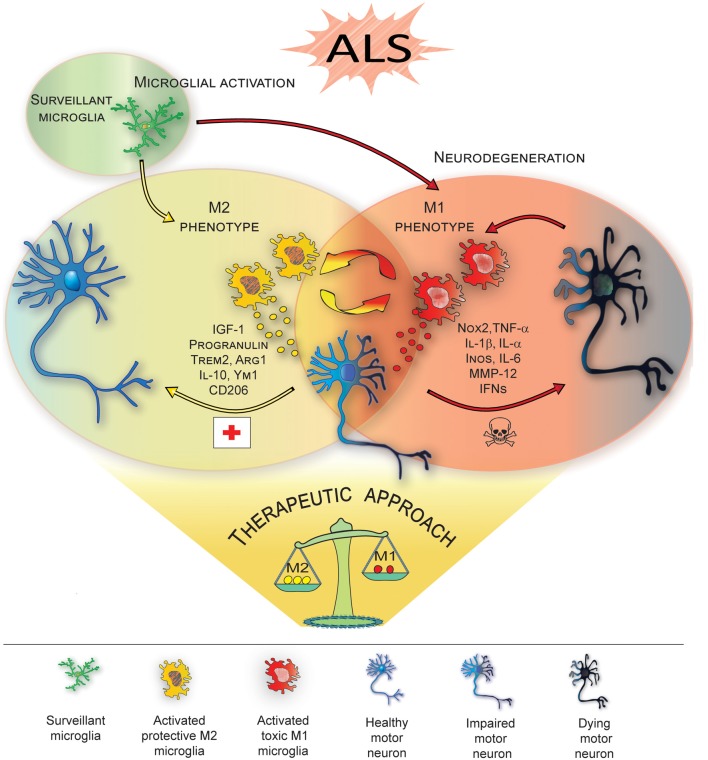
Amyotrophic lateral sclerosis (ALS) is a neurodegenerative disease characterized by a non-cell autonomous motor neuron loss. While it is generally believed that the disease onset takes place inside motor neurons, different cell types mediating neuroinflammatory processes are considered deeply involved in the progression of the disease. On these grounds, many treatments have been tested on ALS animals with the aim of inhibiting or reducing the pro-inflammatory action of microglia and astrocytes and counteract the progression of the disease. Unfortunately, these anti-inflammatory therapies have been only modestly successful. The non-univocal role played by microglia during stress and injuries might explain this failure. Indeed, it is now well recognized that, during ALS, microglia displays different phenotypes, from surveillant in early stages, to activated states, M1 and M2, characterized by the expression of respectively harmful and protective genes in later phases of the disease. Consistently, the inhibition of microglial function seems to be a valid strategy only if the different stages of microglia polarization are taken into account, interfering with the reactivity of microglia specifically targeting only the harmful pathways and/or potentiating the trophic ones. In this review article, we will analyze the features and timing of microglia activation in the light of M1/M2 phenotypes in the main mice models of ALS. Moreover, we will also revise the results obtained by different anti-inflammatory therapies aimed to unbalance the M1/M2 ratio, shifting it towards a protective outcome.
肌萎缩侧索硬化症(ALS)是一种神经退行性疾病,其特征是运动神经元的非细胞自主性丧失。虽然人们普遍认为疾病始于运动神经元内部,但介导神经炎症过程的不同细胞类型被认为与疾病进展密切相关。基于这些原因,人们在ALS动物模型上测试了许多治疗方法,旨在抑制或减少小胶质细胞和星形胶质细胞的促炎作用,并对抗疾病进展。不幸的是,这些抗炎疗法仅取得了一定程度的成功。小胶质细胞在应激和损伤期间所起的作用不明确,这可能解释了这种失败。事实上,现在人们已经充分认识到,在ALS过程中,小胶质细胞表现出不同的表型,从早期的监视状态到激活状态,即M1和M2状态,其特征分别是在疾病后期表达有害基因和保护基因。一致地,只有考虑到小胶质细胞极化的不同阶段,干扰小胶质细胞的反应性,特异性地仅针对有害途径和/或增强营养途径,抑制小胶质细胞功能似乎才是一种有效的策略。在这篇综述文章中,我们将根据ALS主要小鼠模型中的M1/M2表型来分析小胶质细胞激活的特征和时机。此外,我们还将回顾旨在平衡M1/M2比例、使其向保护性结果转变的不同抗炎疗法所获得的结果。