Wang Arthur, Pednekar Noorie, Lehrer Rachel, Todo Akira, Sahni Ramandeep, Marks Stephen, Stiefel Michael F
Department of Neurosurgery, Westchester Medical Center, New York Medical College, Valhalla, New York, USA.
Department of Neurology, Westchester Medical Center, New York Medical College, Valhalla, New York, USA.
Surg Neurol Int. 2017 Jul 18;8:149. doi: 10.4103/2152-7806.210993. eCollection 2017.
The DRAGON score, which includes clinical and computed tomographic (CT) scan parameters, predicts functional outcomes in ischemic stroke patients treated with intravenous tissue plasminogen activator (IV tPA). We assessed the utility of the DRAGON score in predicting functional outcome in stroke patients receiving both IV tPA and endovascular therapy.
A retrospective chart review of patients treated at our institution from February 2009 to October 2015 was conducted. All patients with computed tomography angiography (CTA) proven large vessel occlusions (LVO) who underwent intravenous thrombolysis and endovascular therapy were included. Baseline DRAGON scores and modified Rankin Score (mRS) at the time of hospital discharge was calculated. Good outcome was defined as mRS ≤3.
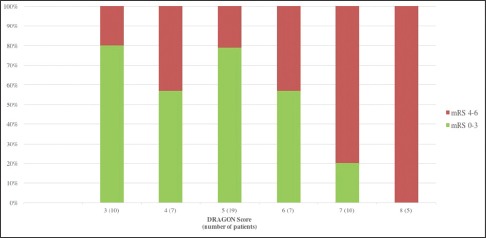
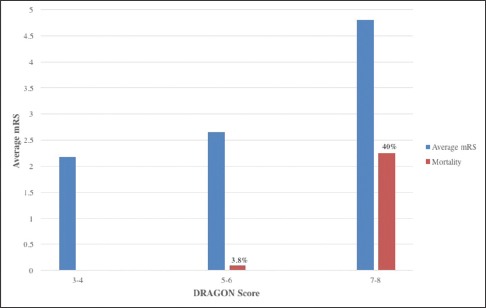
Fifty-eight patients with LVO of the anterior circulation were studied. The mean DRAGON score of patients on admission was 5.3 (range, 3-8). All patients received IV tPA and endovascular therapy. Multivariate analysis demonstrated that DRAGON scores ≥7 was associated with higher mRS ( < 0.006) and higher mortality ( < 0.0001) compared with DRAGON scores ≤6. Patients with DRAGON scores of 7 and 8 on admission had a mortality rate of 3.8% and 40%, respectively.
The DRAGON score can help predict better functional outcomes in ischemic stroke patients receiving both IV tPA and endovascular therapy. This data supports the use of the DRAGON score in selecting patients who could potentially benefit from more invasive therapies such as endovascular treatment. Larger prospective studies are warranted to further validate these results.
包含临床和计算机断层扫描(CT)扫描参数的DRAGON评分可预测接受静脉注射组织纤溶酶原激活剂(IV tPA)治疗的缺血性中风患者的功能结局。我们评估了DRAGON评分在预测接受IV tPA和血管内治疗的中风患者功能结局方面的效用。
对2009年2月至2015年10月在我们机构接受治疗的患者进行回顾性病历审查。纳入所有经计算机断层血管造影(CTA)证实为大血管闭塞(LVO)且接受静脉溶栓和血管内治疗的患者。计算出院时的基线DRAGON评分和改良Rankin评分(mRS)。良好结局定义为mRS≤3。
对58例前循环LVO患者进行了研究。入院时患者的平均DRAGON评分为5.3(范围3 - 8)。所有患者均接受了IV tPA和血管内治疗。多变量分析表明,与DRAGON评分≤6相比,DRAGON评分≥7与更高的mRS(<0.006)和更高的死亡率(<0.0001)相关。入院时DRAGON评分为7和8的患者死亡率分别为3.8%和40%。
DRAGON评分有助于预测接受IV tPA和血管内治疗的缺血性中风患者更好的功能结局。该数据支持使用DRAGON评分来选择可能从血管内治疗等更具侵入性的治疗中获益的患者。需要更大规模的前瞻性研究来进一步验证这些结果。