Department of Psychology, Djavad Mowafaghian Centre for Brain Health, University of British Columbia, Vancouver V6T 1Z3, Canada.
Institut de Neurosciences de la Timone, UMR7289 Centre National de la Recherche Scientifique and Aix-Marseille Université, 13005, Marseille, France.
eNeuro. 2017 Aug 7;4(4). doi: 10.1523/ENEURO.0094-17.2017. eCollection 2017 Jul-Aug.
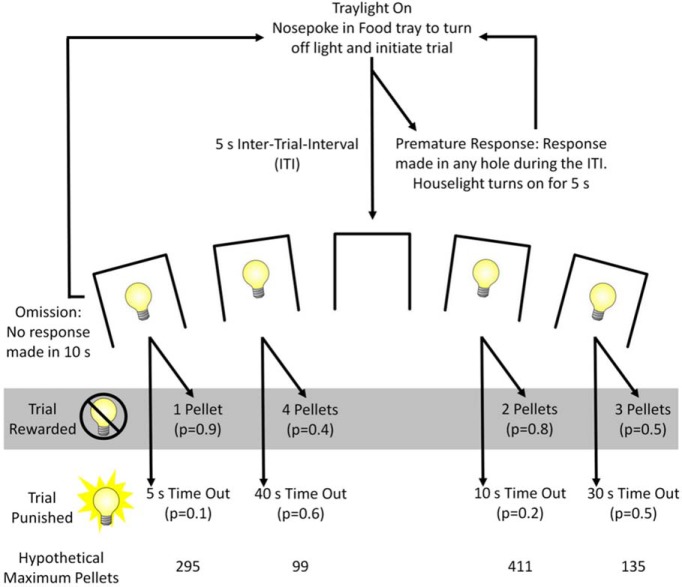
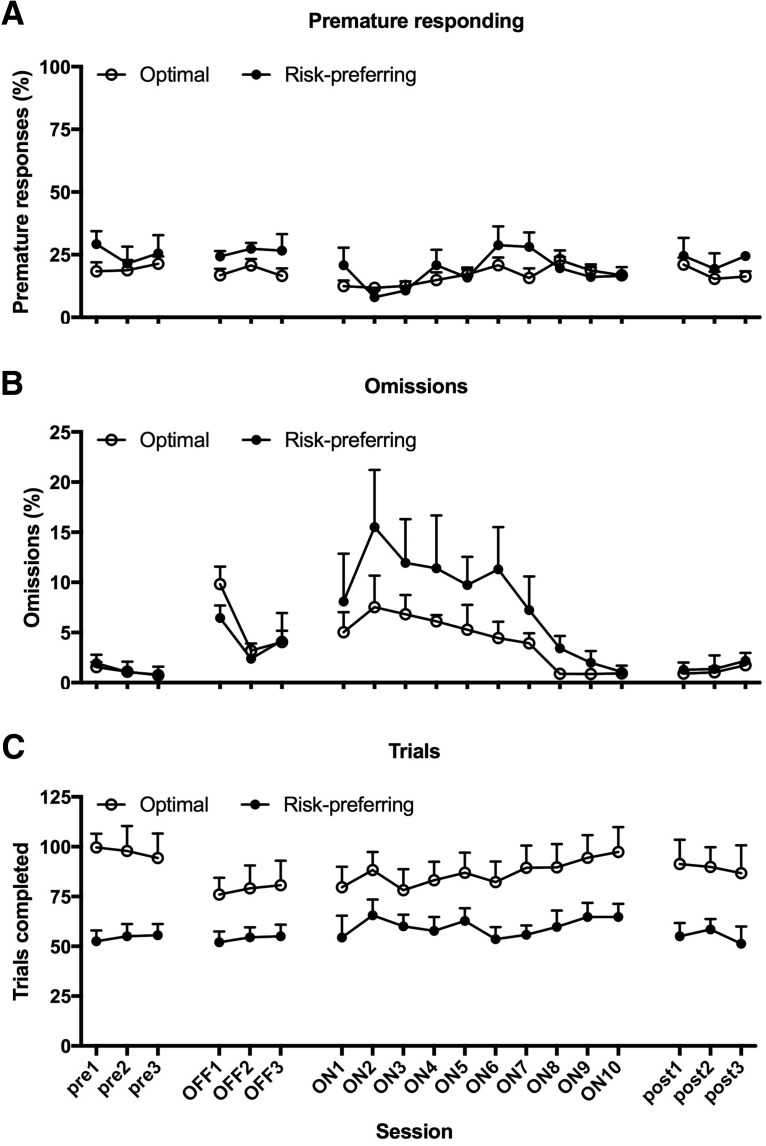
Deep brain stimulation of the subthalamic nucleus (STN-DBS) can improve the motor symptoms of Parkinson's disease (PD) and negate the problematic side effects of dopamine replacement therapy. Although there is concern that STN-DBS may enhance the development of gambling disorder and other impulse control disorders in this patient group, recent data suggest that STN-DBS may actually reduce iatrogenic impulse control disorders, and alleviate obsessive-compulsive disorder (OCD). Here, we sought to determine whether STN-DBS was beneficial or detrimental to performance of the rat gambling task (rGT), a rodent analogue of the Iowa Gambling Task (IGT) used to assess risky decision making clinically. Rats chose between four options associated with different amounts and probabilities of sugar pellet rewards versus timeout punishments. As in the IGT, the optimal approach was to favor options associated with smaller per-trial gains but lower timeout penalties. Once a stable behavioral baseline was established, electrodes were implanted bilaterally into the STN, and the effects of STN-DBS assessed on-task over 10 consecutive sessions using an A-B-A design. STN-DBS did not affect choice in optimal decision makers that correctly favored options associated with smaller per-trial gains but also lower penalties. However, a minority (∼25%) preferred the maladaptive "high-risk, high-reward" options at baseline. STN-DBS significantly and progressively improved choice in these risk-preferring rats. These data support the hypothesis that STN-DBS may be beneficial in ameliorating maladaptive decision making associated with compulsive and addiction disorders.
丘脑底核深部脑刺激(STN-DBS)可以改善帕金森病(PD)的运动症状,并消除多巴胺替代疗法的问题性副作用。尽管人们担心 STN-DBS 可能会增加该患者群体中赌博障碍和其他冲动控制障碍的发展,但最近的数据表明,STN-DBS 实际上可能会减少医源性冲动控制障碍,并减轻强迫症(OCD)。在这里,我们试图确定 STN-DBS 是否对大鼠赌博任务(rGT)的表现有益还是有害,rGT 是一种用于评估临床风险决策的啮齿动物类比物。大鼠在四个选项之间进行选择,这些选项与不同数量和获得糖丸奖励与超时惩罚的可能性相关。与 IGT 一样,最佳方法是偏向与较小单次收益但较低超时惩罚相关的选项。一旦建立了稳定的行为基线,就将电极双侧植入 STN,并使用 A-B-A 设计在 10 个连续疗程中评估 STN-DBS 的治疗效果。STN-DBS 不会影响那些正确选择与较小单次收益但较低惩罚相关的选项的最佳决策者的选择。然而,少数(约 25%)大鼠在基线时更喜欢适应性差的“高风险、高回报”选项。STN-DBS 显著且逐渐改善了这些风险偏好大鼠的选择。这些数据支持了 STN-DBS 可能有益于改善与强迫症和成瘾障碍相关的适应性不良决策的假说。